
 CA
 NZ
 US
 AU
 IND

 UK

 Share
 X (Formerly Twitter)
 Whatsapp
 Facebook
 LinkedIn
 Telegram
 Email This Article
 Copy Link
 Summarize with AI
 Chat GPT
 Perplexity

Summary
Headlam Group (LSE:HEAD) is the UK's largest floorcoverings distributor, listed on London's Main Market. A weak trading update and strategic review in July 2026, after a sharp revenue decline and mounting losses, sent its shares to fresh lows. Whether it is an undervalued turnaround or a value trap hinges on execution, liquidity and the housing market.
Five Key Takeaways
- Headlam Group is the UK's largest distributor of floorcoverings, with operations spanning Britain, France and the Netherlands and a substantial owned property estate.
- A July 2026 trading update reported first-half revenue down 22.8 per cent and higher losses, prompting a strategic review and a steep fall in the share price.
- Net debt has risen while the group remains loss-making, so balance-sheet strength, refinancing and property disposals are now central to the investment case.
- Management retains a transformation plan targeting a return to profitability in 2027, but weak flooring demand and tight liquidity make delivery uncertain.
- Investors should watch the strategic review's outcome, cash generation, property sales and any signs of recovery in the UK renovation and housing market.
Company Overview
Headlam Group plc (LSE:HEAD) is the largest distributor of floorcoverings in the United Kingdom and one of the biggest in Europe, listed on the Main Market of the London Stock Exchange. The group sits between manufacturers and the trade, buying carpet, vinyl, laminate and related products in bulk and supplying independent retailers, contractors and larger commercial customers across Britain, France and the Netherlands.
The business is built on scale, logistics and range. Headlam operates an extensive network of distribution centres and a large delivery fleet, offering next-day service across tens of thousands of product lines. That density of coverage and speed of supply have long been its competitive advantage.
A distributor in transition
Headlam was historically cash-generative and dividend-paying, but a prolonged downturn in flooring demand has pushed it into losses. Over 2025 and 2026 management has reshaped the group around a new core customer strategy, cutting costs, reducing stock and rationalising property, while trying to protect the service proposition. It therefore enters the second half of 2026 as a market leader in transition rather than a stable distributor.
What Has Happened Recently?
The defining recent event came on 14 July 2026, when Headlam issued a trading update and announced a strategic review. The group reported first-half revenue of £188.8 million, down 22.8 per cent year on year from continuing operations, and warned of operating losses higher than a year earlier. Net debt had risen to £36.2 million at 30 June 2026, from £31.4 million at the end of December 2025.
The market reaction was severe. Headlam's shares, already near multi-year lows, fell sharply in the days that followed, extending a long decline and underlining how fragile confidence had become. The update noted that July trading continued in line with a weak June, offering no immediate sign of recovery.
The strategic review is the centrepiece of the announcement. The board is exploring options to strengthen the balance sheet, including refinancing, for which it had already received offers, a possible sale and leaseback of its Coleshill headquarters, further property disposals and new partnerships. Importantly, the review does not include seeking offers for the company itself.
Building on 2025's reset
This followed 2025 full-year results showing revenue of £498.7 million and a statutory pre-tax loss of £69.6 million, which framed 2026 as a year of repair rather than growth.
Why the Stock Is Attracting Attention
Headlam is attracting attention because it pairs a genuine market-leading franchise with a distressed-looking share price. Value investors are drawn to the gap between its position as the UK's largest floorcoverings distributor and a valuation pricing in continued decline. The debate is whether that gap represents mispriced recovery potential or a warning that fundamentals are still deteriorating.
The property estate sharpens the interest. Headlam owns a substantial portfolio of freehold and long-leasehold sites, most recently indicated at a market value of around £75 million, well above book value in past disposals. With the equity value having fallen heavily, such tangible, saleable assets provide a potential floor and a source of liquidity the strategic review is now targeting.
Turnaround or value trap?
The core question is whether Headlam is an undervalued turnaround or a classic value trap. Bulls point to self-help measures, cost reduction, stock discipline and property realisations, plus operational gearing to any recovery in demand. Bears note that revenue keeps falling, losses are widening and net debt is rising, so cheapness alone is no protection. Markets often treat leaders in weak end-markets cautiously until profitability returns, keeping sentiment fragile despite the low rating.
Principal Projects, Products or Operations
Headlam's operations centre on the wholesale distribution of floorcoverings. Its product range spans residential and commercial carpet, luxury vinyl tile, sheet vinyl, laminate, engineered wood, underlay and accessories, sourced from a broad base of domestic and international manufacturers. Its role is to aggregate that supply and make it available quickly to a fragmented base of retailers and trade customers.
The physical network is the heart of the business. Headlam runs regional distribution centres and processing sites supported by a large delivery fleet, enabling frequent, often next-day, deliveries across the United Kingdom, France and the Netherlands. This capability, combined with deep product availability, lets small flooring businesses compete without heavy inventory.
Transformation and core customer strategy
The most significant current project is the transformation programme, anchored by a core customer strategy introduced in late 2025. This focuses resources on the most valuable customer relationships, drives cost and payroll savings, reduces working capital tied up in stock, and rationalises the property footprint through disposals and potential sale-and-leaseback deals. Management frames these actions as necessary to rebuild margins and cash generation, accepting some near-term revenue reduction in pursuit of a leaner, more profitable model.
Latest Financial Position
Headlam's financials reflect a loss-making distributor working through a demand downturn. For the year ended December 2025, revenue was £498.7 million, down 4.6 per cent, with an underlying operating loss of £33.4 million and a statutory operating loss of £63.5 million. The underlying loss before tax was £39.5 million and the statutory loss before tax £69.6 million, while the group moved to net debt of £31.4 million and paid no dividend.
The July 2026 update showed continued pressure. First-half revenue of £188.8 million represented a 22.8 per cent decline, losses were described as significantly higher than a year earlier, and net debt had increased to £36.2 million. Detailed figures are expected with the interim results later in 2026, but the trend on sales, profitability and debt is clearly negative.
Assets against the pressure
Set against this, Headlam retains meaningful tangible assets, including a property portfolio previously valued at around £75 million and a track record of realising sites above book value. The review aims to convert that balance-sheet strength into liquidity. The central issue is whether self-help and asset realisation can stabilise the balance sheet before losses erode it further, and how quickly trading might recover.
Potential Growth Catalysts
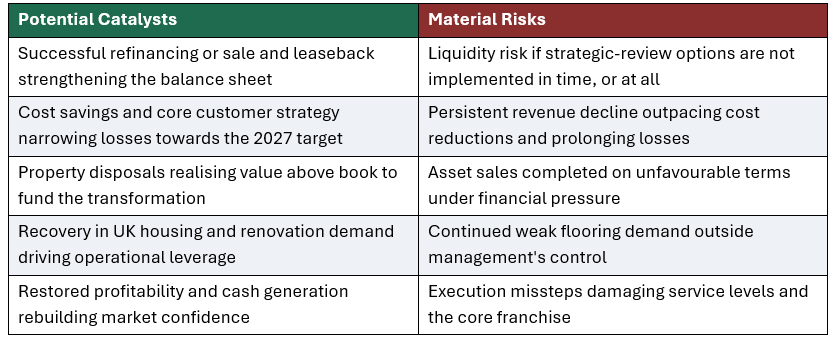
The most immediate potential catalyst is a successful outcome to the strategic review. A refinancing, a sale and leaseback of the Coleshill headquarters, or further property disposals could strengthen the balance sheet, ease liquidity concerns and let management press ahead with the transformation plan rather than manage defensively.
Operational delivery is the second catalyst. Headlam has targeted a return to profitability in 2027 and mid-single-digit operating margins once its strategy is fully implemented, supported by payroll savings, reduced stock and a sharper customer focus. Evidence that cost actions are narrowing losses, and that the strategy is protecting the most valuable revenue, would help rebuild credibility.
Cyclical recovery and self-help
A third catalyst lies in the end-market. Flooring demand is closely tied to housing transactions and the renovation cycle, both of which have been subdued. Any improvement in consumer confidence, housing activity or renovation spending would provide operational leverage to a business built for higher volumes. Combined with disciplined self-help, even a modest cyclical upturn could have a disproportionate effect on profitability, given Headlam's scale and largely fixed cost base, though timing is outside its control.
Material Risks and Challenges
The risks facing Headlam are substantial. The most pressing is liquidity: net debt is rising while the group is loss-making, and management has cautioned that there can be no certainty it will implement any strategic-review options within a reasonable timeframe, or at all. A failure to strengthen the balance sheet in time would intensify financial pressure.
Trading risk is closely related. Revenue has fallen heavily, and the update indicated no immediate improvement, leaving recovery dependent on markets outside the company's control. If flooring demand stays weak, cost savings may be outpaced by volume declines, prolonging losses and cash outflow.
Execution and structural pressures
Execution risk runs through the whole plan. Reshaping customer focus, cutting costs, reducing stock and selling property while maintaining service levels is demanding, and missteps could damage the franchise the strategy is meant to protect. Structural pressures add to the challenge, including competition, changing routes to market, and a fixed-cost network's sensitivity to falling volumes. Dividend suspension, and the possibility of asset sales on unfavourable terms under pressure, further underline the uncertainty for shareholders.
What Investors Should Monitor Next
The most important thing to monitor is the strategic review. Investors should watch for concrete outcomes: a refinancing agreement, a sale and leaseback of the Coleshill site, specific property disposals, or new partnerships. The terms, timing and proceeds will signal how effectively Headlam can shore up its balance sheet and reduce the liquidity risk that now dominates the story.
Trading and cash generation are the second focus. The interim results due later in 2026 should reveal the scale of first-half losses, movements in net debt and working capital, and whether cost actions are beginning to offset revenue declines. Commentary on order trends, customer retention and margins will be read closely for early signs of stabilisation.
Market signals and guidance
Investors should also track the wider flooring market and management's guidance. Data on UK housing transactions and renovation activity frame the demand outlook, while updates on the 2027 profitability target will show whether that ambition still stands. Progress on payroll savings, stock reduction and property realisations, judged against the pace of trading decline, will indicate whether the turnaround thesis is gaining traction or the value-trap concern is deepening.
Balanced Conclusion
Headlam Group (LSE:HEAD) presents one of the more finely balanced situations on the UK market. It is the country's largest floorcoverings distributor, with genuine scale, an entrenched network and a substantial property estate, yet it is loss-making, carrying rising net debt and conducting a strategic review to shore up its finances. That combination draws value investors and makes the outcome uncertain.
The bull case rests on self-help and assets: cost cutting, stock discipline, property realisations and a refinancing could stabilise the balance sheet, while a demand recovery would provide operational leverage towards the 2027 profitability target. The bear case is equally clear: revenue keeps falling, losses are widening, and cheapness offers little protection if the review disappoints or the market stays weak, the hallmark of a value trap.
For investors, the sensible posture is to weigh the tangible-asset backing and turnaround optionality against real liquidity and trading risks, without drawing firm conclusions from any single announcement. Whether Headlam proves an undervalued turnaround or a value trap will be decided by the review's outcome and by trading over the coming quarters.
Catalysts and Risks at a Glance


 Nov 24, 2026





 Please wait processing your request...