
 AU
AU
 CA
CA
 US
US
 NZ
NZ
 IND
IND

 UK
UK

 Share
Share
 X (Formerly Twitter)
 Whatsapp
 Facebook
 LinkedIn
 Telegram
 Email This Article
 Copy Link
 Summarize with AI
 Chat GPT
 Perplexity
Image Source : Krish Capital Pty Ltd
Index Update: The FTSE 100 index, a key benchmark index for the London stock exchange, went down around 0.08% on 11 March 2025.
Macro Update: British consumer spending lost momentum in February, with retail sales rising just 1.1% year-on-year, down from 2.6% in January, despite increasing confidence in personal finances and the broader economy. Persimmon, the British housebuilder, plans to construct more houses and improve margins after exceeding profit expectations for 2024, benefiting from stronger sales and pricing. Domino’s Pizza Group reported a 4% rise in annual core profit to £143.4 million, driven by increased orders and discount promotions. Meanwhile, Britain’s financial regulator may introduce a compensation scheme for motor customers if the Supreme Court rules that they were impacted by hidden commission fees. On the political front, Prime Minister Keir Starmer has urged the Labour government to reconsider its self-imposed debt constraints to break the UK’s low-growth cycle. At the same time, finance minister Rachel Reeves faces tough fiscal decisions as she commits to higher defence spending following the U.S. reducing its support for Ukraine, which could lead to either spending cuts elsewhere or potential tax increases.
Top Market Movers: Among top gainers on FTSE 100 index, Melrose Industries PLC (LSE: MRO) witnessed a rise of 4.57% followed by Persimmon PLC (LSE: PSN) which gained around 2.14%.
Commodity Update: The U.S. dollar weakened against the yen on Tuesday amid concerns about a potential U.S. economic slowdown and ongoing uncertainty surrounding the Trump administration's trade policies. Wall Street's persistent selloff added to the pressure. In commodities, gold rose by 0.01% to $2,901.30, silver increased by 0.12% to $32.56, and copper remained flat at $9,526.30. Brent crude dropped 0.70% to $68.77, nearing a three-year low due to fears of a global economic slowdown and escalating trade tensions. Trump's tariffs on China and retaliatory measures from Beijing further dampened market sentiment.
Our Stance: President Donald Trump's recent imposition of tariffs on major trading partners, including Canada, Mexico, and China, has triggered significant volatility in global financial markets. The S&P 500 has seen a substantial decline, erasing $4 trillion from its peak last month, as investors grow increasingly concerned about a potential economic downturn. This sentiment shift has led to a sharp sell-off in U.S. equities, with notable declines in technology stocks and banks. The tech-heavy Nasdaq Composite experienced its most pronounced drop in over two years. European shares have remained largely unchanged, reflecting investor caution amid the escalating trade tensions and fears of a U.S. recession. The mounting uncertainty has driven investors toward safe-haven assets, such as the Japanese yen, further highlighting the global apprehension surrounding the current trade policies. In light of these developments, it is imperative for the U.S. administration to reassess its trade strategy to mitigate further economic instability and restore investor confidence.
FTSE 100
The FTSE 100 is trading at 8,585.35 on Tuesday, down by 0.17% and forming a bearish candlestick pattern. Despite this, the index remains above the 50-period Simple Moving Average (SMA), which acts as a strong support level, suggesting potential for continued upward momentum in the medium term. However, trading below the 21-period SMA points to short-term weakness, possibly signalling further declines. The Relative Strength Index (RSI) is at 42.15, indicating mild bearish momentum with room for additional losses before a potential rebound. While caution is warranted, short-term traders may find opportunities near support levels. Monitoring momentum shifts is crucial.
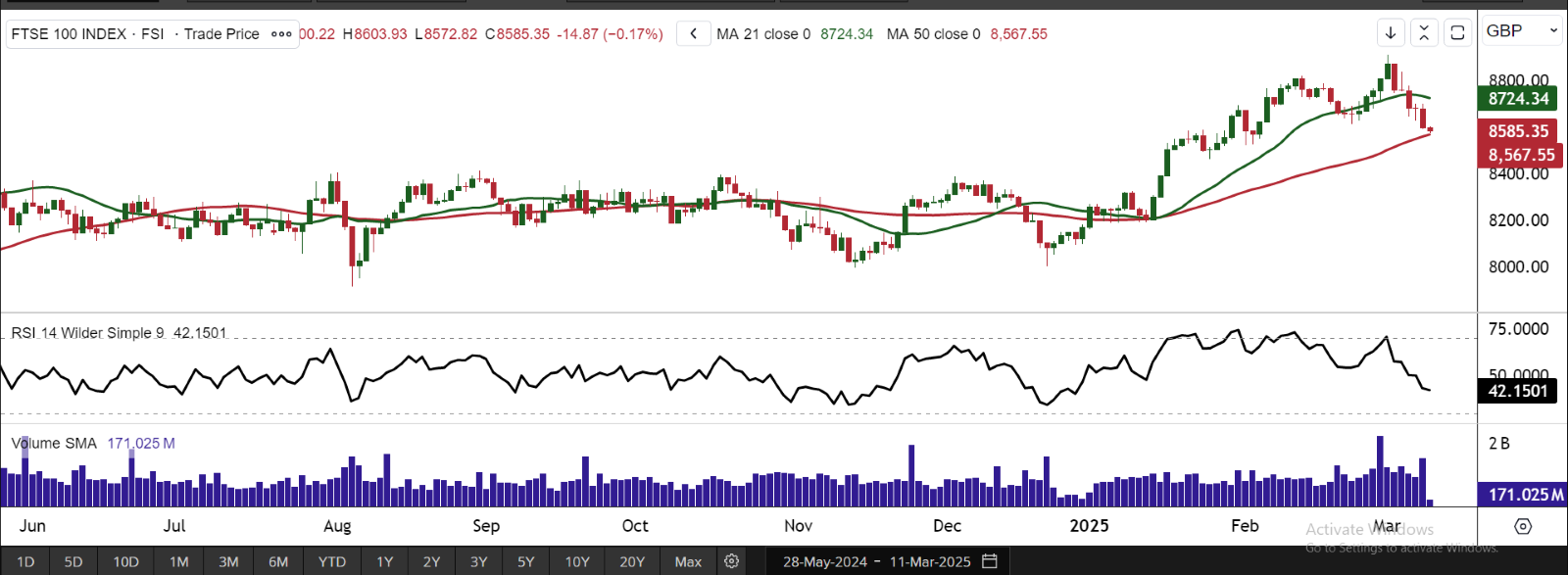
Data Source - EODHD/Others


 Jun 05, 2026




 Please wait processing your request...