
 AU
AU
 CA
CA
 US
US
 NZ
NZ
 IND
IND

 UK
UK

 Share
Share
 X (Formerly Twitter)
 Whatsapp
 Facebook
 LinkedIn
 Telegram
 Email This Article
 Copy Link
 Summarize with AI
 Chat GPT
 Perplexity
Image Source : Krish Capital Pty Ltd
Index Update: The FTSE 100 index, a key benchmark index for the London stock exchange, went up around 0.17% on 27 February 2025.
Macro Update: British Prime Minister Keir Starmer will host European leaders, possibly including Ukrainian President Volodymyr Zelenskiy, to discuss responses to Donald Trump’s push for European nations to take greater responsibility for their own security. Meanwhile, Britain’s vehicle production started 2025 on a weak note, with January output down 18% year-on-year due to declining demand in key markets. The services sector also struggled, as profitability among business and professional firms fell to -37, marking the steepest drop since August 2020 amid cost-of-living pressures. BP has shifted its strategy by cutting renewable energy investments and increasing annual oil and gas spending to $10 billion, following pressure from activist investor Elliott Investment Management. In contrast, Aviva exceeded profit expectations due to strong growth in general insurance premiums and remains on track with its £3.7 billion acquisition of Direct Line.
Top Market Movers: Among top gainers on FTSE 100 index, Rolls Royce Holdings PLC (LSE: RR.) witnessed a rise of 18.99% followed by London Stock Exchange Group PLC (LSE: LSEG) which gained around 3.06%.
Commodity Update: The U.S. dollar strengthened above an 11-week low on Thursday as President Donald Trump's ambiguous remarks about imposing tariffs on Europe and further delays in tariffs on Canada and Mexico created market uncertainty. Trump suggested that 25% tariffs on Mexican and Canadian goods could be enacted by April 2, pushing back the March 4 deadline. In commodity markets, gold dipped 0.12% to $2,926.80, silver fell 0.97% to $32.13, and copper decreased 0.39% to $9,425.50. Meanwhile, Brent crude oil rose 0.30% to $72.72 after Trump reversed Chevron's license to operate in Venezuela, potentially tightening the oil supply.
Our Stance: Global markets remain cautious as investors await Nvidia’s earnings report, which could influence sentiment in the AI sector. While Nvidia’s outlook signals strong demand from major tech firms like Microsoft and Amazon, concerns persist over potential overspending in the AI boom. Meanwhile, U.S. markets wavered after Donald Trump announced a 25% tariff on EU imports, while delaying steep tariffs on Mexico and Canada until April. This policy shift introduces fresh trade uncertainties, adding to market volatility. In Japan, government bond yields rose as expectations for an early Bank of Japan rate hike resurfaced, following heavy bond purchases earlier in the week. Overall, investor sentiment remains mixed, balancing AI-driven optimism against trade policy concerns and shifting monetary dynamics.
FTSE 100
The FTSE 100 closed at 8,731.46 on Wednesday, registering again of 0.72%. Following a bullish candlestick pattern, the index maintains positive market sentiment. It ended near the 21-period Simple Moving Average (SMA), which suggests a favourable short-term outlook. The 50-period SMA provides solid support, reinforcing the potential for continued upward momentum. The Relative Strength Index (RSI) stands at 60.73, indicating healthy bullish strength without reaching overbought levels, which suggests there is still room for further gains. These technical signals point to a positive trend, making the FTSE 100 appealing for short-term investors. On the weekly chart, the FTSE 100 rose 0.84%, closing at 8,659.37. The index remains well above the 50-period SMA at 8,247.27, with support at 8,206.78. Resistance is at 8,850, and a breakout above this level could drive the index towards 8,900. A drop below 8,020, however, would signal downside risk. Investors should monitor these key levels for insights into upcoming price movements.
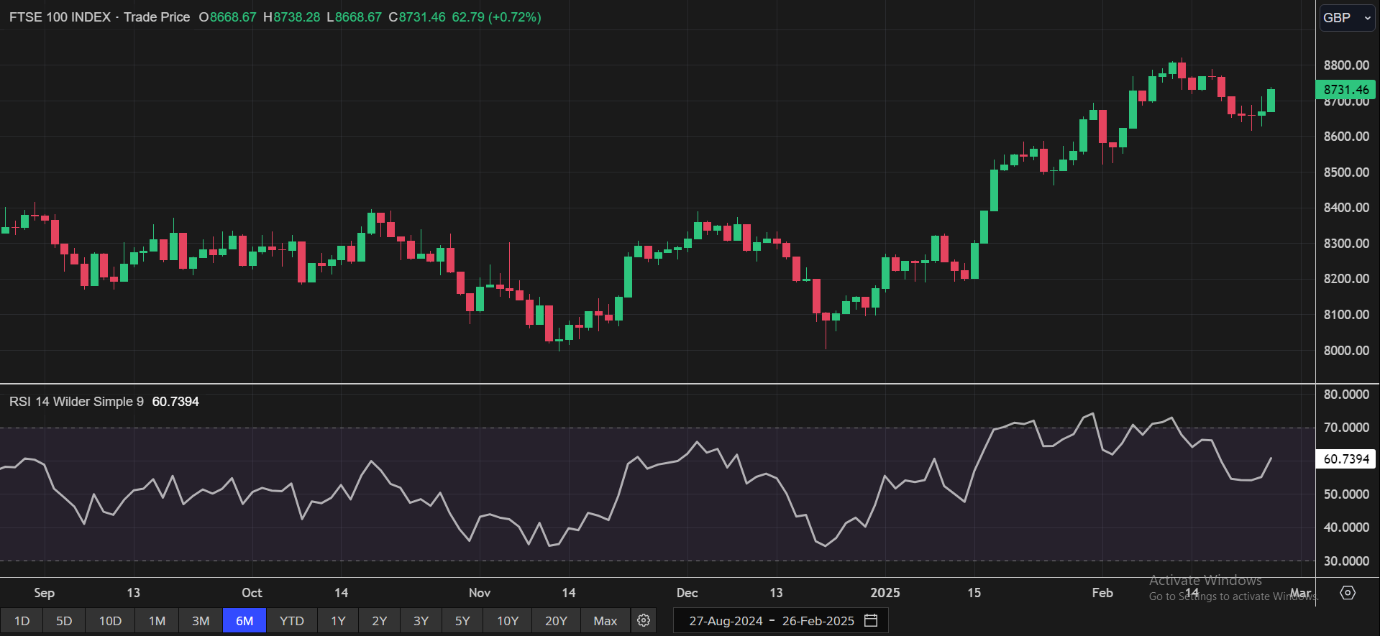
Data Source - EODHD/Others


 Jun 05, 2026




 Please wait processing your request...