
 AU
AU
 CA
CA
 US
US
 NZ
NZ
 IND
IND

 UK
UK

 Share
Share
 X (Formerly Twitter)
 Whatsapp
 Facebook
 LinkedIn
 Telegram
 Email This Article
 Copy Link
 Summarize with AI
 Chat GPT
 Perplexity
Image Source : Krish Capital Pty Ltd
Macro Update: Britain’s economy contracted by 0.1% in January, adding to ongoing economic volatility and challenging finance minister Rachel Reeves' growth agenda. With the Bank of England expected to hold interest rates at 4.5%, cuts may come later in the year. Reeves also faces a £4.4 billion budget deficit, prompting difficult decisions on spending cuts or tax increases. Meanwhile, Prime Minister Keir Starmer is coordinating European efforts to support Ukraine amid ceasefire discussions. In the corporate sector, AstraZeneca is expanding its cell therapy business with a $1 billion acquisition, and Phoenix Group reported strong profits from its pensions and savings unit. However, Britain’s steel industry is struggling with high electricity costs and U.S. tariffs, exacerbating industrial challenges.
Commodity Update: The U.S. dollar remained near a five-month low on Monday, weighed down by President Trump's unpredictable trade policies and weak economic data. March data revealed U.S. consumer sentiment dropped to a near 2-1/2-year low, with inflation expectations rising amid concerns over Trump’s tariffs, sparking a global trade war. In commodities, gold fell 0.19% to $2,995.30, silver dropped 0.36% to $34.31, and copper edged up 0.01% to $9,796.70. Brent crude rose 1.06% to $71.33. U.S. stock futures declined, while Asian markets gained. The week’s key focus is central bank meetings, with the U.S. Federal Reserve expected to hold rates steady.
Our Stance: Global markets are facing heightened volatility due to U.S. policy uncertainty, geopolitical tensions, and central bank decisions. The S&P 500 entered correction territory, losing over $4 trillion in market value, with major stocks like Nvidia and Tesla taking a hit, as Trump’s shifting stance on tariffs adds instability. Investors are eyeing the Federal Reserve’s upcoming meeting for potential rate cuts, while the Bank of Japan, Bank of England, Riksbank, and Swiss National Bank are also set to announce policy decisions. Oil prices surged following U.S. attacks on Yemen’s Houthis, escalating geopolitical risks. Meanwhile, Eurozone bond markets await Germany’s spending vote, while China’s fresh stimulus lifted Asian stocks, despite ongoing trade frictions. With economic uncertainty mounting, markets remain highly reactive to policy shifts, central bank actions, and geopolitical developments.
FTSE 100
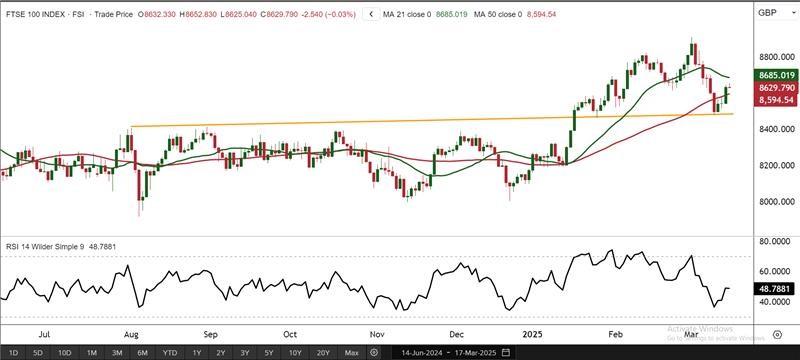
The FTSE 100 is currently trading at 8,629.79, reflecting a modest 0.02% decline on Monday and forming a bearish candlestick pattern. Despite this slight downturn, the index remains below both the 21-period and 50-period Simple Moving Averages (SMA), which are acting as significant resistance levels. This setup suggests the potential for continued downward momentum in the near term. However, the index is holding above a key horizontal support level, which could indicate a possible reversal from recent lows and a shift towards bullish sentiment. The Relative Strength Index (RSI) stands at 48.78, signalling mild bearishness, with further downside potential before a possible recovery. Given the current market uncertainty, caution is advised, but short-term traders may see opportunities near support levels, with momentum shifts being key to determining whether the index will sustain a recovery or continue its decline.
Data Source - EODHD/Others

 Jun 05, 2026



 Please wait processing your request...