
 AU
AU
 CA
CA
 US
US
 NZ
NZ
 IND
IND

 UK
UK

 Share
Share
 X (Formerly Twitter)
 Whatsapp
 Facebook
 LinkedIn
 Telegram
 Email This Article
 Copy Link
 Summarize with AI
 Chat GPT
 Perplexity
Image Source : Krish Capital Pty Ltd
Index Update: The FTSE 100 index, a key benchmark index for the London stock exchange, went up around 0.04% on 13 March 2025.
Macro Update: Britain refrained from immediate retaliation to U.S. President Donald Trump's 25% steel and aluminum tariffs, though Prime Minister Keir Starmer expressed disappointment and kept all options open. Meanwhile, a think tank report revealed that Britain's poorest households are now worse off than those in Slovenia and Malta, highlighting growing inequality since the 2008 financial crisis. In financial markets, the FTSE 100 rebounded by 0.5% after six days of losses, driven by optimism over Ukraine-Russia ceasefire talks and renewed U.S. military aid to Kyiv. Additionally, British lawmakers and NGOs have urged the government to address a legal gap that allows museums to retain African ancestral remains taken during colonial rule, raising ethical concerns over historical artifacts.
Top Market Movers: Among top gainers on FTSE 100 index, Halma PLC (LSE: HLMA) witnessed a rise of 2.99% followed by AstraZeneca PLC (LSE: AZN) which gained around 1.49%.
Commodity Update: The dollar saw a slight rebound on Thursday, bolstered by rising U.S. Treasury yields, as markets grappled with the potential effects of an escalating global trade war on U.S. inflation and growth. President Trump’s threat of additional tariffs on European Union goods added to investor uncertainty, with major U.S. trading partners signalling retaliation. In the commodities market, gold rose by 0.20% to $2,952.55, silver gained 0.16% to $33.79, and copper surged 0.22% to $9,803.15. Meanwhile, Brent crude dropped 0.10% to $70.88, as concerns over the economic impact of tariffs outweighed positive U.S. gasoline stock data.
Our Stance: Recent financial indicators highlight growing investor anxiety over potential economic downturns and escalating trade tensions. The yield spreads between U.S. corporate bonds and Treasury securities have widened to levels not seen since September, with investment-grade spreads reaching 94 basis points and junk bond spreads expanding to 322 basis points. This widening suggests a reduced appetite for riskier assets, often a precursor to recessionary fears. Concurrently, European stocks and U.S. futures experienced declines as concerns over a global trade war overshadowed earlier optimism from subdued U.S. inflation data. Additionally, oil prices have stabilized after a significant surge, reflecting a market balancing near-term demand with broader economic uncertainties. Collectively, these developments underscore a cautious economic outlook, with markets grappling with the implications of trade policies, inflation trends, and fiscal strategies.
FTSE 100
The FTSE 100 traded at 8,556.44 on Thursday, reflecting a 0.18% increase and forming a bullish candlestick pattern. Despite this positive movement, the index remains below both the 21-period and 50-period Simple Moving Averages (SMA), with the 50-period SMA acting as a strong resistance level. This indicates the possibility of continued downward momentum in the near term. However, the index is holding at a key horizontal support level, which could signal a reversal from the recent lows and a shift towards bullish momentum. The Relative Strength Index (RSI) stands at 42.25, pointing to mild bearish sentiment with the potential for further losses before a possible rebound. While caution is advised due to the prevailing uncertainty, short-term traders may see opportunities to capitalize on price movements near support levels. Close monitoring of momentum shifts will be essential to identify the potential for a sustained recovery or continuation of the downward trend.
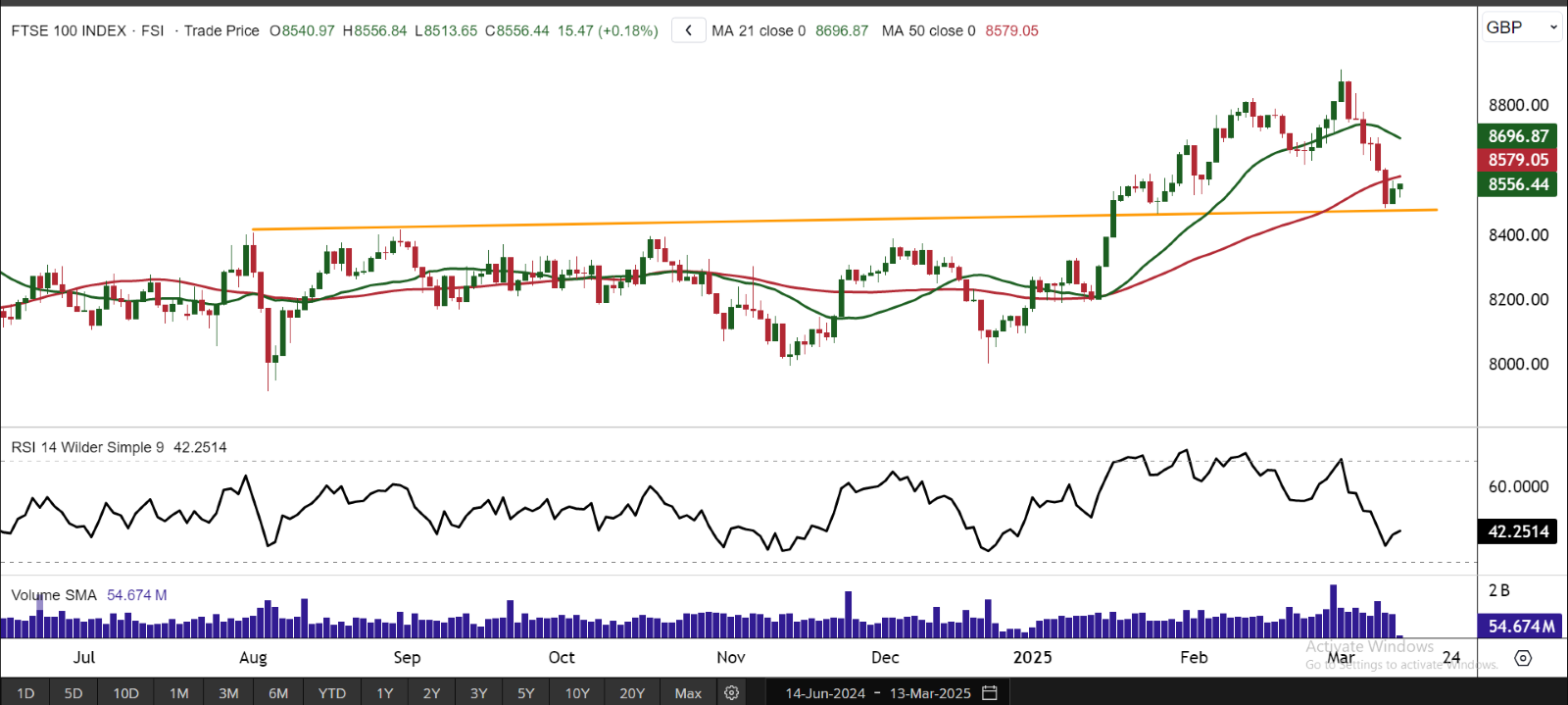
Data Source - EODHD/Others


 Jun 05, 2026




 Please wait processing your request...