
 CA
 NZ
 US
 AU
 IND

 UK

 Share
 X (Formerly Twitter)
 Whatsapp
 Facebook
 LinkedIn
 Telegram
 Email This Article
 Copy Link
 Summarize with AI
 Chat GPT
 Perplexity

Summary
CLS Holdings (LSE:CLI) is a UK-listed commercial property group with offices across the UK, Germany and France. For 2025 it declared a total dividend of 4.0p per share, covered 1.9 times by EPRA earnings under a policy adopted in April 2025, giving a yield of roughly 8% against a mid-July 2026 share price near 49p; the payout has fallen sharply from 7.95p in 2023 as the company retains cash to cut leverage.
Key takeaways
- CLS Holdings (LSE:CLI) declared a total 2025 dividend of 4.0p per share (interim 1.30p, final 2.7p), giving a trailing yield of roughly 8% at a share price near 49p as of 19 July 2026.
- The payout has been rebased twice: from 7.95p in 2023 to 5.28p in 2024 and 4.0p in 2025, under an April 2025 policy targeting cover of 1.5 to 3.0 times EPRA earnings.
- EPRA earnings per share fell to 7.6p and EPRA net tangible assets to 200.7p, leaving 2025 cover at 1.9 times.
- Loan-to-value stood at 50.0% against a 35 to 45% target, with net debt of £852.5m, a 3.8% cost of debt and a continuing disposal programme aimed at cutting leverage.
- Rising vacancy at 14.5% and refinancing needs are the main pressures on the dividend, though a discounted share price and a wide discount to net tangible assets frame the debate.
Dividend snapshot
Why this dividend matters now
Income investors scanning the London market for high headline yields keep landing on the same name: CLS Holdings (LSE:CLI). On a share price hovering near 49p in mid-July 2026, the commercial property group's 4.0p annual dividend screens at roughly 8% — well above the wider UK equity market.
But a near-8% yield rarely arrives without a story attached. This article is written to a research cut-off of 19 July 2026, and the story here is one of a payout that has been deliberately cut, a share price that has fallen well below asset value, and a management team steering hard towards lower debt. The high yield is as much a symptom of a depressed price as a signal of generosity.
That is why the dividend deserves scrutiny rather than a quick screen-and-buy. The headline question — is this high-yield property stock worth watching? — can only be answered by unpicking how sustainable the 4.0p is, and what would have to go right for it to hold or grow.
Company and business model
CLS Holdings plc is a London-listed investment company that owns, manages and develops commercial property, overwhelmingly offices. Its portfolio, valued at around £2.1bn at the 2025 year-end, is spread across three markets: the United Kingdom, Germany and France.
The model is straightforward. CLS holds income-producing office buildings, lets them to a broad tenant base — including a high proportion of government and blue-chip occupiers — and distributes part of the resulting rental profit. Rental income funds the dividend; changes in property valuations drive net asset value up or down.
Unlike many peers, CLS is a conventional company rather than a UK real estate investment trust, so it is not bound by REIT rules that force out most rental profit. That gives the board more discretion over how much to pay — discretion it has used, as the recent record shows.
Latest dividend details
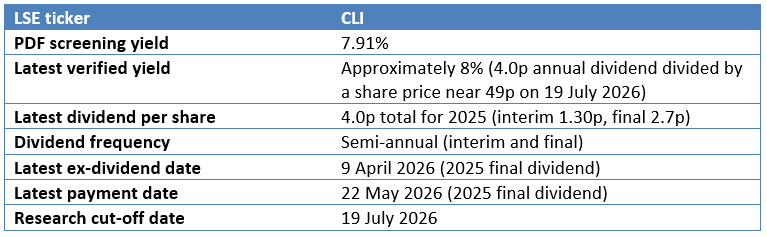
For the 2025 financial year, reported on 13 March 2026, CLS declared a total dividend of 4.0p per share. That comprised:
- an interim dividend of 1.30p, paid on 2 October 2025; and
- a final dividend of 2.7p, proposed with the full-year results.
The 2025 final dividend went ex-dividend on 9 April 2026, with a record date of 10 April 2026 and payment on 22 May 2026. The company also offered shareholders an enhanced scrip alternative, allowing them to take new shares instead of cash.
Distributions are paid twice a year. The 4.0p total is the most recently declared annual figure and forms the basis of the yield calculation below.
How the dividend yield is calculated
The dividend yield is the annual dividend per share divided by the current share price, expressed as a percentage. Using the latest declared annual dividend of 4.0p and a share price of about 49p around 19 July 2026, that gives 4.0p ÷ 49p ≈ 8.2%.
That sits close to the 7.91% figure captured by a screening tool on 19 July 2026. The small difference is what you would expect: a screen's yield is a snapshot, and CLS shares have traded in a tight band around the high-40s to 50p in recent sessions.
The crucial point is that yield moves inversely with price. If the shares fall, the same 4.0p produces a higher yield; if they rise, the yield compresses. A high yield can reflect market pessimism as readily as income strength. It is also worth separating three ideas that are easily blurred:
- Dividend per share is the cash amount (4.0p for 2025).
- Dividend yield is that cash as a percentage of the price (about 8%).
- Total shareholder return combines dividends with any change in the share price, and can be very different from the yield in either direction.
Five-year dividend history
CLS's recent dividend record is the single most important context for judging today's yield. The trajectory has been sharply downward from its 2023 peak. 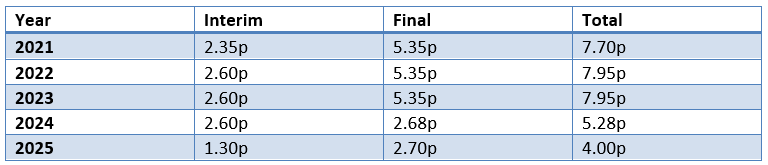
After years of steady increases up to 7.95p, the board cut the final dividend for 2024, taking the annual total down by roughly a third. It then cut again in 2025, reducing the interim to 1.30p and holding the final at 2.7p, for a 4.0p total. Over two years the annual dividend has almost halved.
Dividend growth, cuts or interruptions
There is no ambiguity here: this is a story of dividend cuts, not growth. No payment was missed and the distribution was never formally suspended, but the level was rebased twice in quick succession.
The turning point was a new dividend policy announced in April 2025. Rather than pursuing progressive increases, the board set a framework under which dividends should be covered between 1.5 and 3.0 times by EPRA earnings, retaining more cash to reduce debt and reinvest in the portfolio.
The read-across is twofold. The cuts are painful for anyone who bought for the old 7.95p payout. But a lower, better-covered dividend is, in principle, more resilient than a stretched one — provided earnings hold up.
Earnings and cash-flow cover
Dividend cover measures how comfortably profits fund the payout. For 2025, CLS reported EPRA earnings per share of 7.6p, down from 9.2p in 2024. Against the 4.0p dividend, that equates to cover of about 1.9 times — within the company's stated 1.5 to 3.0 times range.
The fall in EPRA earnings reflected asset disposals, which remove rental income, and the roll-off of prior-year one-off items. Because the dividend was cut alongside the earnings decline, cover was preserved rather than eroded.
Cover near the lower end of the policy band means the buffer is real but not large. If earnings continue to slip — through further disposals, higher vacancy or rising finance costs — the board has signalled it would prioritise the cover range over the cash amount.
Balance sheet, debt and refinancing
Leverage is the pivot on which the CLS investment case turns. At the 2025 year-end the group reported:
- net debt of £852.5m, down from £938.7m a year earlier;
- loan-to-value (LTV) of 50.0%, against a stated target range of 35 to 45%;
- a weighted average cost of debt of 3.8%; and
- a weighted average debt maturity of about 3.6 years.
An LTV of 50% is elevated for the sector and above the company's own target, which is precisely why cash retention has taken priority over the dividend. Management has said the ratio would be closer to the mid-40s on a like-for-like basis and is targeting reductions through further disposals.
On refinancing, CLS said it had dealt with all of its 2025 maturities without pushing up its average cost of funds, and that a further tranche falls due in 2026, part of which had already been addressed by the results date. The 3.8% average cost is relatively low, but as fixed-rate facilities mature they may reset at higher rates, weighing on future earnings and, by extension, dividend cover.
Operational factors affecting distributions
Rent is the raw material of the dividend, so occupancy and collection matter. Two figures stand out from the 2025 results:
- Rent collection remained strong at around 99% of contracted rent, indicating that tenants are, in aggregate, still paying.
- EPRA vacancy rose to 14.5%, up from 12.7% a year earlier — a clear headwind, as empty space earns no rent and still incurs costs.
Management pointed to encouraging leasing momentum, reporting the highest level of new annual rent secured in seven years, and expects vacancy to ease as new lettings complete and expiries moderate. Property valuations fell on a like-for-like basis, though by less than the prior year.
The tension is visible: letting progress is a positive for future income, but the elevated vacancy rate is a drag that must be worked down before earnings can recover meaningfully.
Interest rates and the UK property market
Commercial property is acutely sensitive to interest rates. Higher rates raise borrowing costs and tend to push up the yields that buyers demand, which in turn depresses capital values — the mechanism behind the valuation falls of recent years.
Offices sit at the sharp end of this. Hybrid working has reduced occupier demand for some buildings, widening the gap between prime, well-let space and older stock. CLS's spread across the UK, Germany and France diversifies this risk across three cycles, but does not remove it.
For the dividend, the rate environment matters in two ways: it shapes the cost at which maturing debt is refinanced, and it influences whether the portfolio's value stabilises — which in turn affects the LTV that management is trying to bring down.
What could support the next dividend
Several factors could help the board hold or eventually rebuild the payout:
- Disposals reducing debt: CLS sold assets during 2025 and has signalled further disposals, which would lower net debt and the LTV, easing pressure on cash.
- Letting up vacant space: converting the highest new-rent haul in seven years into occupied, income-producing floorspace would lift EPRA earnings and cover.
- Stable financing costs: refinancing 2025 maturities without raising the average cost of debt suggests the group can manage its liabilities without an immediate earnings shock.
- A conservative policy: the 1.5 to 3.0 times cover framework is designed to make the dividend more defensible than the previous, higher payout.
None of these is assured, but together they describe a plausible path to stabilisation.
Principal risks to the dividend
The risks are substantial and should not be understated:
- Further cuts: the board has already rebased twice and has explicitly prioritised cover and debt reduction over the cash amount.
- Earnings pressure: disposals remove rental income, and rising vacancy reduces it further, both of which erode cover.
- Leverage and refinancing: at 50% LTV, above target, CLS is more exposed than lower-geared peers, and maturing debt may reset at higher rates.
- Valuation declines: continued falls in property values would push LTV higher and could force more disposals at unfavourable prices.
- Sector headwinds: structural questions over office demand remain unresolved across all three of the group's markets.
The wide discount of the share price to EPRA net tangible assets of 200.7p reflects the market pricing in these risks, not a straightforward bargain.
Balanced outlook
The balanced view is that CLS offers a high, currently well-covered yield attached to a business in the middle of a deleveraging effort. The 4.0p dividend is covered 1.9 times, rent collection is high, and management has a plan to cut debt and re-let space. Set against that, the payout has fallen sharply, LTV is above target, vacancy has risen and the office sector faces structural questions. The near-8% yield is compensation for those uncertainties, not a free lunch.
Conclusion
So, is CLS Holdings (LSE:CLI) a high-yield property stock worth watching? On the evidence to 19 July 2026, watching is a fair description — the yield of roughly 8% is real and, for now, covered within the company's stated policy. But the label "high-yield" comes with heavy caveats: the dividend has been rebased twice, leverage is above target, and the elevated yield partly reflects a share price marked well below asset value.
This article offers no recommendation. What it does show is that the CLS dividend is best understood as a lower, more conservatively covered payout on a business prioritising debt reduction — potentially more durable than the old 7.95p, but exposed to earnings, refinancing and property-market risks that any income investor would need to weigh carefully for themselves.


 Nov 25, 2026





 Please wait processing your request...