
 CA
 NZ
 US
 AU
 IND

 UK

 Share
 X (Formerly Twitter)
 Whatsapp
 Facebook
 LinkedIn
 Telegram
 Email This Article
 Copy Link
 Summarize with AI
 Chat GPT
 Perplexity

Summary
Workspace Group (LSE:WKP) cut its total dividend to 26.1p per share for the year to 31 March 2026, giving a yield of roughly 7.6% at a share price near 344p, versus a 7.37% screening figure. The payout is covered about 1.2 times by adjusted underlying earnings, but falling occupancy, a lower rent roll and refinancing risk mean the distribution is not assured.
Key takeaways
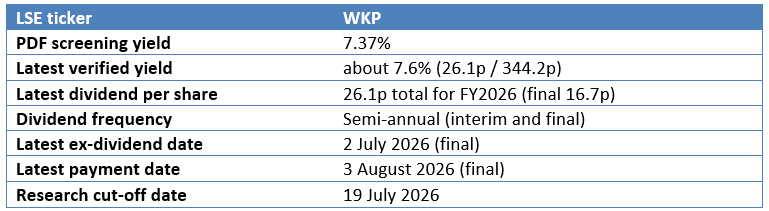
- Workspace Group (LSE:WKP) declared a total dividend of 26.1p for the year to 31 March 2026, down from 28.4p, with the final 16.7p going ex-dividend on 2 July 2026 and payable on 3 August 2026.
- At a share price of about 344p the yield is roughly 7.6%, close to the 7.37% screening figure captured on 19 July 2026; yields move inversely with the share price.
- The dividend is covered about 1.2 times by adjusted underlying earnings of 31.3p, in line with the board's restated covered-dividend policy.
- The balance sheet is moderate, with net debt of £758m, loan-to-value of 35% and an average cost of debt near 3.6%, though refinancing into higher rates is a risk.
- Occupancy of 81.6%, a rent roll down 8.6% and a prior dividend cut underline that the payout depends on a recovery in London flexible-office demand.
Dividend snapshot
Why this dividend matters now
Workspace Group (LSE:WKP) has spent the past year doing something few London landlords enjoy: resetting expectations. On 10 June 2026 the company published full-year results for the 12 months to 31 March 2026 and confirmed a rebased shareholder distribution, trimming the annual dividend to 26.1p a share from 28.4p a year earlier. For an income investor a cut is rarely welcome, yet the way the board has reframed the payout arguably matters more than the headline figure.
This article was researched to a cut-off of 19 July 2026, drawing on the company's results statement and regulatory announcements. Every figure reflects the latest available data at that date; share prices, and therefore yields, move continually.
A property screening tool captured a 7.37% dividend yield for Workspace Group (LSE:WKP) on 19 July 2026. That is screening data, not a forecast. Worked from the 26.1p declared for the year to March 2026 against a share price of roughly 344p, the yield sits nearer 7.6% - firmly high-yield territory, and as much a comment on a share price well below net asset value as on the generosity of the board.
Company and business model
Workspace Group is a real estate investment trust (REIT) that owns and manages flexible business space, overwhelmingly in and around London. Its customers are small and medium-sized enterprises that want space on shorter, more flexible terms than a traditional institutional lease.
As a UK REIT, Workspace must distribute at least 90% of the profits of its tax-exempt property rental business. That structure underpins a regular distribution, but it also ties the dividend closely to rental earnings, which are exposed to occupancy, rent levels and borrowing costs.
The flexible model cuts both ways: it lets Workspace capture rising demand quickly, but income can soften faster than under long leases when demand weakens.
Latest dividend details
For the year ended 31 March 2026, Workspace Group declared a total dividend of 26.1p per share, comprising:
- an interim dividend of 9.4p, paid on 2 February 2026 (ex-dividend 8 January 2026); and
- a final dividend of 16.7p, with an ex-dividend date of 2 July 2026 and a payment date of 3 August 2026.
The dividend is paid twice a year, the interim typically in February and the final in early August. The 16.7p final is the most recently declared distribution as of the 19 July 2026 cut-off. Alongside it, the board restated its policy of covering the dividend at least 1.2 times by adjusted underlying earnings, aligning distributions with recurring cash earnings.
How the dividend yield is calculated
Dividend yield is simply the annual dividend per share divided by the current share price, expressed as a percentage.
- Take the latest declared annual dividend: 26.1p.
- Divide by the share price of about 344p.
- The result is roughly 7.6%.
The 7.37% captured by the screening tool on 19 July 2026 reflects a slightly different price at the moment of capture. That gap illustrates a point often lost in headline numbers: yield rises as the share price falls, even when the dividend itself does not change.
Three related measures should not be confused:
- Dividend yield is income relative to price today.
- Dividend per share is the cash amount paid, here 26.1p for the year.
- Total shareholder return combines dividends with any change in the share price, and can be negative even when a dividend is paid, as it has been for holders who bought before the share price de-rated.
Five-year dividend history
Workspace's distribution has been anything but a straight line. The interim was suspended during the pandemic before the board rebuilt the dividend, and the most recent year brought a fresh reduction. 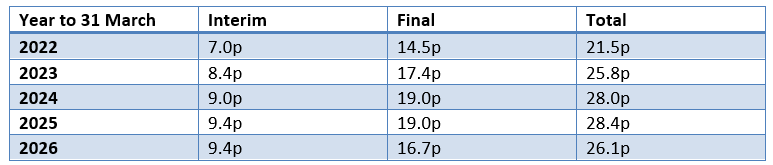
The pattern shows a steady rebuild from the pandemic low, a peak of 28.4p in the 2025 financial year, then a step down to 26.1p, with the reduction concentrated in the final dividend.
Dividend growth, cuts or interruptions
The five-year record makes the risks concrete. Workspace has already interrupted its dividend once this decade and has now cut it again, so investors cannot treat the distribution as fixed.
The latest reduction of about 8% at the full-year level was presented as a deliberate rebasing, tied to the return to a covered policy underpinned by adjusted underlying earnings. That is more conservative than straining to hold a headline figure, but it confirms that the direction of the dividend depends on earnings recovering, not simply on the board's intent.
Earnings and cash-flow cover
Cover is where the reset earns its keep. For the year to 31 March 2026 Workspace reported:
- adjusted underlying earnings per share of 31.3p, down 9.3% from 34.5p;
- net rental income of £113.4m, down 7.1%; and
- trading profit after interest of £60.5m, down 9.4%.
Set the 26.1p dividend against 31.3p of adjusted underlying earnings and cover works out at roughly 1.2 times, consistent with policy. That is a modest cushion, not a wide one: a further slide in net rental income or a rise in interest costs would erode it quickly.
The group also reported a statutory loss before tax of £120.5m, driven mainly by declines in property valuations rather than the cash-generating rental business. Valuation losses do not fund dividends, but they do affect the balance sheet and gearing, and so the headroom the board has.
Balance sheet, debt and refinancing
A high-yielding property share lives or dies by its balance sheet. On this front Workspace looked steadier than the dividend cut alone might suggest:
- net debt of £758m, down from £820m;
- a loan-to-value (LTV) ratio of 35%, up modestly from 34%;
- a weighted average cost of debt of about 3.6%, with roughly 77% of drawn debt at fixed rates; and
- around £242m of undrawn facilities and cash.
An LTV in the mid-30s is moderate for a UK REIT, and a sub-4% cost of debt is helpful in the current environment. The largely fixed debt book limits the immediate hit from higher rates, but the key risk sits at refinancing points, when maturing facilities may reset at higher prevailing rates. The available liquidity gives room to manage those maturities without forced asset sales, though refinancing terms remain a swing factor for future earnings and therefore for the dividend.
Operational factors affecting distributions
Rental income ultimately pays the dividend, so occupancy and rent levels matter as much as the finance line.
- Stabilised portfolio occupancy was 81.6%, down from 83.0%.
- Total rent roll was £127.3m, down 8.6%.
- Estimated rental value averaged £48.94 per square foot, down 3.8%.
Softer occupancy and a lower rent roll explain much of the earnings pressure behind the reset. For a flexible operator serving smaller businesses, occupancy can move quickly, so a recovery in London SME demand would feed through to income relatively fast, and further weakness would do the reverse.
Interest rates and the UK property market
The backdrop for UK commercial property in 2026 remains one of adjustment. Higher interest rates in recent years have lifted the yields investors demand from property, a large part of why Workspace's valuations fell and its shares trade at a wide discount to net asset value. Elevated financing costs raise the bar for refinancing and dampen valuations, while any easing in rates would tend to support values and reduce refinancing risk.
Because Workspace's dividend is anchored to rental earnings rather than property values, valuation swings do not directly cut the cash payout. But they influence LTV, refinancing capacity and sentiment, all of which feed back into how secure the distribution looks.
What could support the next dividend
Several factors could underpin, or lift, future distributions:
- A recovery in London occupancy above the current 81.6%, feeding a higher rent roll.
- Delivery of the group's "Fix, Accelerate, Scale" strategy, which targets over £125m of trading profit before interest in the medium term.
- Maintenance of the 1.2 times cover policy, linking any dividend growth to genuine earnings growth.
- Stable or falling debt costs at refinancing, protecting the earnings that fund the payout.
None of these is assured, and no dividend has been declared beyond the 16.7p final for the year to March 2026.
Principal risks to the dividend
The risks are specific and material:
- Payout reductions: Workspace has already suspended and later cut its dividend this decade; the covered policy explicitly ties future payments to earnings.
- Earnings pressure: falling net rental income and a lower rent roll have already reduced adjusted earnings, squeezing cover.
- Occupancy: at 81.6%, occupancy has room to fall further, which would reduce distributable income.
- Leverage and refinancing: while the balance sheet is moderate, debt maturing into higher rates could raise finance costs and cut into earnings.
- Interest rates and valuations: further valuation declines would lift LTV and could constrain the board's flexibility.
- Sector dynamics: the flexible-office market is competitive and cyclical, and SME demand is sensitive to the wider economy.
Balanced outlook
The objective picture is mixed. On the supportive side, Workspace has rebased its dividend to a covered level, holds a moderate LTV, benefits from a low average cost of debt and a mostly fixed debt book, and retains meaningful liquidity. The shares also trade at a substantial discount to EPRA net tangible assets of £6.87 per share, which some investors read as value and others as the market's verdict on risk.
On the cautionary side, earnings, occupancy and the rent roll all fell in the latest year, cover is only around 1.2 times, and the dividend has just been cut. The high headline yield is partly a product of a weak share price, not simply a rich payout.
Conclusion
So, is flexible-office demand creating an income opportunity at Workspace Group (LSE:WKP)? The honest answer is that it depends on your view of London occupancy and interest rates, and your tolerance for a dividend already reset once this year.
The yield of roughly 7.6% (or the 7.37% screening figure captured on 19 July 2026) is real and, for now, covered about 1.2 times by adjusted underlying earnings - more reassuring than a stretched, uncovered payout. But that is not the same as security: the distribution has been cut, cover is thin, and both earnings and occupancy were moving the wrong way in the latest results.
Workspace Group (LSE:WKP) therefore offers a high, currently covered income underpinned by a moderate balance sheet, set against genuine operational and refinancing risks. Whether that constitutes an opportunity is a judgement each investor must make, and this article offers no view on whether to buy, sell or hold.


 Nov 27, 2026





 Please wait processing your request...