
 CA
 NZ
 US
 AU
 IND

 UK

 Share
 X (Formerly Twitter)
 Whatsapp
 Facebook
 LinkedIn
 Telegram
 Email This Article
 Copy Link
 Summarize with AI
 Chat GPT
 Perplexity

Summary
In his first speech as UK prime minister on 20 July 2026, Andy Burnham promised cheaper essentials, less regional inequality and a government for every part of the country, calling the change the most significant political moment in 40 years. Each pledge implies large delivery and fiscal challenges.
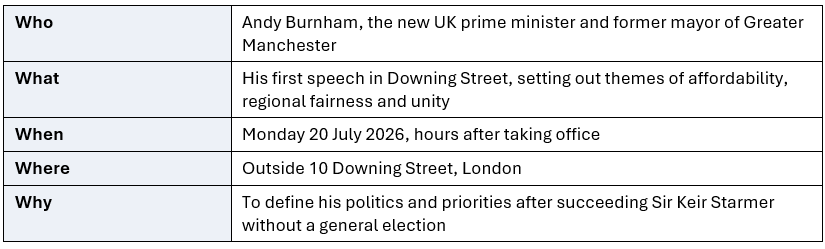
Who, What, When, Where and Why
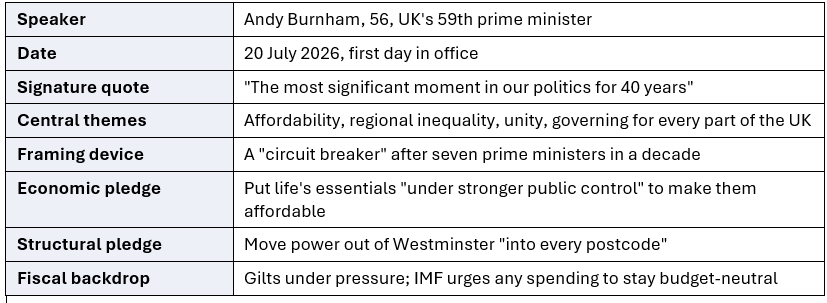
Key Facts
Five Key Takeaways
- Burnham used affordability as his opening promise, pledging to bring life's essentials under stronger public control, but the speech offered themes rather than costed policy.
- His attack on the centralisation and de-industrialisation of the 1980s framed regional inequality as the country's core problem and devolution as the answer.
- The pledge to govern for "every part of the United Kingdom" is politically unifying but sets a high bar he can be measured against in every region.
- Calling this the most significant moment in 40 years raises expectations sharply for a leader who took office without a general election.
- The unresolved tension is fiscal: bold public-control and investment promises collide with nervous bond markets and an IMF warning against unfunded spending.
What Happened
On Monday 20 July 2026, hours after King Charles III invited him to form a government, Andy Burnham stood outside 10 Downing Street and delivered his first speech as prime minister. It was the moment a politician known for nine years as mayor of Greater Manchester, and nicknamed the "King of the North", introduced himself to the country as its 59th prime minister and the seventh in a decade.
The address was built around a handful of clear themes rather than a detailed policy list. Burnham led with affordability and the cost of living, promising to build what he described as a new economy that would put life's essentials back under stronger public control to make them affordable again. He said concrete measures on immediate cost-of-living pressures would follow the next day.
He then turned to regional inequality, arguing that Britain had taken wrong turns since the 1980s by centralising power in Westminster and de-industrialising large parts of the country. His remedy, he said, was to take power out of the capital and carry it into what he called every postcode, so communities could tackle their own challenges. He tied this to a promise to re-industrialise using public procurement.
Running through the speech was a call for unity and renewal after years of instability. Burnham framed the change as a "circuit breaker" for a country that had cycled through six predecessors, said politicians had "not been good enough" and needed to be better, and pledged to govern for every part of the United Kingdom. He set out longer-term ambitions, including a ten-year national plan, more council homes, expanded mental health support and an instruction to work towards ending rough sleeping. The line that framed the day was his claim that "this change today is the most significant moment in our politics for 40 years."
Why It Matters
A first speech from the steps of Downing Street is not legislation, but it is the clearest early signal of how a prime minister intends to govern and how they want to be judged. For Burnham, who reached office through an uncontested Labour leadership rather than a general election, the speech carried extra weight: it had to supply the mandate that the ballot box did not.
The themes he chose are significant because they define the yardsticks his government can now be measured against. By putting affordability first, he has invited voters to watch their energy, housing and transport costs as the test of success. By making regional inequality his central diagnosis, he has committed to outcomes that are visible far beyond London and the South East.
The promise to govern for "every part of the United Kingdom" is politically shrewd but demanding. It reaches towards voters in the nations and regions, and towards those tempted by Reform UK, yet it also raises expectations in places that have heard similar pledges from previous governments and seen limited change. The higher the rhetoric, the sharper the contrast if delivery falls short.
Most consequential is the economic framing. A promise to bring essentials under stronger public control, to re-industrialise and to invest in every region implies spending and structural reform at a moment when gilts are under pressure, mortgage rates have risen after a resumption of Middle East hostilities, and the International Monetary Fund has warned that any response to the energy-price shock should stay targeted, temporary and budget-neutral. The gap between the ambition and the arithmetic is where this premiership will be tested.
The style of the speech matters too. Its informal, optimistic register was a conscious contrast with the managerial tone of recent years, and an attempt to rebuild a bond with voters who have watched leaders come and go. That approach can generate goodwill, but it also raises a familiar risk in politics: hope is easy to project and hard to sustain once the trade-offs of government become visible.
Detailed Analysis
Decoded closely, the speech is less a set of instructions than a statement of values with policy attached. Each of its main themes carries a plausible practical meaning, and each contains a point where the promise could strain against money, institutions or politics.
Affordability: essentials under public control
The most eye-catching phrase was the promise to put life's essentials back under stronger public control to make them affordable. In plain terms, this points towards a more interventionist role for the state in the markets for energy, water, housing and transport, whether through public ownership, tighter regulation, price mechanisms or public procurement. It is a deliberate break from the assumption that competition alone will deliver lower bills, and it speaks directly to households squeezed by high energy costs and rising mortgage rates.
In practice, the promise is easier to state than to cost. Stronger public control can mean cheaper bills for consumers, but the cost usually reappears elsewhere, in subsidy, in the price of buying assets, or in the investment that private capital would otherwise have provided. The warning signs are already visible in the utilities sector, where South East Water has said it is struggling to secure new funding and has blamed political scrutiny for denting investor confidence.
The strain point is fiscal credibility. Burnham has said he will use any flexibility within the fiscal rules, and analysts suggest that flexibility could mobilise extra infrastructure investment over the rest of the decade. But bond investors are watching for signs of unfunded commitments, and the columnist Martin Wolf has cautioned that there is no free fiscal lunch, only hard choices. Affordability delivered through the balance sheet, rather than through genuine cost reduction, would test that discipline quickly.
There is also a definitional gap to fill. The speech did not specify which essentials would come under stronger public control, or by what mechanism, and the difference between energy, water, housing and transport is substantial. Bringing down a household energy bill is a different task from building council homes, and each carries its own timescale and price tag. Until those details arrive, the affordability promise is a direction of travel rather than a plan, and voters squeezed today will judge it by how quickly the direction becomes delivery.
Regional inequality: power into every postcode
The heart of the speech was Burnham's argument that Britain went wrong in the 1980s by centralising power and hollowing out its industrial base, and that the cure is radical decentralisation. For a former metro mayor, this is home territory: his pitch is that decisions taken in Whitehall have failed communities that understand their own needs better, and that moving power outward can unlock growth that has been stifled.
The practical meaning is a likely expansion of devolution, with more powers and resources handed to mayors, combined authorities and local institutions, and a re-industrialisation effort steered through public procurement so that state spending supports domestic supply chains. Commentators have argued that a devolution "big bang" could raise national productivity and living standards, and banks including NatWest and Lloyds have signalled appetite to finance regional growth.
The strain runs in two directions. Devolution transfers not just power but blame, and a Westminster government that keeps control of the money while devolving responsibility risks setting up local leaders to fail. There is also a targeting question: one argument holds that the real divide is between insiders and outsiders rather than north and south, and that people on the periphery of prosperous areas can be left behind even when a region as a whole appears to thrive. Delivering for every postcode is a far harder test than delivering for every region.
Unity and the 40-year claim
The rhetorical spine of the speech was unity and renewal. Burnham cast himself as a "circuit breaker" after years of turnover, conceded that politicians had not been good enough, and promised to govern for every part of the United Kingdom. The tone was deliberately positive and informal, an attempt to restore trust in a system that has produced seven prime ministers in ten years.
The claim that this is "the most significant moment in our politics for 40 years" is the boldest single line in the speech, and the one most likely to be quoted back to him. It is a striking assertion for a leader who arrived without a general election, and it sets an expectation of change on the scale of a political realignment rather than a change of personnel. If the substance does not match the billing, the phrase becomes a hostage to fortune.
Unity also has an internal dimension. Burnham leads a party with a recent history of resignations and factional strain, and his cabinet blends former rivals, soft-left allies and Blairite technocrats. Governing for every part of the country requires holding that coalition together through the first hard choices on spending, welfare and energy. As one analysis put it, Labour may have handed Burnham a mandate without yet knowing his full programme, which makes the early translation of themes into policy the real test of whether the unity is substantive or presentational.
What Happens Next
The immediate sequel to the speech is delivery on cost of living. Burnham promised concrete measures the following day, and part of his early reset involves scrapping the previous government's digital identity scheme and redirecting the money towards cost-of-living priorities. These first moves will show whether the affordability promise translates into tangible relief or remains a slogan.
The harder tests come from the in-tray. Chancellor John Healey inherits a near-£5bn gap in the defence spending plan, gilt markets nervous about higher borrowing, and an IMF warning against an unfunded spending surge. How the Treasury reconciles Burnham's investment ambitions with those constraints will define the credibility of the whole agenda, and will signal whether the fiscal-rule flexibility he has invoked is used prudently.
On regional inequality, watch for the shape of any devolution package: which powers move, how much money follows, and whether local leaders gain genuine control or merely responsibility. Decisions on the North Sea licensing ban, the India trade deal and its implications for Welsh steel, and the future of struggling water companies will each test the promise to govern for every part of the country.
Party management will shadow every one of these choices. Burnham has promised unity, but his broad cabinet spans former rivals and rival traditions, and the first serious disagreement over spending, welfare or energy will reveal how durable that consensus is. A leader who framed his arrival as a circuit breaker cannot afford an early return to the resignations and infighting that defined the years before him.
Finally, the ten-year plan he trailed will need to become a document with numbers attached. A prime minister who has set a 40-year benchmark for the significance of his arrival will be judged on whether that plan is deliverable within the fiscal reality he inherits, and within a parliament that runs, at the latest, to 2029.
Conclusion
Andy Burnham's first speech was a clear statement of values: essentials made affordable, power pushed out to the regions, and a country governed as a whole rather than from its capital. It was fluent, optimistic and rooted in the devolution politics that made his name. As a piece of positioning, it did what a first speech should do, giving voters a recognisable idea of what this prime minister stands for.
The unresolved question is whether the themes can survive contact with the money. Every headline promise, from cheaper essentials to re-industrialisation to investment in every postcode, points towards a more active and more expensive state at a moment when markets and the IMF are urging restraint. Decoded honestly, the speech is a set of ambitions with the hard choices still to come.
By declaring this the most significant political moment in 40 years, Burnham has chosen to be measured against a very high bar. Whether that confidence looks prescient or premature will depend not on the words outside Downing Street, but on the decisions taken inside it over the months ahead.


 Oct 06, 2026





 Please wait processing your request...