
 CA
 NZ
 US
 AU
 IND

 UK

 Share
 X (Formerly Twitter)
 Whatsapp
 Facebook
 LinkedIn
 Telegram
 Email This Article
 Copy Link
 Summarize with AI
 Chat GPT
 Perplexity

Summary
HMRC's modernisation has produced a visible early win: in 2025-26 the tax authority answered more calls, more quickly, with satisfaction around 80%. But faster phone lines are the easiest gain to deliver and to lose. The decisive test is the digital shift, moving from about 78% of interactions handled online today to a target of at least 90% by 2030. Adoption is growing, with 7.6 million HMRC app users and 19.7 million Personal Tax Account users, but the remaining taxpayers are the hardest to move. Exchequer Secretary Dan Tomlinson oversees a roadmap to 2030, with Making Tax Digital expanding from April 2026. Success means durable, cheaper self-serve while vulnerable users stay protected; failure means digital-by-force pushing people back onto strained helplines.
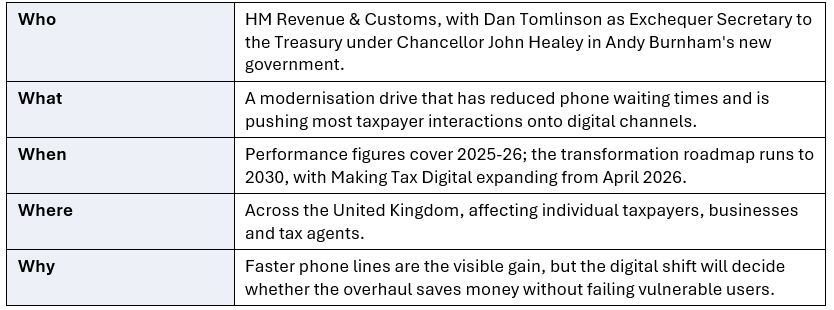
Who, What, When, Where and Why
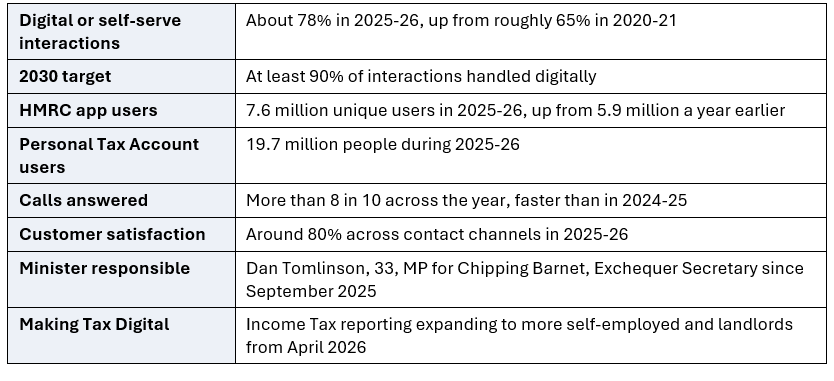
Key Facts
Five Key Takeaways
- Shorter phone queues are real and welcome, but they are the easiest part of the overhaul to deliver and to reverse.
- The decisive test is the digital shift: HMRC wants at least 90% of interactions online by 2030, up from about 78% today.
- Success means people move to the app and online accounts and stay there, cutting cost while satisfaction holds near 80%.
- Failure means digital defaults push confused or vulnerable taxpayers back onto strained phone lines, undoing the savings.
- Making Tax Digital's expansion from April 2026 is the moment the strategy meets millions of taxpayers at once.
What Happened
For years the most reliable complaint about Britain's tax authority was simple: you could not get through on the phone. Helpline waits stretched past twenty minutes at their worst, letters went unanswered for weeks, and the National Audit Office and MPs' committees returned again and again to the same theme of a service under strain.
In 2025-26 that picture improved. HM Revenue & Customs answered more calls and answered them more quickly than the year before, with more than eight in ten calls picked up across the year and post response times also recovering. Capacity, HMRC says, now broadly matches demand rather than lagging behind it.
The department frames this as evidence that its wider overhaul is working. That overhaul is not really about phone lines at all. It is a plan to shift the bulk of routine contact away from telephones and post and onto digital channels: the HMRC app, the Personal Tax Account, the Business Tax Account and automated online services.
The numbers behind the digital push are already substantial. Around 78% of customer interactions now run through digital or self-serve channels, up from roughly 65% at the start of the decade. The HMRC app reached 7.6 million unique users in 2025-26, up from 5.9 million the year before, and 19.7 million people used their Personal Tax Account.
Overseeing this from the Treasury is Dan Tomlinson, the Exchequer Secretary. At 33, the Chipping Barnet MP and former Resolution Foundation economist is one of the government's younger ministers, and he inherits a transformation roadmap that runs to 2030. He does so under a new Chancellor, John Healey, and a new Prime Minister, Andy Burnham, both of whom need HMRC to deliver savings without generating fresh political grief.
The roadmap itself is best understood as a channel-shift strategy with a customer-service promise attached. HMRC wants to answer fewer calls not by refusing to help, but by making the online experience good enough that fewer people feel the need to ring. On its own telling, the department is running marginally ahead of plan on that channel-shift objective, which is why officials are keen to present 2025-26 as a turning point rather than a one-off recovery.
Why It Matters
It is tempting to read shorter phone queues as proof of success. That reading is too generous. Waiting times are the most visible metric HMRC reports, but they are also the easiest to move in the short term and the easiest to lose again.
Call performance can be bought with staff, overtime and temporary hiring, especially outside the January Self Assessment peak. If demand rises or budgets tighten, the queues can lengthen just as quickly as they shortened. A single busy season with a system change can undo a year of progress.
The digital shift is different in kind. It is structural, expensive to build and slow to reverse. If HMRC can genuinely move most taxpayers to self-serve online, it can answer fewer calls because fewer people need to ring at all. That is where the durable cost savings, and the durable improvement, are meant to come from.
This matters for the public finances as much as for customer service. HMRC collects the revenue that funds everything else, and a cheaper, more accurate tax service frees money the Treasury badly needs. Burnham has promised to use fiscal flexibility for investment, and Healey inherits tight spending plans; an efficient tax authority is one of the few levers that improves the books without raising a single rate.
It also matters because tax touches almost everyone. Get the digital shift right and millions save time; get it wrong and the people least able to cope, the elderly, the digitally excluded, those with complex affairs, are the ones pushed back onto the phones the overhaul was supposed to relieve.
There is a credibility dimension too. Every large public-service modernisation carries the memory of expensive government IT projects that promised savings and delivered disruption. HMRC's task is to show that this programme belongs in the other category, where technology genuinely lightens the load, and the way it handles the awkward transition years will decide which story the public believes.
Detailed Analysis
To judge whether the overhaul has worked, it helps to separate three questions: what has actually improved, what the digital shift really demands, and what success and failure would each look like in practice.
The phone-line win is real, but modest and fragile
The improvement in call handling is genuine and should not be dismissed. Answering more than eight in ten calls, faster than the previous year, is a meaningful recovery for a service that had become a byword for frustration. Customer satisfaction sitting at around 80% across channels supports the claim that the experience is better than it was.
But context matters. HMRC has long worked to a target of answering calls within about five minutes on average, and past years saw that target badly missed. Recovering to an acceptable standard is a return to the baseline the public expects, not a leap beyond it.
Professional bodies are notably cautious. The ICAEW, reviewing 2025-26, agreed that HMRC answered calls and post more quickly, yet reported that agents and taxpayers still feel service quality falls short of what they expect. Speed of answer is not the same as resolution; a quickly answered call that does not solve the problem simply produces a second call.
The fragility is the deeper point. Phone performance depends on staffing levels that can be cut, and on demand that spikes with every policy change and filing deadline. Treating the current numbers as a permanent victory would be a mistake, because nothing structural yet guarantees they hold.
It is worth remembering how bad things had become. Not long ago callers reported average waits well beyond twenty minutes, and one widely cited estimate put the total time taxpayers spent on hold across a year at the equivalent of centuries. Against that backdrop, a return to answering most calls promptly feels like a transformation, but it is really the restoration of a service the public was always entitled to expect.
The digital shift is the real transformation
The heart of the overhaul is the plan to handle at least 90% of interactions digitally by 2030, up from roughly 78% today. That last stretch is the hardest, because the taxpayers who have not already moved online are disproportionately those who find it difficult to.
Adoption so far is encouraging. The app's growth to 7.6 million users, nearly 20 million Personal Tax Account users, and rising volumes of payments and queries handled online show that when digital services are good enough, people use them. In January 2026 alone customers used the app millions of times to check details and make payments.
The mechanism matters. Every routine query resolved in the app, a tax code check, a payment, a simple update, is a call that never needs answering. That is why the digital shift, not the call statistics, is what makes the phone improvement sustainable. The two are linked: online self-serve is what keeps the queues short.
HMRC has also leaned on automation, including online guidance and chatbots, to deflect simple questions before they reach a human. Handled well, this frees advisers for the complex cases that genuinely need a person. Handled badly, it becomes a barrier that traps people in loops and erodes the very trust the department is trying to build.
The economics are compelling, which is precisely why the strategy carries risk. A digital interaction costs a fraction of a phone call, so shifting even a modest share of contact online produces large savings. The danger is that the pursuit of those savings tempts the department to move faster than taxpayers can follow, closing the human door before the digital one is reliably open.
What success and failure actually look like
Success is not simply a higher digital percentage. Success is people choosing online channels, resolving their issue first time, and staying there, while satisfaction holds and the minority who need human help still get it promptly. On that definition, a 90% digital share only counts as a win if the remaining 10% are served well rather than abandoned.
Failure has a recognisable shape too. It looks like digital-by-default becoming digital-by-force: helplines quietly restricted to nudge people online, followed by a surge of confused or excluded taxpayers ringing anyway, longer queues returning, and complaints rising. HMRC has faced exactly this criticism before when it closed or limited helplines too fast.
The politically dangerous failure is a botched rollout of a major change landing on an unprepared public. Making Tax Digital for Income Tax, which expands from April 2026 to more self-employed people and landlords, is the obvious flashpoint. It asks people to keep digital records and report quarterly, a real behavioural shift for those used to a single annual return.
For Tomlinson and Healey, the measure that matters is whether cost per interaction falls while satisfaction stays near current levels and vulnerable users are protected. Cheaper and worse would be a failure dressed as a saving; cheaper, faster and fairer, sustained through a major rollout, would be the overhaul actually working.
What Happens Next
The next twelve months will test the strategy more than the last five did. The expansion of Making Tax Digital for Income Tax from April 2026 brings a fresh cohort of taxpayers into digital record-keeping and quarterly updates, and the smoothness of that transition will shape public confidence in the whole programme.
Watch the leading indicators rather than the headline waiting time. The share of interactions handled digitally, first-contact resolution rates, app and online account growth, and complaint volumes will reveal whether people are genuinely migrating or merely being pushed. Satisfaction holding near 80% while digital share climbs would be the strongest sign of health.
The support offered to those who cannot go digital is the other thing to watch. A credible overhaul keeps a well-staffed, accessible route for the digitally excluded and for complex cases, and resists the temptation to close helplines to force behaviour change before the online alternatives are proven.
For the Treasury, the fiscal stakes are immediate. Burnham has signalled he will use any flexibility within the fiscal rules, and Healey faces tight plans and a near-term spending squeeze. A tax authority that costs less to run while collecting more accurately is a quiet win the government can bank without a tax rise, which is precisely why ministers will keep a close eye on Tomlinson's brief.
Expect scrutiny from the usual quarters. The National Audit Office, the Public Accounts Committee and professional bodies such as the ICAEW will keep testing whether faster answers translate into resolved problems, and whether the digital shift is lifting service or simply lowering cost.
Conclusion
So, has the HMRC overhaul worked? The honest answer is: partly, and provisionally. The phone-line recovery is real and worth acknowledging, but it is the easiest part of the job and the part most easily lost.
The verdict that counts rests on the digital shift, and that story is still being written. The direction is promising, with millions moving to the app and online accounts, yet the hardest ten percentage points and the biggest behavioural change lie ahead, not behind.
The distinction is what separates a genuine transformation from a public-relations improvement. Shorter queues that depend on extra staff can vanish in a bad season; a taxpayer base that self-serves online reshapes the service permanently and pays for itself.
For Dan Tomlinson, and for the Chancellor and Prime Minister above him, the task is to resist declaring victory on the visible metric while the structural one is unfinished. If the digital shift succeeds without leaving vulnerable people behind, the overhaul will deserve the credit. If it stalls, or forces people online before the tools are ready, the faster phone lines will look less like progress and more like a distraction from the test that mattered.


 Oct 06, 2026





 Please wait processing your request...