
 CA
 NZ
 US
 AU
 IND

 UK

 Share
 X (Formerly Twitter)
 Whatsapp
 Facebook
 LinkedIn
 Telegram
 Email This Article
 Copy Link
 Summarize with AI
 Chat GPT
 Perplexity

Summary
On 20 July 2026, new UK Prime Minister Andy Burnham appointed John Healey, 66, as chancellor of the exchequer, surprising MPs who had expected the former Labour leader Ed Miliband to take the Treasury. Healey, a Brownite Treasury veteran first elected in 1997, had resigned as defence secretary last month after criticising Sir Keir Starmer over defence funding. His appointment signals that Burnham prioritises fiscal credibility and market confidence over a rapid, spending-led agenda, especially with UK gilts under pressure. Healey's first task is a near-£5bn gap in the inherited defence spending plan, while Burnham seeks to use fiscal-rule flexibility, potentially £16bn, for infrastructure investment. Miliband instead became foreign secretary.
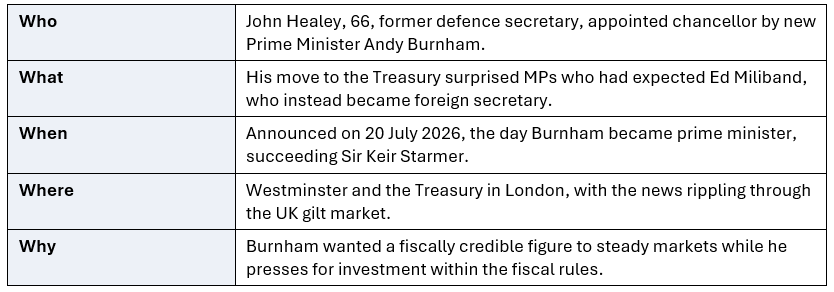
Who, What, When, Where and Why
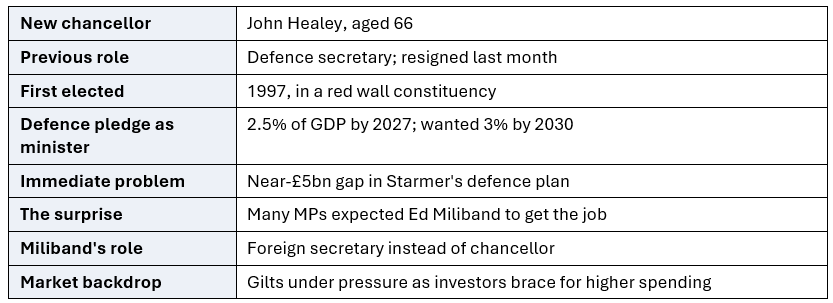
Key Facts
Five Key Takeaways
- Healey is a Brownite Treasury veteran, not a newcomer, and his appointment reads as a bid for fiscal credibility.
- The choice denied the Treasury to Ed Miliband, whose supporters wanted him as chancellor; he takes the Foreign Office instead.
- Healey resigned as defence secretary only last month, criticising Starmer over defence funding, making his return unusual.
- His first task is a near-£5bn gap in the previous government's defence spending plan.
- Gilts are under pressure, so Healey must reassure bond investors while Burnham pushes to use fiscal-rule flexibility for investment.
What Happened
On 20 July 2026, hours after Andy Burnham entered Downing Street as Britain's 59th prime minister, his choice for chancellor of the exchequer landed as one of the day's genuine surprises. The job went to John Healey, 66, the former defence secretary who had resigned from the cabinet only last month.
Healey's return to the front rank was unexpected for two reasons. He had left government in June after publicly criticising Sir Keir Starmer's lack of authority during a Treasury dispute over defence spending. And within Westminster, the widespread assumption had been that the Treasury would go to Ed Miliband, the former Labour leader whose supporters had openly lobbied for him to take it.
Instead, Miliband was handed the Foreign Office. The reshuffle placed a fiscally cautious Treasury veteran at the centre of economic policy and moved the party's most prominent climate campaigner to diplomacy. For MPs reading the runes of a new premiership, the pairing said a great deal about how Burnham intends to govern.
Healey is not a novice at the Treasury. He was first elected in 1997, served as a Treasury minister under Tony Blair, and is a former trade unionist regarded as a moderate in the Brownite tradition. He holds a red wall seat, and at points in Labour's recent turbulence he had been mentioned as a possible caretaker prime minister.
His appointment therefore reads less as a gamble on an outsider than as a deliberate reach for a familiar, steadying figure. Burnham, who won the Labour leadership uncontested and faces no requirement to hold a general election until 2029, has chosen to open his premiership by signalling continuity and control at the Treasury rather than radical change.
Why It Matters
The identity of a chancellor shapes markets, spending and the balance of power inside a government. Burnham's decision matters first because of who did not get the job. Many in the party wanted Ed Miliband, an advocate of ambitious public investment and rapid decarbonisation, to run the Treasury. Placing Healey there instead suggests Burnham wants a brake as much as an accelerator on the public finances.
It matters, too, because of the moment. UK government bonds, known as gilts, have been under pressure as investors brace for higher spending under the new prime minister. When investors sell gilts, the government's borrowing costs rise, which in turn feeds through to mortgage and business lending rates. A chancellor perceived as disciplined can calm that nervousness; one seen as a spender can inflame it.
Burnham has said he will use any flexibility within the fiscal rules, and analysts have suggested he could mobilise as much as an extra £16bn for infrastructure over the rest of the decade. That ambition needs a chancellor the bond market trusts to keep the arithmetic honest. Healey, a Treasury alumnus with a reputation for caution, fits that requirement more comfortably than a champion of expansive spending would.
There is a further reason the appointment carries weight. Healey knows the defence brief intimately, and his first task at the Treasury is a near-£5bn gap in the previous government's defence spending plan. Handing the public finances to the very minister who quit over that shortfall is a striking bet: the man who demanded more money for defence must now decide how the whole budget adds up.
There is also a signal in the timing. Burnham inherits no obligation to hold a general election until 2029, which in theory gives him the space to take difficult decisions early. Choosing a cautious chancellor at the outset suggests he intends to use that runway to build economic credibility first, and to bank the political dividends of any recovery closer to the vote.
Finally, the choice signals the kind of Labour government Burnham wants to lead. For all his reputation as the campaigning King of the North, his first economic move was orthodox. That tension, between a leader elected on the promise of change and a Treasury built for continuity, will define the early months of his premiership.
Detailed Analysis
To understand the appointment, it helps to separate three threads: who Healey is, what his elevation says about Burnham's economic strategy, and how the markets and the wider party are likely to respond. Each points to a premiership trying to reconcile appetite for investment with the discipline the bond market is demanding.
The making of a cautious Treasury man
John Healey is one of the more experienced figures in the parliamentary Labour Party. Elected in 1997 on the wave that brought Tony Blair to power, he served as a Treasury minister before going on to hold a range of roles across nearly three decades in the Commons. A former trade unionist, he is placed on the party's moderate, Brownite wing, and represents a red wall seat of the kind Labour cannot take for granted.
That background gives him credibility with two audiences at once. To the parliamentary party, he is a known quantity who has been talked of, at moments of crisis, as a plausible caretaker prime minister. To officials and investors, he is a Treasury insider who understands how budgets are built and how quickly market confidence can drain away.
His most recent job complicates the picture. As defence secretary under Starmer, Healey moved quickly, ordering a rapid Ministry of Defence strategy review and cultivating close ties with his American counterpart, Pete Hegseth. He persuaded Starmer to lift defence spending to 2.5 per cent of GDP by 2027, a commitment consistent with the broad direction set out in the 2025 Strategic Defence Review.
Then came the break. Healey resigned last month, criticising Starmer's lack of authority in a Treasury dispute over defence funding, and on his way out demanded a firm date for reaching 3 per cent of GDP on defence in 2030. That a minister who quit over spending is now the guardian of the entire budget is the paradox at the heart of his appointment.
What the choice signals about economic strategy
Personnel is policy, and few appointments telegraph intent as clearly as the choice of chancellor. By preferring Healey to Miliband, Burnham has signalled that the first priority of his economic strategy is credibility rather than a rapid, spending-led reset. It is a message aimed as much at bond investors as at his own backbenches.
The subtext is a familiar debate about whether governments face a free fiscal lunch. The Financial Times commentator Martin Wolf has argued that the biggest mistake a new government can make is to imagine there is one, and that in reality there are only hard choices. Burnham's language, promising to use any flexibility within the fiscal rules rather than to tear them up, suggests he has absorbed the point.
The international backdrop reinforces the caution. The International Monetary Fund has said Burnham cannot afford to boost public spending, and that any response to the energy-price shock from the US-led conflict with Iran should remain targeted, temporary and budget-neutral. A chancellor with Healey's instincts is better suited to holding that line than one elected to loosen the purse strings.
Yet the strategy is not simply austerity by another name. Burnham still wants to unlock investment, potentially an extra £16bn for infrastructure over the rest of the decade, by using the flexibility the fiscal rules allow. The bet is that a trusted chancellor buys the political room to borrow for investment without triggering the market punishment that a less disciplined figure might provoke. Whether those two aims can be squared is the central question of the new government's economics.
Markets, the defence gap and party management
The most immediate audience is the gilt market. With bonds already under pressure, Healey's early job is to reassure investors that the new government's ambitions will be financed responsibly. His reputation for caution helps, but reassurance will ultimately rest on numbers, not personality: a credible plan for spending and borrowing that survives contact with the Office for Budget Responsibility and the markets.
The near-£5bn gap in the previous government's defence plan sharpens that test. Healey championed higher defence spending and wanted a 3 per cent target locked in for 2030. As chancellor he must now weigh that demand against every other call on the budget, from the roughly £200bn National Health Service to the cost-of-living relief Burnham has promised. The minister who once pushed for more must now police the total.
Party management is the third dimension. Miliband's move to the Foreign Office leaves a cohort of MPs and members who wanted him at the Treasury feeling passed over. Burnham will need to show them that ambition on investment and the environment has not been abandoned, only routed through a more cautious gatekeeper. Managing that expectation is a political task as much as an economic one.
Commentators have counselled patience and realism. The economist Mohamed El-Erian has argued that policy must go beyond announcements and budget arithmetic to command lasting confidence. For Healey, that means the substance of delivery, not the symbolism of appointment, will decide whether the markets extend the new government the benefit of the doubt.
His relationship with the wider Treasury team also matters. With figures such as Dan Tomlinson serving as Exchequer Secretary, Healey inherits a department in the middle of its own modernisation, from cutting phone waiting times at HM Revenue and Customs to a harder digital overhaul. Steadying that machine while setting a credible fiscal course is the quiet, unglamorous work on which his tenure will rest.
What Happens Next
The first weeks will be about tone and reassurance. Expect Healey to make early statements aimed squarely at investors, stressing that the government will work within its fiscal rules and that any additional borrowing will be for investment rather than day-to-day spending. Every word will be parsed by a gilt market that has already priced in some anxiety about the new administration.
Attention will then turn to a fiscal event. A new chancellor typically wants an early opportunity to set out his approach, whether through a statement to Parliament or a formal Budget, complete with independent forecasts from the Office for Budget Responsibility. That is when the promise to use flexibility within the fiscal rules will be tested against hard numbers.
The defence question will not wait. Healey must decide how to close the near-£5bn gap in the inherited defence plan while honouring Burnham's cost-of-living commitments. His own past demand for 3 per cent of GDP by 2030 will be quoted back to him, and how he reconciles it with the wider budget will be an early measure of his authority.
There is also the relationship with Number 10 to define. Burnham has spoken of using fiscal flexibility to boost investment; Healey is the more cautious of the two. Whether the pair present a united front, or whether the familiar tension between a spending-minded centre and a disciplined Treasury re-emerges, will shape the government's coherence.
Externally, the energy-price shock from the conflict with Iran continues to feed into mortgage and energy costs, and the IMF is watching for any sign of an unfunded spending surge. Healey's room for manoeuvre will be shaped as much by events abroad as by choices at home, leaving little margin for error in his opening months.
Conclusion
John Healey's move from the defence brief he quit to the Treasury he now runs is the most revealing appointment of Burnham's opening day. It tells us the new prime minister values market credibility, prizes fiscal discipline over a spending-led reset, and is willing to disappoint the wing of his party that wanted Ed Miliband in charge of the economy.
The appointment is not without risk. Handing the budget to a minister who resigned over defence funding, at a moment when gilts are under pressure and a near-£5bn shortfall must be resolved, invites obvious questions about consistency and control. Burnham is betting that Healey's caution and experience are worth more than the enthusiasm a bolder choice might have generated.
The measure of that bet will be whether Healey can hold the confidence of the bond market while giving Burnham enough room to invest. If he manages it, the surprise of 20 July will look like shrewd judgement. If he cannot, the tension between a change-minded prime minister and a cautious chancellor will become the defining strain of the new government.


 Oct 06, 2026





 Please wait processing your request...