
 CA
 NZ
 US
 AU
 IND

 UK

 Share
 X (Formerly Twitter)
 Whatsapp
 Facebook
 LinkedIn
 Telegram
 Email This Article
 Copy Link
 Summarize with AI
 Chat GPT
 Perplexity

Summary
London's stock market has spent years shrinking as companies were taken over or listed in New York, but 2026 has brought a more hopeful reading. EY figures show 23 UK IPOs in 2025 raising about £2.1bn, up sharply from 2024, with most momentum in the final quarter. The Financial Conduct Authority's 2024 listing overhaul scrapped the three-year track-record rule, merged listing categories and eased dual-class shares, while a new three-year stamp-duty exemption cut trading costs for fresh listings. A pipeline including Norwegian software group Visma and several UK fintechs has thickened. Yet the recovery is only partial: just two IPOs completed in the first quarter of 2026, delistings still outpace new arrivals, and the valuation discount to US peers has barely narrowed. For Andy Burnham's government, a lasting revival depends less on rules than on reviving economic growth.
Who, What, When, Where and Why
Key Facts
Five Key Takeaways
- The optimistic case rests on hard changes: lighter FCA listing rules, a three-year stamp-duty break for new listings and a 2025 rebound that saw IPO proceeds rise sharply from a very low base.
- A thickening pipeline matters most. A large anchor flotation such as Visma, and a queue of UK fintechs, could restore confidence far faster than any rule change.
- The recovery is real but partial. A weak first quarter of 2026, with only two IPOs, showed how quickly volatility can stall the momentum built up late in 2025.
- The deeper problem is unresolved: British shares still trade at a discount to US peers, and delistings and takeovers keep draining the market faster than new listings refill it.
- For Andy Burnham's government, a healthier listing market is less a policy to be delivered than a by-product of credible, sustained economic growth.
What Happened
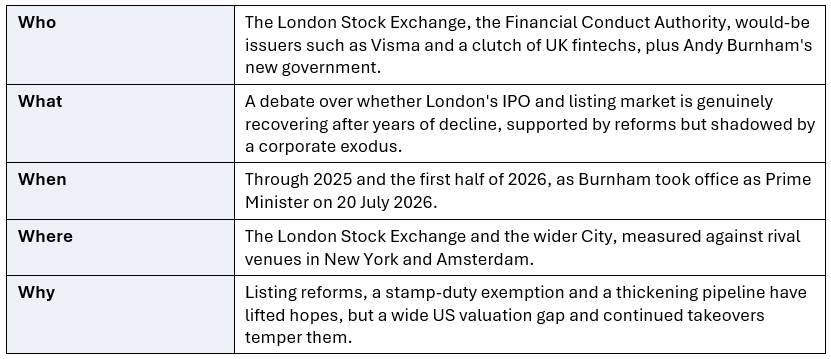
For much of the past decade the London stock market has been written up as a place companies leave rather than arrive. Household names have been bought by foreign owners, a handful of prized firms have shifted their primary listing to New York, and the flow of new flotations slowed to a trickle. In 2026 a more hopeful reading has started to gain ground: that the listing market, while still subdued, is quietly stronger than the gloom suggests.
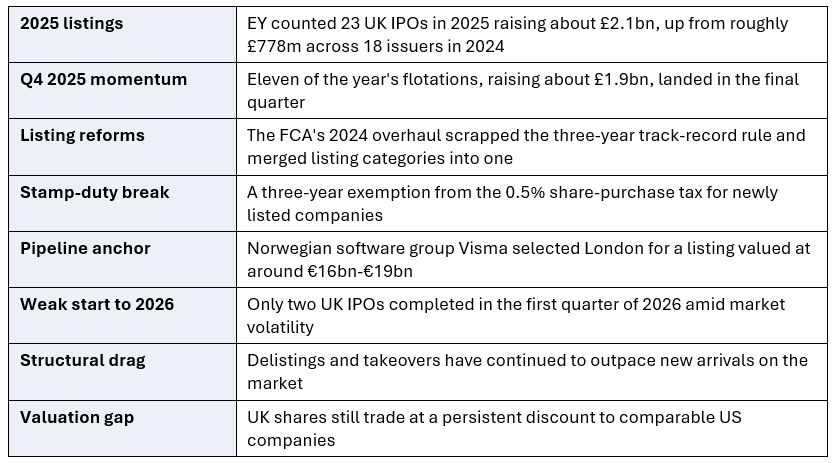
The numbers behind that optimism come from a low base but point in the right direction. According to figures from the professional-services firm EY, London hosted 23 initial public offerings in 2025, raising around £2.1bn between them. That was a sharp increase on 2024, when roughly £778m was raised across 18 issuers, and much of the momentum arrived late: eleven of the year's flotations, worth about £1.9bn, were completed in the final quarter alone.
An initial public offering, or IPO, is the moment a private company first sells its shares to the public and joins a stock exchange. A run of them signals that founders believe the market will value their business fairly. After several thin years, even a modest rebound has been read as a thaw.
Policy has been working in the same direction. In 2024 the Financial Conduct Authority carried out the biggest overhaul of London's listing rules in decades, scrapping the requirement for a three-year track record, merging the old premium and standard segments into a single category, easing the treatment of dual-class share structures and reducing the number of decisions that must be put to a shareholder vote. The aim was to make London simpler and more welcoming, closer in spirit to New York.
The government has added a financial sweetener. The Autumn Budget introduced a three-year exemption from the 0.5 per cent stamp duty charged on share purchases for companies newly listed in London, a measure intended to make trading in fresh listings cheaper and the venue more competitive. Together, the reforms and the tax break form the backbone of the optimistic case.
Yet the same period carried a warning. The first quarter of 2026 produced only two UK IPOs as market volatility, partly linked to the energy-price shock from the conflict with Iran, pushed companies to wait. Proceeds recovered in the second quarter, but delistings continued to outpace new arrivals. The revival is real but far from settled.
Why It Matters
A stock market is more than a scoreboard for the City. It is one of the main channels through which savers' pensions own a slice of domestic growth, and through which growing companies raise the capital to expand, hire and invest. When that channel narrows, the effects reach well beyond the Square Mile.
London's decline as a listing venue has become a proxy for a bigger anxiety about Britain's economic standing. Every prized company that floats in New York, and every mid-sized firm bought cheaply by a foreign owner, is taken as evidence that the country is selling its future too cheaply. A credible recovery in new listings would be one of the clearest signs the trend can be turned.
That is why the debate matters to the new government. Andy Burnham entered Downing Street on 20 July 2026 promising to raise investment and rebalance growth towards the regions. A deeper, more active market makes it easier for ambitious British firms, including those outside the south-east, to raise money at home rather than looking abroad for capital.
For ordinary savers, the outcome is not abstract. A thinner domestic market means index-tracking pension funds hold fewer UK shares, so British savers capture less of the growth generated at home. A genuine listing revival would help reverse that quiet leakage of ownership and opportunity.
Detailed Analysis
To weigh whether London's market is stronger than it looks, it helps to separate three questions. What have the reforms actually changed? How solid is the pipeline of companies that might list? And why does the corporate exodus refuse to go away? The optimistic and pessimistic readings both draw on real evidence, which is why the honest answer is a qualified one.
The reforms rewiring London's market
The most concrete grounds for optimism are the rule changes that London has already made. The Financial Conduct Authority's 2024 overhaul removed several long-standing barriers at once. Companies no longer need a three-year financial track record to list, which opens the door to younger, faster-growing businesses. The old two-tier system of premium and standard listings has been replaced by a single category with a simpler set of obligations.
The reforms also softened rules that had irritated founders. Dual-class share structures, which let entrepreneurs keep voting control after floating, are treated more generously, bringing London closer to New York on a point that had driven some technology firms across the Atlantic. Fewer transactions now require a formal shareholder vote, cutting cost and delay for listed companies making acquisitions.
Alongside the listing rules, the government has attacked the cost of trading. The three-year stamp-duty exemption for newly listed firms removes the 0.5 per cent charge that buyers normally pay on UK share purchases, a levy that critics have long argued quietly discourages investment in British stocks. For a fresh listing, cheaper trading can mean deeper demand and a more stable share price.
The early evidence is that these changes have helped sentiment more than they have transformed volumes. The 2025 rebound in proceeds, concentrated in the final quarter, suggests firms that had postponed flotations began to move once conditions steadied. Analysts have been careful, though, to describe the effect as improving accessibility rather than guaranteeing a flood of deals. Rules can lower the barriers to listing; they cannot by themselves create the confidence that makes companies want to. That is the nub of the optimistic case: London has done much of the unglamorous institutional work that reformers demanded for years.
A pipeline worth watching
The second reason for cautious optimism is the pipeline. A market recovers not on rules but on deals, and the roster of companies weighing a London listing has grown more interesting. The most watched candidate is Visma, a Norwegian business-software group reported to have selected London for a flotation valued at roughly €16bn to €19bn. A listing of that scale would signal that London can still win large technology names.
Behind any single anchor sits a broader queue. A cluster of British fintechs, including digital banks such as Monzo and Starling and payments firms that have grown up in the UK, are regularly cited as potential future listings, alongside consumer and insurance businesses owned by private equity looking for an exit. Each is a decision that has not yet been made, but collectively they represent a reservoir of possible supply that did not obviously exist a few years ago.
The importance of a big, successful listing is psychological as much as financial. If a marquee name floats in London, prices well and then trades strongly in the months that follow, it signals to every founder and board weighing where to list that the City can deliver. Confidence of that kind is self-reinforcing, and it is precisely what a run of disappointing or cancelled deals had drained away.
The caution is that a pipeline is not a result. Plans slip, valuations disappoint and companies keep their options open until the last moment; there have already been reports that some prospective issuers could delay. A flotation pencilled in for London can be redirected to New York, sold to a private buyer or shelved entirely if markets wobble. The weak first quarter of 2026, with just two completed IPOs, was a reminder of how easily a promising queue can stall when volatility returns. The pipeline therefore supports optimism without vindicating it; whether it converts into completed flotations is the test the next year or two will set.
The exodus that will not quite go away
The strongest argument for scepticism is that the plumbing beneath the market still leaks. Even in a better year, delistings and takeovers have continued to outpace new arrivals, so the total pool of London-listed companies has kept shrinking. A handful of fresh flotations does not refill a market that is losing established names to private-equity buyers, foreign acquirers and relocations to New York.
Underlying that drain is a valuation gap that has barely narrowed. UK-listed shares still trade at a persistent discount to comparable American companies, a difference rooted in years of thin domestic demand, an index weighted towards banks, miners and energy rather than high-growth technology, and a risk premium attached to Britain's slower growth. That discount is what makes British firms tempting targets and what tempts some to seek richer valuations abroad.
The competitive backdrop makes the gap harder to close. New York continues to attract the largest technology listings, and a prospective wave of American mega-flotations threatens to pull global capital away from London just as it tries to rebuild. Reforms can make London more welcoming, but they cannot on their own persuade investors to pay New York multiples for London-listed shares.
There are also live reminders that individual deals remain fragile. Reports that the planned London listing of the retailer Superdrug, owned by the Hong Kong-based group AS Watson, could be delayed by market conditions illustrate how quickly a headline candidate can turn uncertain. Each hesitation feeds the narrative that London is a difficult place to float, which is exactly the perception the reforms are meant to dispel.
None of this means the optimists are wrong, but it sets a demanding bar. A genuinely stronger market would show new listings consistently outweighing departures and the valuation discount beginning to close. On the evidence so far, London has managed the first only in a single strong quarter and made little progress on the second.
What Happens Next
The immediate priorities of the new government lie elsewhere: the cost of living, energy prices and a near-£5bn gap in defence spending inherited from its predecessor. But the conditions that determine whether London's listing market recovers run straight through Burnham's economic agenda.
The clearest near-term signal will be the pipeline. If Visma proceeds with a London flotation and prices well, and one or two well-known UK fintechs follow, the optimistic reading will look justified. If those deals slip to New York or are pulled, the sceptics will feel confirmed. The next several months of announcements will matter more than any speech.
The listing reforms already made by the Financial Conduct Authority will continue to bed in, and their real effect on the volume of new flotations should become clearer over 2026 and 2027. The three-year stamp-duty exemption, meanwhile, will be judged by whether it lifts demand rather than by its design.
Broader policy will shape the backdrop. Efforts to channel more of Britain's pension savings into domestic equities, which command cross-party support in principle, could deepen demand and narrow the valuation gap over time, though they raise hard questions about savers' returns. The International Monetary Fund has cautioned the government that its response to the energy shock should stay targeted, temporary and budget-neutral, a reminder that money for incentives is tight.
Above all, the market will track the economy. Cheap valuations are ultimately a verdict on Britain's growth prospects, so the surest way to revive listings is to make British companies worth more by making the economy grow faster. That places the fate of London's IPO comeback less in the hands of regulators than in the success or failure of Burnham's central promise.
Conclusion
The case that London's listing market is stronger than it looks is not empty cheerleading. The exchange has rewritten its rulebook, cut the cost of trading new listings, seen IPO proceeds rebound from a dismal low and assembled a pipeline that once again includes potential anchor deals. After years of retreat, those are genuine foundations.
But the caveats are just as real. The rebound rests on a single strong quarter and a weak start to 2026, delistings and takeovers still drain the market faster than flotations refill it, and the valuation discount that makes British firms cheap has barely moved. A recovery that is real but partial is exactly what the evidence describes.
The distinction matters because it implies a clear test: whether the pipeline converts into completed listings, and whether departures from the market finally slow.
For a Prime Minister who has staked his premiership on investment and regional renewal, the listing market is a useful barometer. It will strengthen not because ministers will it to, but because a growing economy makes companies want to raise money and stay British. Deliver that, and London's comeback becomes self-sustaining. Fail, and even the best-designed rulebook will not fill the market back up.


 Oct 06, 2026





 Please wait processing your request...