
 CA
 NZ
 US
 AU
 IND

 UK

 Share
 X (Formerly Twitter)
 Whatsapp
 Facebook
 LinkedIn
 Telegram
 Email This Article
 Copy Link
 Summarize with AI
 Chat GPT
 Perplexity

Summary
Newly qualified nurses across the UK are struggling to find NHS jobs even as wards remain short-staffed and vacancy lists run into the tens of thousands. Trusts under financial pressure have frozen or delayed recruitment, thinning out the entry-grade Band 5 posts that graduates depend on. The Royal College of Nursing argues the situation exposes a failure of workforce planning rather than a real surplus of nurses: training places were expanded without funded, guaranteed posts to match, and RCN Wales has warned up to half of newly qualified nurses there could face unemployment. Graduates such as University of Birmingham nurse Millie Field risk leaving the profession or moving abroad, deepening the shortage the freeze was meant to save against. New health secretary Yvette Cooper, overseeing an NHS of roughly £200bn in Andy Burnham's government, inherits the paradox as an early test of competence.
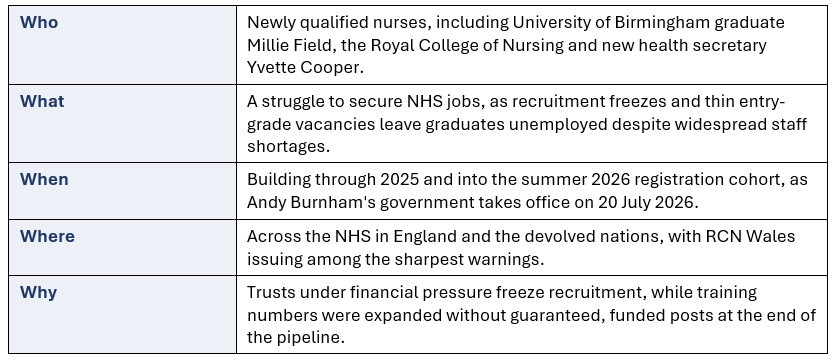
Who, What, When, Where and Why
Key Facts
Five Key Takeaways
- Newly qualified nurses report being unable to find NHS jobs even as wards remain short-staffed and vacancy lists run high.
- Recruitment freezes imposed by cash-strapped trusts have thinned out the entry-grade Band 5 posts that graduates depend on.
- The Royal College of Nursing argues the situation exposes a failure of workforce planning rather than a genuine surplus of nurses.
- Nurses who cannot find work risk leaving the profession or moving abroad, deepening the very shortage the freeze was meant to save money against.
- Health secretary Yvette Cooper inherits a paradox that tests whether the new government can make the NHS both affordable and competently run.
What Happened
Britain trains thousands of nurses each year to plug what officials describe as one of the deepest workforce shortages in the health service. Yet as the summer 2026 cohort prepares to register, a growing number of newly qualified nurses report that they cannot find a job in the National Health Service at all.
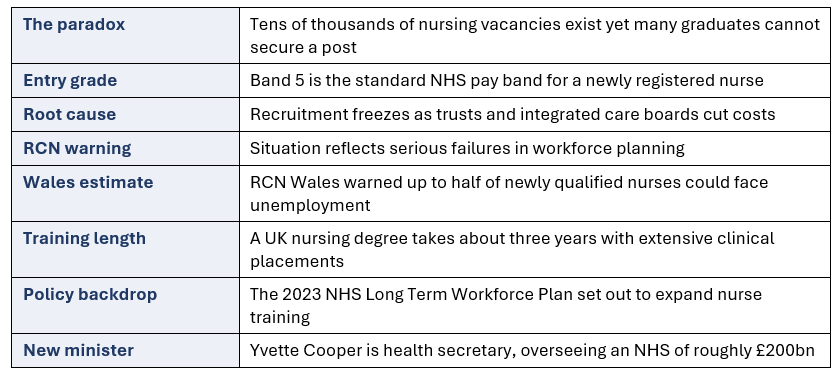
The paradox has become one of the sharpest illustrations of NHS dysfunction. Wards remain short-staffed, patients wait on trolleys in corridors and vacancy lists still run into the tens of thousands, but the entry-level posts that graduates rely on have thinned out. Many trusts have imposed recruitment freezes as they try to balance strained budgets, leaving Band 5 positions, the standard grade for a newly registered nurse, scarce.
Millie Field, a nursing graduate from the University of Birmingham, is among those caught in the squeeze. Like many in her cohort, she completed a demanding three-year degree and thousands of hours of supervised clinical placements, only to find that the health service she trained to join had little room to take her on. Her experience, of applications submitted and vacancies that never materialised, has become emblematic of a wider generational frustration.
The Royal College of Nursing has warned repeatedly that the situation exposes a failure of workforce planning. Its campaigning has carried the blunt slogan "use us or lose us", a reference to the risk that graduates unable to find NHS work will drift into other careers, move abroad or leave nursing altogether, taking their training with them.
The issue now lands on the desk of a new health secretary. Yvette Cooper, moved to the Department of Health and Social Care in Andy Burnham's cabinet after Wes Streeting's departure, inherits a service of roughly £200bn and a contradiction at its heart: an NHS that says it is desperate for nurses while turning newly qualified ones away.
Why It Matters
At first glance, a shortage of first jobs for nurses might look like a temporary mismatch that the labour market will correct. The reality is more troubling, because the losses it creates are not easily reversed.
Training a nurse is expensive and slow. A registered nurse in England typically completes a three-year degree combining academic study with extensive clinical placements. When a graduate cannot secure a post within months of qualifying, the public investment in that training risks being wasted, and the individual's hard-won clinical confidence can fade before it is ever used on a ward.
There is also a retention dimension. Nurses who cannot find NHS work do not simply wait. Some take jobs in social care, retail or unrelated sectors; others emigrate to systems in Australia, Canada or the Gulf that actively recruit British-trained staff. Once they have gone, luring them back is difficult and costly.
The freeze sits awkwardly beside the government's own stated ambitions. The NHS Long Term Workforce Plan, published in 2023, set out to expand nurse training substantially, on the premise that the service faced a structural shortfall that would worsen without action. Turning away the very graduates that plan helped to produce undermines its logic and corrodes trust among students weighing whether nursing is a secure career.
For patients, the consequences are indirect but real. Short-staffed wards are associated with worse outcomes, longer waits and greater pressure on the nurses who remain, feeding a cycle of burnout and further departures. A freeze that keeps qualified nurses out of work while wards run hot is, in effect, a false economy dressed up as a saving.
Politically, the timing is difficult. Burnham has built his early premiership around the cost of living and public-service reform, and the NHS is the most visible test of both. A story about trained nurses unable to work while patients wait cuts directly against the promise of a health service that is both compassionate and competently run. For Cooper, it is an early signal that the department's problems are not only about money, but about how that money is planned and spent.
Detailed Analysis
To understand how a service short of nurses can freeze the hiring of new ones, it helps to separate three things: how the finances force the freeze, why "shortage" and "no vacancies" are not contradictions, and what the human cost looks like for graduates like Millie Field.
Why a shortage and a hiring freeze coexist
The apparent contradiction dissolves once the difference between clinical need and budgeted posts is understood. A vacancy in NHS statistics is a funded position that an employer is trying to fill. Clinical need is the number of nurses a ward actually requires to be safe. The two are not the same, and the gap between them is where the paradox lives.
When trusts and integrated care boards, the bodies that plan and pay for local NHS services, are ordered to cut costs, one of the fastest levers is to freeze or delay recruitment into vacant posts, or to leave them unfilled rather than remove them formally. A ward can therefore be dangerously understaffed against clinical need while advertising few vacancies, because the budget will not stretch to fill them.
Newly qualified nurses feel this most acutely because they depend on entry-grade Band 5 posts, the very jobs most exposed when employers trim. Experienced nurses can hold existing roles; graduates need new ones to be created or backfilled. When the pipeline of Band 5 openings narrows, the newest registrants are first to be shut out.
The squeeze has been compounded by pressure on so-called bank shifts, the flexible, ad hoc work that nurses often use to bridge gaps between contracts. Reports of reduced bank pay and tighter limits on bank hours have removed a fallback that graduates once used to gain experience and income while hunting for a permanent role.
A failure of workforce planning
The RCN's central charge is that this is not bad luck but poor planning. Professor Sandy Harding of RCN Wales described the situation facing newly registered nurses as "deeply concerning" and one that "exposes serious failures in workforce planning". In Wales, the college has warned that up to half of newly qualified nurses could face unemployment when recruitment opens, a figure that would be startling in any system, let alone one describing itself as short-staffed.
The problem is a disconnect between the two ends of the pipeline. Training places were expanded on the assumption that demand would be funded, but the money to employ the resulting graduates was never guaranteed in the same breath. Universities recruited and taught students against a promise of need that the employing side of the NHS has not been resourced to honour.
That mismatch reflects a deeper structural issue. Nurse training is planned nationally and years in advance, while hiring decisions are made locally and annually, hostage to each employer's in-year financial position. When budgets tighten, the local decision to pause recruitment overrides the national ambition to grow the workforce, and no single body is accountable for reconciling the two.
The result is waste on both sides of the ledger. Public money spent training nurses yields no return if those nurses cannot be employed, and the shortage the training was meant to solve persists regardless. Critics argue that until workforce planning ties training numbers to funded, guaranteed posts, the cycle will keep repeating with each graduating cohort.
The human cost and the case of Millie Field
Behind the statistics are individuals who spent years preparing for a vocation and now question whether it wants them. Millie Field's account, of a University of Birmingham degree completed and applications that led nowhere, captures a frustration shared across the 2026 cohort.
For graduates in this position, the costs are practical as well as emotional. Many carry student debt and expected a salaried Band 5 post to begin repaying it and to start their careers. Instead they face uncertainty, agency work of variable reliability, or the prospect of moving away from the regions where they trained and hoped to serve.
There is a confidence cost too. Newly registered nurses are at their most vulnerable in their first year, when supervised experience turns academic knowledge into safe practice. A prolonged gap after qualifying can erode skills and self-belief, making the eventual return to a ward harder for both the nurse and the employer.
The reputational damage extends beyond any one graduate. Prospective students, and the schoolchildren the NHS hopes will one day consider nursing, hear that even qualified nurses cannot get jobs. That message, more than any recruitment campaign, shapes whether the next generation views nursing as a secure and respected career, or a precarious one to be avoided.
What Happens Next
The immediate question is how the new government responds. Yvette Cooper arrives at the Department of Health and Social Care with a reputation for grip rather than grand vision, and the nurse-jobs paradox is the kind of administrative failure that rewards attention to detail over rhetoric.
In the short term, the RCN and others are pressing for practical fixes: guaranteed first posts for newly qualified nurses, an end to blanket recruitment freezes on entry-grade roles, and clearer data on how many graduates are actually out of work. A parliamentary petition and a sustained "use us or lose us" campaign have kept the issue visible.
A more durable answer requires reform of workforce planning itself. That means tying the number of training places funded each year to a realistic, funded projection of the posts employers will actually be able to offer, so that supply and demand are planned together rather than in separate silos.
The NHS Long Term Workforce Plan, already due for a refresh, is the obvious vehicle. Ministers will face pressure to update it so that it accounts not only for how many nurses to train, but for how their employment will be guaranteed and paid for once they qualify.
Money is the binding constraint. Burnham has signalled he will use flexibility within the fiscal rules to support investment, but the health budget must stretch across waiting lists, social care and pay as well as recruitment. Whether entry-grade nursing posts are prioritised will reveal how the new government weighs long-term workforce stability against immediate financial pressure.
There are also devolved dimensions. Health is run separately in Wales, Scotland and Northern Ireland, so solutions in England will not automatically travel, and the sharpest warnings so far have come from RCN Wales. A UK-wide problem may require four different fixes. For graduates entering the labour market this autumn, though, the calendar is unforgiving. The measure that matters to them is simple: whether the posts they trained for exist when they qualify.
Conclusion
The spectacle of newly qualified nurses unable to find work in a health service that says it is desperate for them is among the clearest examples of a system whose planning and financing have fallen out of step.
It is a solvable problem, and that is what makes it so frustrating. The nurses exist, the need exists and the training investment has already been made. What is missing is the funded, guaranteed post at the end of the pipeline, and the joined-up planning that would make sure it is there.
For individuals like Millie Field, the stakes are personal: a vocation prepared for over years that now hangs on whether an employer can afford to say yes. For the NHS, the stakes are cumulative, because every graduate lost to another sector or another country is a shortage deepened rather than eased.
For Yvette Cooper and the Burnham government, the episode is an early test of competence in the department that voters watch most closely. Fixing it will not require a landmark reform or a large cheque so much as the unglamorous work of aligning training, budgets and hiring so they point the same way.
Until that alignment is achieved, each summer will bring another cohort of qualified nurses knocking on doors that a short-term saving has quietly closed. Whether the new government can reopen them will say a good deal about its wider promise to make the state work better.


 Oct 06, 2026





 Please wait processing your request...