
 CA
 NZ
 US
 AU
 IND

 UK

 Share
 X (Formerly Twitter)
 Whatsapp
 Facebook
 LinkedIn
 Telegram
 Email This Article
 Copy Link
 Summarize with AI
 Chat GPT
 Perplexity

Summary
As Andy Burnham became UK prime minister on 20 July 2026, the Financial Times commentator Martin Wolf set out what he called the first rule of government: there is no free fiscal lunch, only hard choices. The idea is that all public spending must be funded by taxes, borrowing or cuts elsewhere. Burnham's promise to use any flexibility within the fiscal rules is not the same as having spare money, since borrowing still has to be financed and satisfy investors. The first live test is a near-£5bn gap in the inherited defence spending plan, which pits military spending against the NHS and cost-of-living relief. The IMF has said Burnham cannot afford to boost public spending and that energy support should stay targeted, temporary and budget-neutral, while gilts are under pressure. The spending trap is the temptation to treat flexibility as free money and spend ahead of a credible plan to pay.
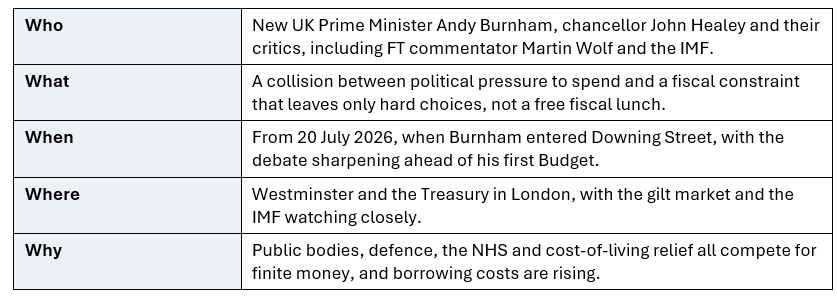
Who, What, When, Where and Why
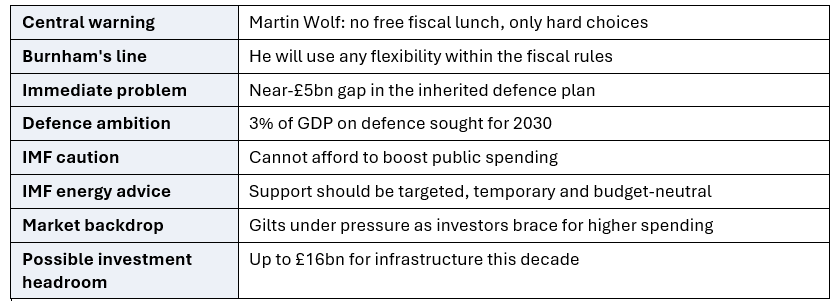
Key Facts
Five Key Takeaways
- The central idea is simple but unforgiving: there is no free fiscal lunch, so every new commitment has to be paid for by tax, borrowing or a cut elsewhere.
- Burnham's promise to use any flexibility within the fiscal rules is not the same as having spare cash; flexibility still has to be financed.
- The near-£5bn defence gap is the first live test of that constraint, pitting military spending against the NHS and cost-of-living relief.
- The IMF has said Burnham cannot afford to boost public spending and that energy support should stay targeted, temporary and budget-neutral.
- With gilts under pressure, the bond market can enforce discipline faster and more brutally than any political opponent.
What Happened
Andy Burnham entered Downing Street on 20 July 2026 promising change, and immediately ran into the oldest constraint in government. Within days, the Financial Times commentator Martin Wolf set out what he called the first rule of government: the biggest mistake a new administration can make is to imagine there is a free fiscal lunch. In reality, he argued, there are only hard choices.
The phrase is deliberately plain. A free fiscal lunch would mean money that could be spent without anyone having to pay for it. Wolf's point is that no such money exists. Every extra pound the state commits comes from higher taxes, more borrowing, or a cut to something else. The politics of spending can obscure that arithmetic, but it cannot repeal it.
Burnham has not claimed otherwise. His public position is that he will use any flexibility within the fiscal rules to support investment. That is a carefully chosen formula. It stops short of promising a spending free-for-all, yet signals to his party and the country that he intends to find room to act where the previous government would not.
The trouble is that flexibility is not the same as free money. The fiscal rules are self-imposed limits on how much the government borrows and for what, and any headroom within them still has to be financed. Analysts suggest Burnham could mobilise an extra £16bn for infrastructure over the rest of the decade, but even that would be borrowed, not conjured, and would still have to satisfy investors.
So the opening act of the Burnham government is a quiet argument about a hard truth. On one side is the political temptation to spend, sharpened by years of squeezed services, an energy-price shock from the US-led conflict with Iran, and a cost-of-living promise at the heart of his pitch. On the other is a fiscal constraint that the bond market, the IMF and commentators like Wolf are determined to enforce.
Why It Matters
The idea of a free fiscal lunch matters because believing in it is how governments get into trouble. A new administration that assumes it can spend without a corresponding cost tends to over-promise, under-fund, and then discover the gap only when the money runs short or the markets object. Wolf's warning is, in effect, a plea to start from the constraint rather than the wish.
For Burnham, the constraint is immediate. His government inherits a near-£5bn gap in the previous administration's defence spending plan. That is not an abstract figure but a live decision: the money must be found, or the defence ambition trimmed, or something else in the budget must give. It is the first hard choice, and it lands in his opening weeks.
The choice is unforgiving because the alternatives all cost something. Borrowing the money would add to pressure already visible in the gilt market. Raising taxes would collide with a cost-of-living message built on easing the squeeze on households. Cutting elsewhere would mean less for the roughly £200bn National Health Service or the very relief Burnham has promised.
This is what economists mean by opportunity cost, and it is the heart of the no-free-lunch idea. A pound spent on one priority is a pound not available for another. In a tight fiscal position, the government is choosing not between good and bad options but between competing goods, each with a genuine claim behind it.
It matters, too, because the referees are external. The International Monetary Fund has said Burnham cannot afford to boost public spending, and that any response to the energy shock should remain targeted, temporary and budget-neutral. The gilt market, where the government sells its debt, has been under pressure as investors brace for higher spending.
Finally, it matters for the character of the government. Burnham was elected leader uncontested and faces no requirement to hold a general election until 2029, giving him room to take difficult decisions early. But that also removes any excuse: with time and a majority, the constraint he faces is not political weakness but fiscal reality, and how he handles it will define what kind of prime minister he is.
Detailed Analysis
To see why the spending trap is so dangerous, it helps to take the idea apart. Three things are worth examining: what no free fiscal lunch actually means in practice, how the near-£5bn defence gap turns that abstraction into a concrete decision, and why the political temptation to spend runs so directly into the fiscal constraint around it.
What a free fiscal lunch really means
The phrase borrows from an older economists' saying that there is no such thing as a free lunch. Applied to public finance, it means government spending is never costless. Whatever the state hands out on one side of the ledger, it must raise on the other, through taxation now, borrowing that becomes taxation later, or a cut to some other form of spending.
This is easy to lose sight of because costs and benefits are often separated in time. The benefit of a new programme is immediate and popular; the cost may be deferred through borrowing, spread thinly across taxpayers, or hidden in a service quietly starved of funds. Wolf's rule is a reminder that the cost has not vanished just because it is harder to see.
Borrowing does not escape the rule; it reschedules it. When a government borrows, it sells gilts, pays interest on them and eventually repays them. If investors doubt the plan, they demand a higher return, pushing up borrowing costs across the economy, from the state's own interest bill to household mortgage rates. Debt is a way of paying later, usually with interest, not a way of avoiding payment.
There is a narrow exception: investment that genuinely pays for itself. Borrowing to build infrastructure that raises the economy's productive capacity can, over time, generate the growth and tax revenue to cover its cost. This is the logic behind Burnham's talk of using flexibility for investment, and the estimated £16bn of possible infrastructure spending. But the exception is demanding: the investment has to work, and the market has to believe it will.
The near-£5bn defence gap as a live test
Nothing illustrates the no-free-lunch rule more sharply than defence. The previous government lifted the defence budget towards 2.5 per cent of GDP by 2027, and John Healey, then defence secretary and now chancellor, pushed for a firm date to reach 3 per cent by 2030. But the plan he inherited to fund it contains a near-£5bn gap, now the Treasury's problem.
The paradox is pointed. The minister who resigned last month partly over defence funding must now decide how the whole budget adds up. As chancellor, Healey cannot simply grant his old department the money it wants; he has to weigh it against every rival claim. The champion of higher defence spending has become the guardian of the total, which is exactly the discipline the no-free-lunch rule imposes.
The wider context makes the choice harder still. The US-led conflict with Iran has raised the salience of defence at the very moment it has driven up energy prices, squeezed households and pushed some mortgage rates higher. Spending more on defence is easy to justify in principle; finding the money without adding to those pressures is the difficulty.
Every route out of the gap has a price tag. Borrowing the £5bn risks unsettling a gilt market already on edge. Raising taxes to cover it would strain the cost-of-living promise. Cutting elsewhere means confronting the NHS, welfare or other services with their own shortfalls. No option avoids a cost; there is only a choice about who bears it, which is precisely Wolf's point.
The temptation to spend and the constraint that resists it
The political incentives all pull towards spending. Burnham built his reputation as a campaigner and won power on a promise of change, cost-of-living relief and reduced regional inequality. After years of austerity, the demand for the state to do more is real and widely felt. Saying yes is popular; saying no is the harder, lonelier task the job now requires.
Against that pull stands a fiscal constraint with several enforcers. The IMF has been explicit that Burnham cannot afford to boost public spending, and that support to cushion the energy shock should be targeted, temporary and budget-neutral, meaning aimed at those who need it, wound down when the shock passes, and paid for rather than added to the deficit. It is a precise instruction, and a warning against open-ended commitments.
The gilt market is the more immediate discipline. Investors have pushed UK bonds lower as they brace for higher spending, and when they sell, the government's borrowing costs rise. That feedback loop moves faster than any Budget cycle: a plan the market distrusts is punished in days, not years. It is why Burnham's careful phrase about flexibility within the rules matters; the rules are partly a signal to investors that the arithmetic will hold.
Commentators have urged the same realism. Camilla Cavendish has argued that hope is not enough to govern, and Mohamed El-Erian has warned that policy must go beyond announcements and budget arithmetic to command lasting confidence. The common thread is that credibility is earned through choices, not slogans, and a government that pretends the constraint away will be found out.
The deeper risk is a slow one. A government that spends first and finds the money later can drift into a position where debt-interest costs crowd out the services it wanted to protect, and where each Budget starts from a worse baseline than the last. The spending trap is not a single dramatic mistake but the accumulation of small evasions of the no-free-lunch rule, until the choices become far harder than they needed to be.
What Happens Next
The first real test will be a fiscal event. A new chancellor usually wants an early Budget or statement to set out his approach, complete with independent forecasts from the Office for Budget Responsibility. That is where Burnham's promise to use flexibility within the fiscal rules will meet hard numbers, and where the defence gap and the cost-of-living pledge will have to be reconciled.
The defence decision will not wait for a tidy moment. Healey must choose how to close the near-£5bn shortfall while honouring the government's other commitments, and his own past demand for 3 per cent of GDP by 2030 will be quoted back to him. How he squares that with the wider budget will show whether the government has accepted the constraint or is still hoping to spend around it.
The gilt market will deliver a running verdict. Every signal about borrowing and spending will be priced within hours, and the government's room for manoeuvre will expand or contract with investor confidence. A credible, funded plan can buy space to invest; a plan that looks like a free lunch can see that space taken away, with higher borrowing costs feeding into mortgages and the wider economy. The IMF, meanwhile, will watch whether energy support stays targeted, temporary and budget-neutral rather than becoming a permanent subsidy.
Watch, above all, for how Burnham and Healey talk about trade-offs. A government that has internalised the no-free-lunch rule will explain its choices in terms of what it gives up as well as what it gives. A government still tempted by the free lunch will announce the benefits and stay quiet about the cost, and the gap between the two styles will tell voters and investors a great deal.
Conclusion
Burnham's premiership begins with a promise of change and a constraint that does not care about promises. Martin Wolf's first rule of government, that there is no free fiscal lunch, is not a partisan point but an accounting one: whatever the state spends, it must raise, and the only question is who pays and when.
The near-£5bn defence gap makes the abstraction concrete. It cannot be filled without borrowing that unsettles markets, taxes that strain the cost-of-living message, or cuts that fall on services already under pressure. It is the first of many such choices, and how the government handles it will set the pattern.
The temptation to spend is genuine and, after years of squeezed services, understandable. But the enforcers of the constraint, the IMF, the gilt market and the arithmetic itself, are unsentimental. Ignoring them does not remove the cost; it defers and enlarges it.
The spending trap, then, is not that Burnham wants to invest. It is the danger that his government mistakes flexibility for free money, spends ahead of a credible plan to pay, and finds its choices narrowing until the hard decisions it postponed return, larger and less forgiving. Avoiding it means governing by the first rule from the start: there is no free fiscal lunch, only hard choices honestly made.


 Oct 06, 2026





 Please wait processing your request...