
 CA
 NZ
 US
 AU
 IND

 UK

 Share
 X (Formerly Twitter)
 Whatsapp
 Facebook
 LinkedIn
 Telegram
 Email This Article
 Copy Link
 Summarize with AI
 Chat GPT
 Perplexity

Summary
Prime Minister Andy Burnham, who took office on 20 July 2026, is maintaining Labour's ban on new licences for oil and gas exploration in the North Sea, continuing a policy advanced by Ed Miliband, now Foreign Secretary. The ban applies to new exploration only; existing fields continue to produce. It flows from a manifesto commitment and Labour's goal of near-full electricity decarbonisation by 2030. The industry body Offshore Energies UK criticises the policy, warning it threatens jobs, deters investment, cuts tax revenue and increases reliance on imported liquefied natural gas. The Unite union runs a No ban without a plan campaign, accepting the climate direction but demanding a funded just transition before drilling stops. An ongoing US-led conflict with Iran has caused an energy-price shock, sharpening the energy-security argument. Supporters counter that oil and gas sell at global prices, so new fields would not lower bills, and that the North Sea is a declining basin. The real test is whether Burnham delivers a credible transition plan for affected workers, particularly around Aberdeen and north-east Scotland.
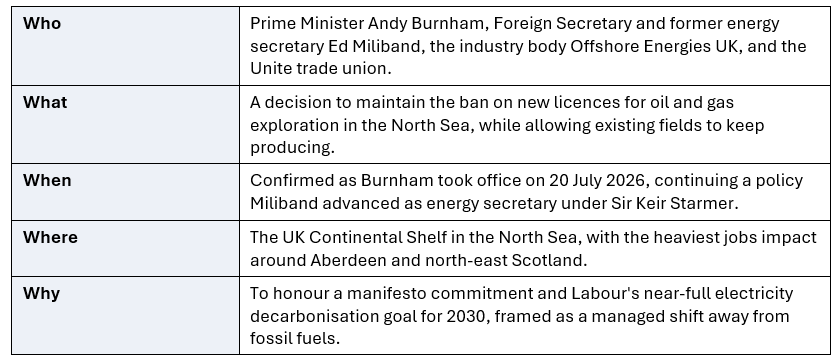
Who, What, When, Where and Why
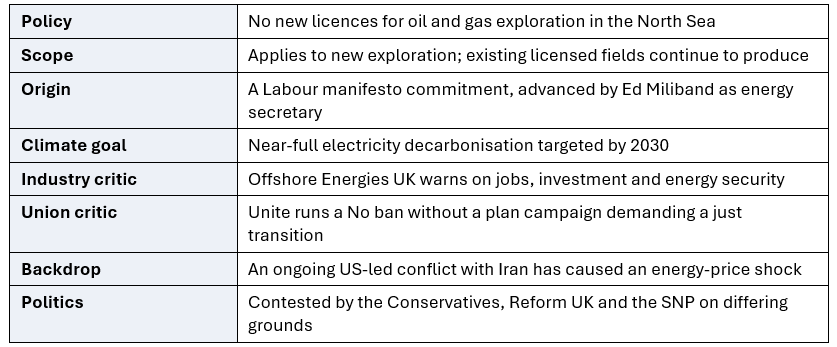
Key Facts
Five Key Takeaways
- Burnham is keeping the ban on new North Sea exploration licences, aligning with Ed Miliband rather than softening the policy under pressure.
- The ban covers new exploration only; fields already licensed continue to produce, so this is a decision about the basin's future, not an immediate shutdown.
- Offshore Energies UK argues the policy risks jobs, investment and tax revenue and leaves Britain more reliant on imported gas.
- The Unite union's No ban without a plan campaign frames the fight as one about a guaranteed just transition, not climate denial.
- The Iran-war energy shock has sharpened the energy-security argument, making the timing politically harder for the new government.
What Happened
Andy Burnham entered Downing Street on 20 July 2026 with a long list of contested inheritances, and one of the first he chose not to disturb was energy policy. His government confirmed that it will maintain the ban on new licences for oil and gas exploration in the North Sea, a policy Ed Miliband advanced as energy secretary under Sir Keir Starmer.
The decision matters partly because of who now sits where. Miliband has moved from energy to the Foreign Office, and many had expected a new PM to use the reshuffle to recalibrate a divisive policy. Instead, Burnham has kept the line, signalling that Labour's climate commitments survive the change of leadership largely intact.
It is important to be precise about what the ban does and does not do. It stops the government issuing new licences to explore for oil and gas in previously unlicensed parts of the UK Continental Shelf. It does not shut down existing fields, which continue to pump under licences already granted, nor does it halt production overnight.
The policy flows from a Labour manifesto commitment and sits alongside the party's goal of near-full electricity decarbonisation by 2030. Ministers cast it as part of a managed shift away from fossil fuels, paired with investment in offshore wind, grid upgrades and the publicly owned Great British Energy.
The response from the sector was swift and critical. Offshore Energies UK, the industry body, has repeatedly warned that closing the basin to new exploration threatens jobs, deters investment and leaves Britain more dependent on imported gas. It argues that domestic production is cleaner than shipped-in liquefied natural gas.
Criticism has also come from organised labour. The Unite union, whose members include offshore and supply-chain workers, runs a campaign under the slogan No ban without a plan, arguing that a credible, funded route to alternative jobs must come before, not after, the door closes on new drilling.
Why It Matters
Few policies capture the central tension of Burnham's premiership as neatly as this one. He took office promising to reduce regional inequality and govern for every part of the United Kingdom, yet the community most exposed to the North Sea decision is one Labour has struggled to win over: the oil-and-gas workforce of north-east Scotland.
The energy-security argument has rarely felt more live. An ongoing US-led conflict with Iran has triggered an energy-price shock, pushing up wholesale costs, feeding into mortgage rates and reminding voters how exposed Britain remains to global supply swings. Critics of the ban seize on that backdrop to argue that turning away domestic reserves is reckless timing.
Supporters of the policy counter that energy security and new exploration are not the same thing. Oil and gas are sold on global markets, so barrels pumped from a new British field would fetch the world price rather than lowering domestic bills. On this view, real security comes from cutting demand and building home-grown renewables, not from chasing a declining basin.
There is also a hard geological fact underneath the politics. The North Sea is a mature province whose output has been falling for two decades, and industry analysts expect production to keep declining regardless of licensing policy. The argument is therefore less about reversing decline than about how fast it happens and who bears the cost.
For the Treasury, the stakes are fiscal as well as environmental. Oil and gas generate tax revenue, and a shrinking sector means less of it, at a moment when Chancellor John Healey is grappling with a near-£5bn gap in defence plans and nervous gilt markets. Every strand of energy policy now competes with acute spending pressures.
The decision is a test of whether Burnham can hold a climate line while answering the jobs question honestly. The union critique is pointed precisely because it is not a demand to keep drilling forever; it is a demand for a plan. If the government cannot show workers a credible path to new employment, the ban becomes a symbol of decline rather than transition.
Detailed Analysis
Underneath a binary headline sits a genuinely difficult trade-off. The case for the ban and the case against it both contain real arguments, and the strength of the policy depends less on the slogan than on what the government does around it. Three threads are worth separating out.
The climate case for holding the line
The intellectual core of the ban is straightforward. If Britain is serious about reaching net zero, the logic runs, it cannot keep opening new fossil-fuel frontiers whose reserves would be burned over decades that must instead see emissions fall sharply. Licensing new exploration sends the opposite signal to investors and to the public.
Miliband's wider agenda gives the policy its context. He pursued near-full electricity decarbonisation by 2030, backed a rapid build-out of offshore wind, and created Great British Energy to channel public investment into clean power. Within that framework, closing the door on new drilling is a matter of consistency rather than a standalone gesture.
Advocates also stress that most emissions come from burning oil and gas, not from extracting it, so adding domestic supply does little to cut the carbon released when the fuel is used. Because the product sells at global prices, new North Sea barrels would not meaningfully lower what British households pay at the pump or on their heating bills.
There is a credibility argument too. Having promised the ban in its manifesto, Labour would invite charges of weakness and inconsistency if it reversed course under the first burst of industry lobbying. For a government keen to project steadiness to markets and voters alike, keeping a stated commitment has value in itself.
The industry and union case against
The objections are not identical, and it is worth distinguishing them. Offshore Energies UK speaks for companies and makes an investment-and-security argument: shut the basin to new exploration and capital, skills and supply chains drift abroad, leaving Britain to import more of the gas it will still burn during the transition.
The imported-gas point carries weight. Liquefied natural gas shipped from overseas typically has a higher production and transport carbon footprint than gas piped from the North Sea, so a ban that raises imports could, on some measures, mean higher global emissions even as domestic output falls. Critics call that outcome self-defeating.
Unite's critique comes from a different direction. As a union, its concern is the workforce, and its No ban without a plan campaign frames the issue as one of sequencing and fairness. Its complaint is not that the climate goal is wrong, but that ministers risk repeating the mistakes of past industrial closures by removing work before replacement jobs exist.
That places the government in an awkward political spot. It cannot easily dismiss Unite as a climate sceptic, because the union accepts the direction of travel. The demand is for guaranteed retraining, investment in ports and manufacturing, and a timetable that matches new green jobs to the offshore roles being wound down. Meeting it costs money the Treasury is short of.
The geographic concentration sharpens all of this. The jobs at issue cluster around Aberdeen and north-east Scotland, where the industry has anchored the local economy for half a century. A poorly managed decline there would land hardest on exactly the kind of community Burnham has promised not to leave behind.
Burnham's balancing act and the politics
For Burnham, the decision is as much about coalition management as about carbon. He owes his position to a Labour movement that includes both climate campaigners who see the ban as non-negotiable and unions like Unite whose members feel the sharp end of it. Holding those groups together is a recurring theme of his early premiership.
Keeping Miliband's policy while moving him to the Foreign Office is a telling compromise. Burnham retains the substance of the climate agenda but shifts its most polarising advocate away from the energy brief, giving himself room to present the transition in his own, more consensual language of jobs and regional renewal.
The opposition parties are circling from different angles. The Conservatives under Kemi Badenoch, who has attacked Miliband for making Britain poorer, cast the ban as ideological self-harm during an energy shock. Reform UK goes further, courting industrial and working-class voters with a straightforwardly pro-drilling message.
The SNP faces its own bind. It must defend Scottish oil-and-gas jobs while professing strong climate ambitions, a tension that gives Labour some cover but also a rival bidding for the same north-east votes. The politics of the North Sea are unusually crowded, and no party occupies the ground comfortably.
The honest reading is that the licensing decision is the easy half. The hard half is the transition plan that must accompany it: the funding, the timetable and the concrete projects that would turn a ban into a bridge. Whether Burnham delivers that, rather than whether he holds the line on licences, is what will ultimately decide if the policy is judged a success.
What Happens Next
The first thing to watch is the transition plan. The government's credibility with unions and workers rests on translating the ban into a funded, sequenced route to alternative employment, with detail on ports, manufacturing, carbon capture and offshore wind supply chains. Expect Unite to keep pressing the No ban without a plan message until that detail arrives.
The autumn Budget will be the moment of truth. Any serious just-transition programme needs money, and Chancellor John Healey must weigh it against the defence gap, cost-of-living support and the IMF's caution that Britain's response to the energy shock should stay targeted, temporary and budget-neutral. Ambition will meet arithmetic there.
Existing projects remain a live flashpoint. Because the ban covers new exploration rather than already licensed fields, decisions on developments that predate it, and any that reach the courts on environmental grounds, will test how absolute the policy really is in practice. Each case will be read as a signal of intent.
The energy-security debate will not fade while the Iran war continues. If wholesale prices stay high and bills climb, pressure to soften the stance will grow, and the government will have to keep making the argument that new domestic barrels would not have cushioned the shock in any case.
Scotland is the political weather-vane. With north-east jobs at stake and the SNP, Conservatives and Reform all bidding for those voters, Labour's handling of the transition will shape its standing there. Burnham's promise to govern for every part of the country will be measured against how Aberdeen fares.
Finally, watch the language. Burnham is likely to reframe the policy away from Miliband's decarbonisation framing towards jobs, investment and regional renewal, presenting the ban as one part of a positive industrial offer rather than a prohibition. Whether that reframing convinces the workers most affected is the open question.
Conclusion
Burnham's choice to keep the ban on new North Sea exploration licences is a statement of continuity: Labour's climate commitments have survived a change of prime minister, and Ed Miliband's central policy endures even as he moves departments. For a leader keen to look steady, holding the line has a logic of its own.
But the decision resolves the smaller question and opens the larger one. The climate case for not licensing new fields is coherent, and so is the industry's warning about imports and investment and the union's insistence on a plan before a ban. None of these arguments is a straw man, which is why the politics are so hard.
The verdict rests on the transition, not the prohibition. If Burnham can pair the ban with funded retraining, real projects and a credible timetable, especially in north-east Scotland, he can frame it as a managed shift rather than a managed decline. If he cannot, the policy risks becoming the symbol of loss its critics predict.
For now, the ban stays and the pressure builds. The jobs-versus-climate debate has not been settled by Burnham's decision; it has merely moved to the harder ground of delivery, where slogans give way to budgets, timetables and the lived experience of the communities the policy affects most.


 Oct 06, 2026





 Please wait processing your request...