
 CA
 NZ
 US
 AU
 IND

 UK

 Share
 X (Formerly Twitter)
 Whatsapp
 Facebook
 LinkedIn
 Telegram
 Email This Article
 Copy Link
 Summarize with AI
 Chat GPT
 Perplexity

Summary
Andy Burnham's decision to keep Shabana Mahmood as home secretary when he became prime minister on 20 July 2026 highlighted a shift in British politics: being called 'right-wing' on immigration and crime no longer carries the stigma it once did. Mahmood is a 'Blue Labour' figure — socially conservative on migration and crime, more left-wing on the economy — whose hardline reforms drew rhetorical praise from Reform UK's Nigel Farage. Reform's rise, at times leading national polls, has reshaped incentives for every party and moved the 'Overton window' rightward. Supporters see Labour reconnecting with lost working-class voters; critics warn it concedes ground to the right and risks alienating progressives. With no election required until 2029, whether the realignment endures remains contested.
Who, What, When, Where and Why
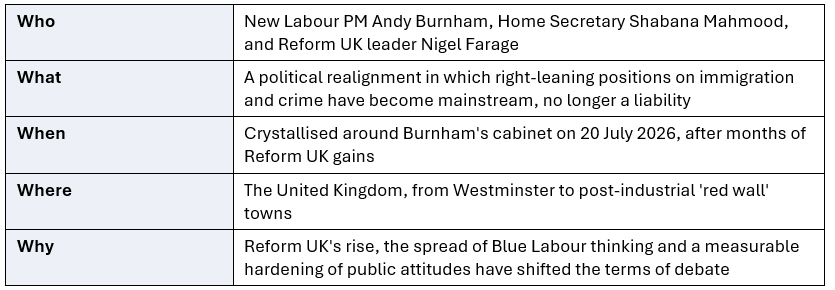
Key Facts

Five Key Takeaways
- Burnham's decision to retain Shabana Mahmood as home secretary signals continuity on a tougher line on migration and crime.
- 'Blue Labour' — socially conservative but economically left — has moved from the margins towards the centre of Labour thinking.
- Reform UK's rise under Nigel Farage has reshaped the incentives facing every established party.
- The 'Overton window' on immigration and crime has shifted, draining the term 'right-wing' of much of its old sting.
- The realignment is contested and may not be permanent; younger voters in particular often lean the other way.
What Happened
When Andy Burnham walked into Downing Street on 20 July 2026 as Britain's 59th prime minister, one of his most closely watched choices was a person he decided not to move. Shabana Mahmood, 45, kept her post as home secretary, the department responsible for policing, borders and immigration.
Mahmood is the first Muslim woman to hold one of the great offices of state. Over the previous year she had become the public face of Labour's most hardline migration policies, pursuing a crackdown that borrowed language and instincts more often associated with the political right.
She is frequently described as a 'Blue Labour' figure. The phrase, linked to the academic and peer Maurice Glasman, describes a strand of the party that is socially conservative on questions such as immigration, crime and national identity, while remaining more left-wing on the economy. It prizes family, place and community over what its advocates see as rootless liberalism.
That combination once sat awkwardly inside a party whose activist base leans progressive. In 2026 it has moved closer to the centre of Labour thinking. Nigel Farage, leader of the insurgent Reform UK, went so far as to say he agreed 'rhetorically' with some of Mahmood's reforms — a remark that would once have been politically radioactive for a Labour minister to attract.
Retaining Mahmood was therefore more than a routine reshuffle decision. It signalled that the new government intends to hold, rather than soften, a firmer line on migration and law and order.
It also crystallised a broader change in British politics: the growing sense that being labelled 'right-wing', especially on immigration and crime, no longer carries the stigma it once did.
Why It Matters
For most of the past three decades, 'right-wing' functioned in mainstream British debate as a term of caution, if not outright insult. Politicians of the centre-left, and even the centre-right, often took pains to avoid it, particularly on immigration, where the charge of harshness could damage careers.
That taboo has weakened. The reasons are partly electoral and partly cultural, and they matter because they shape what any government now feels able to say and do.
The clearest driver is the rise of Reform UK. Under Nigel Farage, the party has moved from the fringes to a central place in the national conversation, at times leading opinion polls and drawing support from voters who once backed both the Conservatives and Labour. Its core offer is a hard line on immigration, including proposals to freeze new arrivals.
Reform's success has changed the incentives for the established parties. Labour strategists fear losing working-class 'red wall' seats to Farage as much as to the Conservatives. That fear pushes the party towards positions, and language, it might once have rejected.
The cultural shift is harder to measure but just as real. Analysts talk about the 'Overton window', the range of ideas considered acceptable in public debate at any given moment. On immigration and crime, that window has moved. Arguments once confined to the right are now aired routinely across the spectrum.
For Burnham, this creates both opportunity and risk. Keeping Mahmood lets him present Labour as serious about control and security, potentially blunting Reform's appeal. But it also risks alienating progressive members and voters who see the direction of travel as a capitulation.
The stakes are high because the next general election is not required until 2029. Burnham has years, not months, to define his government. The choices he makes now about tone and priorities will shape whether Labour fights the next election on its own terms or on ground chosen by its rivals.
Detailed Analysis
The realignment on display in Burnham's cabinet did not happen overnight. It reflects a longer contest over what Labour stands for, how voters have moved, and how the meaning of political labels themselves has changed.
The Blue Labour bet
Blue Labour began as a small intellectual project after the party's 2010 election defeat. Its argument was that Labour had lost touch with socially conservative working-class voters by embracing a liberalism that felt indifferent to community, borders and tradition.
For years the tendency was marginal, tolerated more than embraced. Mahmood's prominence marks how far it has travelled. As justice secretary and then home secretary, she pursued policies designed to signal control: faster removals, tighter rules and firm rhetoric on those who break the law.
Supporters argue this is not a betrayal of Labour values but a recovery of them. They point out that many of the party's traditional voters, in post-industrial towns and diverse city neighbourhoods alike, hold socially conservative views and want secure borders and safe streets. On this reading, a party that ignores those concerns abandons the very people it was founded to represent.
Critics see something different. They warn that chasing Reform on migration validates the terms of the argument set by the right, and that Labour cannot out-tough a party built around the issue. Some progressive members regard the crackdown as morally troubling and electorally self-defeating, arguing that it depresses turnout among the younger and minority-ethnic voters the party also needs.
The internal argument is now conducted openly rather than behind closed doors. Where Blue Labour ideas were once confined to seminar rooms and pamphlets, they are debated on the front bench and across the press. Glasman's own elevation to the House of Lords gave the tendency a foothold, and Mahmood's record has given it a working example inside government.
Mahmood herself has rejected the choice as a false one, insisting after a difficult by-election that Labour must not become 'more Green or more Reform' but should hold its own course.
The Farage effect
Reform UK is the gravitational force reshaping this debate. Its rise has been the most consequential development in British party politics since the 2024 general election.
Polling through 2025 and into 2026 repeatedly showed Reform level with or ahead of Labour — an unusual position for a party with only a handful of MPs. Its appeal rests on a simple, insistent message about immigration and a broader claim that the mainstream has failed ordinary people.
Farage's remark that he agrees 'rhetorically' with some of Mahmood's reforms was double-edged. For Reform, it was a way of claiming credit and casting Labour as imitators. For the government, being praised by Farage is politically awkward, inviting attack from the left while doing little to win over Reform's committed supporters.
This is the central dilemma the established parties face. Move towards Reform's positions and you risk legitimising the party while failing to satisfy voters who prefer the original. Hold firm and you risk ceding ground to a rival that has set the terms of debate.
The Conservatives, under Kemi Badenoch, face the same squeeze from the other side, competing with Reform for the right-of-centre vote. That two-front pressure helps explain why the vocabulary of the right has spread so widely, and why 'right-wing' has lost much of its power to wound.
There is also a semantic dimension. When a position is held across Labour, the Conservatives and Reform alike, calling it 'right-wing' no longer marks it as extreme or fringe. The label describes a broad coalition, and an insult that everyone shares gradually stops functioning as an insult at all.
The shifting centre of gravity
Underlying these party manoeuvres is a deeper movement in public opinion and elite debate. On immigration and crime, the centre of gravity has shifted, and with it the boundaries of acceptable argument.
Several forces are at work. Sustained high levels of net migration, pressure on housing and public services, and a run of high-profile security stories have hardened attitudes among parts of the electorate. Economic strain, sharpened by the energy-price shock from the ongoing conflict with Iran, has added to a sense of scarcity that tends to favour tougher positions.
At the same time, the fraying of the old two-party system has fragmented the vote and rewarded parties willing to speak plainly on identity and control. In that environment, the label 'right-wing' describes a large and growing constituency rather than a marginal one.
Commentators disagree about how deep the change runs. Some see a decisive, long-term realignment driven by demography and economics. Others argue that attitudes are more volatile than they appear, moving with the headlines, and that a spell of falling migration or renewed prosperity could soften them again.
None of this means opinion has moved uniformly or permanently. Britain remains divided, and many voters hold liberal views on immigration and diversity. Younger cohorts in particular often lean the other way. Analysts caution that windows can move back as well as forward, and that today's consensus may prove less durable than it looks.
What has changed is the political calculation. For a Labour prime minister to keep a home secretary praised by Nigel Farage, and to treat that as an asset rather than a liability, would have been hard to imagine a decade ago. In 2026 it is simply part of the landscape.
What Happens Next
The immediate test is how Burnham manages the tension inside his own party. By keeping Mahmood, he has chosen continuity on migration and security. Progressive MPs and members who wanted a softer approach will be watching for any sign of movement, and their patience is not unlimited.
Much will depend on delivery. Tough rhetoric on immigration invites scrutiny of results. If arrivals remain high or removals stall, the government risks the worst of both worlds: criticism from the left for its stance and from the right for failing to enforce it. Farage will be quick to exploit any gap between promise and outcome.
The broader question is whether Labour can define the argument or merely follow it. Some in the party want Burnham to reframe the debate around economic security and public services, linking control of borders to jobs, housing and wages rather than fighting on identity alone. That approach, associated with the Blue Labour tradition, aims to win back Reform-leaning voters without adopting Reform's framing wholesale.
Reform, for its part, will keep pressing. The party has signalled ambitions well beyond Westminster, including challenges at devolved elections, and it will continue to treat immigration as its defining issue. Its performance in coming contests will indicate whether its rise is a durable realignment or a protest that fades.
The Conservatives face their own reckoning. Squeezed between Labour's tougher posture and Reform's insurgency, Badenoch's party must decide how far to chase the same ground.
For now, the direction of travel is clear enough. On immigration and crime, the political conversation has moved to terrain once considered the preserve of the right. Whether that proves a lasting shift or a passing phase is a question that will shape the years before the next election.
Conclusion
The retention of Shabana Mahmood as home secretary is a small decision that speaks to a large change. A Labour prime minister has chosen to keep a figure known for hardline migration policies, and to do so as a statement of intent rather than a source of embarrassment.
That would have been difficult in an earlier era, when 'right-wing' served as a warning label that mainstream politicians worked to avoid. The rise of Reform UK, the spread of Blue Labour thinking, and a measurable hardening of public attitudes have together drained much of the term's old sting.
None of this settles the underlying arguments. Supporters see a party reconnecting with voters it had lost; critics see a drift that concedes too much to the right and risks alienating progressives. Both readings capture part of a genuinely contested picture.
What is not in doubt is that the ground has moved. The centre of gravity on immigration and crime sits further right than it did, and the vocabulary of British politics has adjusted accordingly.
For Andy Burnham, the challenge is to turn that shifted landscape into a coherent programme rather than a series of defensive gestures. With no election required until 2029, he has time to try. Whether he can hold his party together while doing so is among the defining questions of his premiership.


 Oct 06, 2026





 Please wait processing your request...