
 AU
AU
 CA
CA
 US
US
 NZ
NZ
 IND
IND

 UK
UK

 Share
Share
 X (Formerly Twitter)
 Whatsapp
 Facebook
 LinkedIn
 Telegram
 Email This Article
 Copy Link
 Summarize with AI
 Chat GPT
 Perplexity
Highlights
- Energy penny stocks remain driven by exploration progress and funding developments.
- Offshore asset activity and licensing updates continue to shape company narratives.
- Capital inflows and loan agreements play a key role in supporting operations.
- Project-level developments influence how these small-cap energy companies are tracked.
- Market attention often follows updates tied to partnerships, drilling, and financing.
In the UK equity market, penny stocks often sit at the intersection of early-stage opportunity and evolving corporate developments. These companies, typically listed on the AIM market, tend to be driven by project updates, funding arrangements, and exploration outcomes rather than established revenue streams. For market participants, the narrative around such stocks is often shaped not just by current performance, but by what lies ahead—whether that is drilling activity, licensing progress, or capital restructuring. Within this landscape, companies such as Westmount Energy and Synergia Energy continue to draw attention as their respective updates provide insight into how operational and financial developments can influence this segment.
Westmount Energy: Exploration Exposure and Portfolio Developments
Westmount Energy Limited (AIM: WTE.L) operates as an investment vehicle with a focus on oil and gas exploration ventures, particularly through its exposure to offshore Guyana assets. The company’s positioning links its performance to developments across key exploration blocks, including the Canje Block, which has been associated with significant deepwater discoveries.
During the reported period, activity across its investee portfolio reflected a combination of strategic partnerships and operational shifts. In the North Falklands Basin, developments around the Sea Lion project contributed to increased activity, including farm-in agreements and consolidation initiatives. Navitas Petroleum’s entry into the PL001 licence as operator marked a change in operational dynamics, while JHI Associates retained a minority working interest under loan-carried terms.
Across Guyana-focused assets, multiple developments shaped the outlook. The Canje Block licence lapsed in March 2026 and remained subject to extension discussions with the Government of Guyana. Meanwhile, activity continued around the Kaieteur and Orinduik blocks, including farm-down processes and ongoing engagement with authorities regarding exploration and appraisal programmes.
The company reported a cash position of £0.224 million alongside listed securities valued at £0.441 million as of December 2025, with no outstanding debt. These figures provide context around its financial standing as it continues to participate in exploration-led investments.
Technical Snapshot
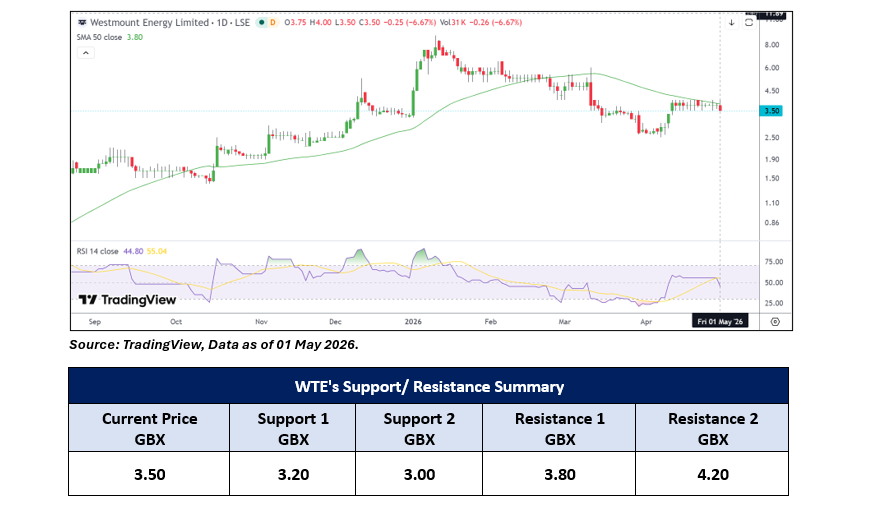
Westmount Energy is trading near 3.50, down 6.67%, and remains below its 50-day SMA around 3.80, indicating a soft near-term structure. Price action shows a mild rebound attempt after a recent decline, but the move is facing pressure near the moving average. The chart reflects a consolidation phase with lower highs forming in the short term. The 14-day RSI near 44.80 is below its signal line, suggesting subdued momentum. Immediate support is seen near 3.20–3.00, while resistance is placed around 3.80–4.20. A sustained move beyond this range could define the next directional bias.
Synergia Energy: Funding Arrangements and Working Capital Focus
Synergia Energy’s recent update centred on a funding arrangement designed to support working capital requirements. The company entered into a loan agreement of up to US$700,000 with Republic Investment Management, structured across two tranches.
The first tranche of US$350,000 became available in April 2026, with the second tranche scheduled for availability no earlier than September 2026, subject to mutual agreement. Both tranches carry an interest rate of 7.5% and are repayable within 12 months from the drawdown date. The loan has been provided on an unsecured basis.
Alongside the loan, Republic Investment Management will receive share options equivalent to the loan principal, with an exercise price set at a 10% premium to the prevailing share price at the time of each drawdown. These options have a term of 12 months and can be exercised to offset the loan principal.
The transaction is categorised as a related party transaction under AIM rules, as Republic holds a 12.4% stake in the company. The board, excluding the related party, assessed the terms of the agreement as fair and reasonable following consultation with its nominated adviser.
Technical Snapshot
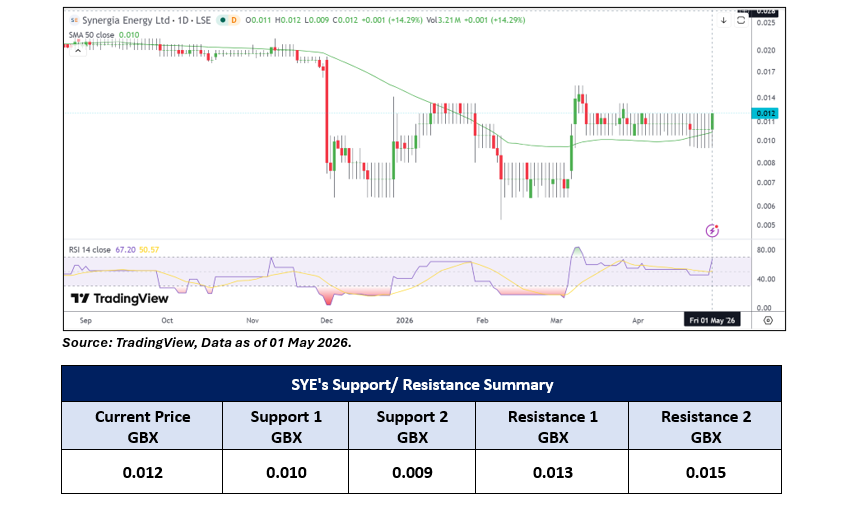
Synergia Energy Ltd is trading near 0.012, up 14.29%, and has moved slightly above its 50-day SMA around 0.010, indicating an improving short-term structure. Price action shows a consolidation phase after a sharp rebound, with the stock attempting to stabilize near recent highs. The move suggests a gradual shift from range-bound behaviour toward a potential upside extension. The 14-day RSI near 67.20 is above its signal line, reflecting firm momentum without being excessively stretched. Immediate support is seen near 0.010–0.009, while resistance is placed around 0.013–0.015. A sustained move higher could extend the current recovery phase.
Understanding UK Penny Stocks: Key Characteristics
Penny stocks in the UK market, particularly those listed on the AIM exchange, often exhibit certain defining features. These companies are typically smaller in size, with share prices trading at lower absolute levels and market capitalisations reflecting early-stage or niche operations.
Operational updates, such as exploration results or funding announcements, tend to have a direct influence on market attention. In many cases, these companies rely on external financing, partnerships, or capital markets activity to support ongoing operations. As a result, announcements related to loans, placements, or joint ventures often become central to their narrative.
Additionally, exposure to sectors such as natural resources, technology development, or emerging industries is common, with company performance linked to project milestones rather than established earnings.
Market Context: Why These Stocks Remain on Watchlists
The appeal of UK penny stocks often lies in their connection to future developments. Exploration companies, for example, may see their trajectory shaped by drilling outcomes or licensing decisions, while others depend on capital inflows to advance projects.
In the case of Westmount Energy, developments across offshore assets and partner-led activities provide ongoing updates that influence its positioning. For Synergia Energy, funding arrangements and working capital management remain central to its operational continuity.
These dynamics contribute to why such companies frequently appear on watchlists, as their updates offer insight into how smaller-cap firms navigate operational progress and financial requirements within the broader market environment.
Conclusion: A Segment Driven by Updates and Developments
UK penny stocks continue to reflect a segment where company-specific developments play a defining role. Whether through exploration progress, strategic partnerships, or funding agreements, updates from companies such as Westmount Energy and Synergia Energy highlight the factors that shape this part of the market.
As these companies move through different stages of their operational and financial cycles, their announcements provide a lens into how early-stage and smaller-cap firms evolve within the UK equity landscape.
FAQs
What are UK penny stocks?
UK penny stocks are shares of smaller companies, often listed on the AIM market, that trade at relatively low prices and are typically associated with early-stage or niche operations.
Why do exploration companies feature in penny stock lists?
Exploration companies are common in this segment because their valuation is often linked to project milestones such as drilling results and resource assessments.
What role do funding announcements play for penny stocks?
Funding announcements, including loans or placements, are important as they provide the capital needed for operations and project development.
Why are updates important for tracking penny stocks?
Updates related to operations, partnerships, or financing often influence how these companies are viewed, making regular announcements a key part of their market narrative.


 Jun 26, 2026




 Please wait processing your request...