
 AU
AU
 CA
CA
 US
US
 NZ
NZ
 IND
IND

 UK
UK

 Share
Share
 X (Formerly Twitter)
 Whatsapp
 Facebook
 LinkedIn
 Telegram
 Email This Article
 Copy Link
 Summarize with AI
 Chat GPT
 Perplexity
Introduction: The Growing Importance of Dividend Investing
Dividend-focused investing continues to be a cornerstone strategy for investors seeking steady income, particularly in periods of economic uncertainty. In 2026, market participants are navigating a complex backdrop shaped by persistent inflation, geopolitical tensions, and relatively slow economic expansion.
The UK equity market has long been recognised for its strong dividend culture. Compared to many global markets, the FTSE 100 offers relatively attractive income opportunities. While the average yield may appear moderate, a number of companies provide significantly higher payouts, drawing attention from income-oriented investors.
However, higher yields are not always synonymous with better investment opportunities. In many cases, elevated yields reflect underlying risks such as declining share prices or pressure on company earnings. Therefore, investors must look beyond headline numbers and assess the sustainability and quality of dividend payments.
Macroeconomic Landscape: Key Drivers of Dividend Sustainability
Interest Rate Environment
Interest rates remain a key influence on dividend investing. With borrowing costs still elevated, investors have viable alternatives in fixed-income instruments, which can reduce the relative appeal of dividend stocks.
At the same time, higher interest rates increase financing costs for companies. This can compress profit margins and limit the cash available for shareholder distributions, potentially putting pressure on dividend payouts.
Economic Growth Outlook
The UK economy is experiencing modest growth, with consumer spending and business investment remaining subdued. Slower economic activity directly affects corporate earnings, which are the foundation of dividend payments.
Companies operating in cyclical sectors may face greater earnings volatility, increasing the likelihood of dividend adjustments during weaker periods.
Inflation Pressures
Inflation continues to play a critical role in shaping investment returns. Even when dividends remain stable, rising prices reduce their real purchasing power.
As a result, investors should prioritise companies that demonstrate the ability to increase dividends over time, ensuring that income keeps pace with inflation.
Geopolitical Risks
Ongoing geopolitical tensions, particularly in energy markets, have introduced additional uncertainty. While higher commodity prices can support earnings for energy companies, they also increase costs for businesses across other sectors, indirectly affecting profitability and dividend capacity.
Currency Impact
Many UK-listed companies generate a substantial portion of their revenues overseas. Currency fluctuations, particularly movements in the British pound, can therefore influence reported earnings and dividend payments. A weaker pound can enhance overseas earnings when converted back to sterling, while a stronger currency may have the opposite effect.
Dividend Investing Fundamentals
What Makes Dividends Attractive?
Dividends provide investors with a tangible and recurring income stream, which can be especially valuable during periods of market volatility. Unlike capital gains, which depend on share price movements, dividends offer a more predictable form of return.
They also serve as a signal of financial strength, as companies that consistently pay dividends are often those with stable cash flows and disciplined capital allocation policies.
Dividend Yield Explained
Dividend yield is a commonly used metric that expresses annual dividend payments as a percentage of the share price. While it provides a quick way to compare income opportunities, it must be interpreted carefully.
A rising yield may not always indicate improved returns—it can also result from a falling share price, which may reflect deteriorating fundamentals.
Dividend Cover Ratio
The dividend cover ratio is a crucial measure of sustainability. It indicates how comfortably a company’s earnings can support its dividend payments.
A ratio above one suggests that earnings are sufficient to cover dividends, while a ratio below one raises concerns about long-term sustainability. Investors should treat low coverage ratios as a warning sign requiring further analysis.
Total Return Approach
Focusing solely on dividend yield can be misleading. A comprehensive investment approach considers total return, which includes both dividend income and capital appreciation.
Stocks offering moderate yields with stable or growing share prices may deliver superior overall returns compared to those with high yields but declining valuations.
Compounding Through Reinvestment
Reinvesting dividends can significantly enhance long-term returns. By using dividend income to purchase additional shares, investors can benefit from compounding, where returns generate further returns over time.
This approach is particularly effective for long-term investors who do not rely on dividends for immediate income.
Top High-Yield UK Dividend Stocks (2026)
The UK market features several companies offering attractive dividend yields across different sectors. These include firms from advertising, housing, financial services, insurance, energy, and consumer goods industries.
While some stocks provide exceptionally high yields, others offer a balance between income and stability. Understanding the underlying business models and financial health of these companies is essential before making investment decisions.
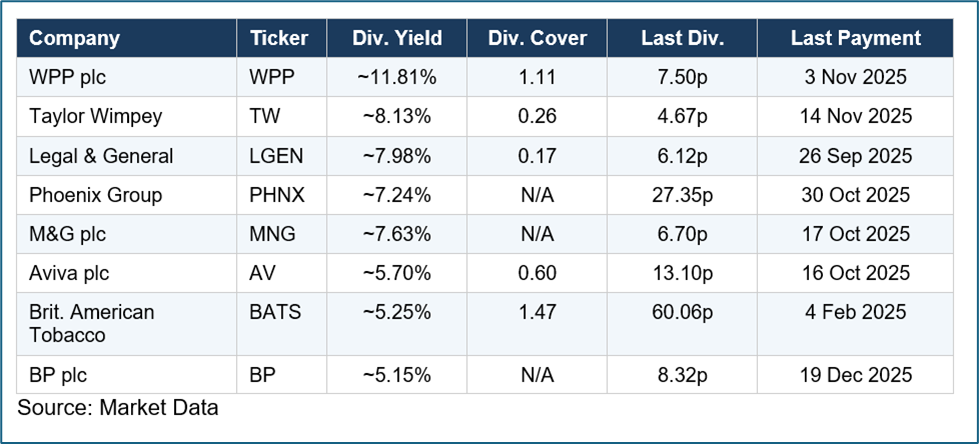
Detailed Stock Analysis
- WPP plc – Ultra-High Yield with Structural Risks
WPP stands out due to its exceptionally high dividend yield. However, this elevated yield is largely a reflection of share price weakness rather than strong underlying performance.
The company operates in a cyclical industry where advertising spending fluctuates with economic conditions. Additionally, structural changes such as digital disruption and evolving marketing trends present ongoing challenges.
Although earnings currently cover the dividend, the margin of safety is limited, making the payout vulnerable to any decline in profitability.
- Taylor Wimpey – Cyclical High-Yield Play
Taylor Wimpey operates in the UK housing sector, which is highly sensitive to interest rates and consumer confidence. The company offers an attractive dividend yield, but its financial metrics raise concerns.
A very low dividend cover ratio suggests that current payouts may not be sustainable without an improvement in earnings. The cyclical nature of the housing market further increases the risk of dividend reductions during downturns.
- Legal & General – Attractive but Risky Yield
Legal & General provides a strong dividend yield supported by its position in the financial services sector. However, its dividend payments exceed reported earnings, indicating potential sustainability issues.
While the company benefits from diversified operations, it remains exposed to market fluctuations and regulatory changes, which could impact future payouts.
- Phoenix Group – Income Through Cash Flows
Phoenix Group’s business model focuses on managing closed insurance portfolios, generating predictable cash flows over time.
This approach supports its dividend payments, but sustainability depends on the company’s ability to maintain cash generation and execute acquisitions effectively. Any disruption to this model could affect future income distributions.
- M&G – Balanced Income Opportunity
M&G combines asset management and insurance operations, offering a diversified income stream. The company has demonstrated resilience and maintains a commitment to shareholder returns.
However, it remains sensitive to market performance and investor flows, which can influence revenue and profitability.
- Aviva – Stability Over Yield
Aviva offers a relatively moderate yield compared to peers but stands out for its stability. Its diversified business model and strategic focus on core markets enhance its ability to sustain dividends.
Investors seeking a balance between income and reliability may find Aviva a more attractive option.
- British American Tobacco – Strong Coverage
British American Tobacco generates substantial cash flows, supporting its dividend payments with a strong coverage ratio.
Despite its financial strength, the company faces long-term challenges from regulatory pressures and changing consumer behaviour. These factors must be considered when evaluating its future prospects.
- BP – Energy-Driven Income
BP’s dividend is closely tied to commodity prices, particularly oil and gas. Elevated energy prices can boost earnings and support dividends in the short term.
However, the inherent volatility of energy markets and the ongoing transition towards cleaner energy sources introduce uncertainty over the long term.
Comparative Insights: Yield vs Risk
A clear relationship exists between dividend yield and risk. Companies offering the highest yields often face the greatest uncertainty regarding sustainability.
Moderate-yield stocks, while less eye-catching, typically provide more stable income streams. Investors should aim to balance yield with reliability when constructing a portfolio.
How to Evaluate Dividend Stocks
A structured approach is essential when assessing dividend opportunities. Investors should:
- Review dividend history for consistency
- Analyse earnings coverage
- Examine free cash flow generation
- Assess balance sheet strength
- Understand industry-specific risks
This comprehensive evaluation helps identify companies with sustainable and reliable dividend profiles.
Dividend Taxation in the UK (2026)
Dividend income is subject to taxation beyond a limited allowance. With recent reductions in the allowance and increases in tax rates, investors face a higher tax burden on dividend income.
Utilising tax-efficient investment vehicles such as ISAs and SIPPs can significantly improve net returns by shielding income from taxation.
Dividend Reinvestment Strategy
Reinvesting dividends is a powerful way to grow wealth over time. By continuously reinvesting income, investors can benefit from compounding, which accelerates portfolio growth.
This strategy is particularly effective for long-term investors who prioritise capital accumulation over immediate income.
Building a Diversified Dividend Portfolio
Diversification is critical to managing risk in a dividend portfolio. Investors should allocate capital across multiple sectors to reduce reliance on any single industry.
Combining high-yield and moderate-yield stocks can provide a balance between income and stability. Additionally, limiting exposure to individual holdings helps protect against unexpected dividend cuts.
Risks in Dividend Investing
Yield Trap
Extremely high yields may indicate underlying issues rather than attractive opportunities. Investors should investigate the reasons behind elevated yields.
Dividend Cuts
Companies can reduce or suspend dividends in response to financial challenges, highlighting the importance of diversification.
Inflation Risk
Rising prices can erode the real value of dividend income, making growth an important consideration.
Capital Loss
Declining share prices can offset income gains, reinforcing the need to focus on total return.
Sector Trends in UK Dividend Market
Certain sectors dominate dividend payments in the UK. Financial services and insurance companies are major contributors, followed by energy firms.
Consumer staples provide stable income streams, while utilities and real estate offer defensive characteristics but may face interest rate sensitivity.
International Comparison
Compared to global markets, the UK offers relatively higher dividend yields. This is largely due to its sector composition, which includes mature, cash-generating industries.
For international investors, UK equities provide an opportunity to access higher income levels, though currency fluctuations must be considered.
Conclusion: Strategy for 2026 and Beyond
Dividend investing remains a compelling strategy in the UK market, but success requires careful stock selection and disciplined portfolio construction.
Rather than chasing the highest yields, investors should focus on sustainability, diversification, and long-term growth potential. Companies with strong fundamentals and consistent cash generation are better positioned to deliver reliable income over time.
A balanced approach that combines income generation with capital preservation will be key to navigating the evolving market landscape in 2026 and beyond.


 Jun 26, 2026




 Please wait processing your request...