
 CA
 NZ
 US
 AU
 IND

 UK

 Share
 X (Formerly Twitter)
 Whatsapp
 Facebook
 LinkedIn
 Telegram
 Email This Article
 Copy Link
 Summarize with AI
 Chat GPT
 Perplexity

Summary
Impax Asset Management Group plc (LSE:IPX), a London-based specialist in sustainable-transition investing, reported on 10 July 2026 that assets under management rose 4.4% to £23.3bn in the quarter to 30 June 2026. The increase of £979m came from investment performance, markets and currency (about £2.73bn), which more than offset net outflows of roughly £1.75bn, including a £754m one-off Exit Tender at Impax Environmental Markets plc. Flows through its largest distribution partner, BNP Paribas Asset Management, are improving and US systematic funds saw inflows, but the group is still losing assets on a net basis. Full-year 2025 revenue fell 16.6% to £141.9m and the dividend was cut to 12.0p. Impax is reducing costs and launching a European UCITS systematic product. Key risks are persistent outflows, ESG-sentiment headwinds and client concentration. This is analysis, not investment advice.
Five Key Takeaways
- Group AUM climbed £979m (4.4%) to £23.3bn in Q3 FY2026, driven almost entirely by investment performance, market movement and currency.
- Net flows stayed negative at roughly £1.75bn, of which £754m related to a one-off Exit Tender at Impax Environmental Markets plc.
- Underlying flows are improving: the largest distribution partner, BNP Paribas Asset Management, is showing better trends and US systematic equity funds attracted inflows.
- Full-year 2025 results were weak, with revenue down 16.6% to £141.9m and the dividend cut to 12.0p, reflecting two years of heavy outflows.
- Management is cutting costs, launching new products and leaning on strong relative performance, but ESG-sentiment headwinds and client concentration remain material risks.
Company Overview
Impax Asset Management Group plc is a London-headquartered, AIM-quoted fund manager that specialises in investing around the transition to a more sustainable economy. Founded in 1998 and led since inception by chief executive Ian Simm, the firm manages money across listed equities, fixed income and a smaller private-markets business, with strategies spanning environmental markets, thematic and systematic equities, and sustainability-tilted bonds. Its clients are predominantly institutions and, through third-party distributors, retail investors in Europe and North America. Impax also acts as investment adviser to several London-listed investment trusts, most visibly Impax Environmental Markets plc. The group expanded its US and fixed-income footprint through the 2018 acquisition of Pax World Management and the more recent purchase of high-yield specialist SKY Harbor. Its defining commercial relationship is with BNP Paribas Asset Management, which distributes Impax strategies across continental Europe and, having originally taken a stake of around 28%, remains both the largest distribution partner and a substantial shareholder. That focus on sustainable investing has been a powerful tailwind in some years and a pronounced headwind in others, making Impax unusually sensitive to shifts in investor appetite for environmental and ESG-labelled products.
What Has Happened Recently?
On 10 July 2026 Impax published its AUM update for the third quarter of its financial year, the three months to 30 June 2026. Group assets rose to £23.3bn, up £979m or 4.4% on the £22.3bn reported at end-March. Crucially, the gain came from performance rather than sales: investment returns, market movement and foreign-exchange effects added around £2.73bn, offsetting net outflows of roughly £1.75bn. Within those outflows, £754m stemmed from a one-off Exit Tender at Impax Environmental Markets plc, the closed-ended trust Impax advises, which accounted for a little over 40% of the quarter's redemptions. Excluding that tender, net outflows were close to £994m. Management pointed to genuinely encouraging signals beneath the headline: flow trends through its largest distribution partner, BNP Paribas Asset Management, were improving, and its US systematic equities funds recorded net inflows. The company reiterated that many of its strategies were outperforming their benchmarks, and flagged plans to launch its first UCITS systematic equities product in Europe later in the year. Equity Development, which covers the stock, summarised the release in a note dated 17 July 2026 titled "AUM +4% in Q3 on strong returns, improving flows", broadly echoing the company's framing of a business stabilising after a punishing period; such broker commentary is the analyst's own view.
Analysis of the Latest Development
The central question for investors is whether Impax has turned a corner or simply enjoyed a favourable quarter for markets. The evidence is genuinely mixed. On the positive side, the composition of the AUM rise matters: a £2.73bn contribution from performance and markets is a reminder that Impax's underlying strategies have been delivering, with the company reporting that a clear majority of assets were ahead of benchmark earlier in 2026. Relative performance is the raw material of future sales, because distributors and consultants rarely allocate to managers that are lagging. The moderation in redemptions through BNP Paribas and the inflows into US systematic funds suggest the worst of the outflow cycle may be easing. Set against that, the group is still losing money on a net basis. Even stripping out the tender, close to £1bn left the business in a single quarter, and that is the figure that ultimately drives fee revenue. The recovery, in other words, is being carried by asset prices rather than by winning net new mandates, and asset prices are not within management's control. A candid reading is that Impax has stabilised its asset base and improved its trajectory, but has not yet demonstrated the sustained positive net flows that would confirm a durable turnaround. Until quarterly flows turn convincingly positive, the AUM line will remain hostage to market direction and to sentiment towards sustainable investing. It is also worth remembering the base effect: AUM has fallen from a peak above £37bn, so a 4.4% quarterly gain, while welcome, recovers only a fraction of what was lost. The market's muted reaction suggests investors want the flow picture confirmed before re-rating the shares.
Financial Performance and Balance Sheet
Impax's reported numbers underline how far revenues have fallen from their peak. For the year ended 30 September 2025, group revenue dropped 16.6% to £141.9m, adjusted operating profit fell 36.2% to £33.6m, and the adjusted operating margin narrowed to 23.7% from 31.0%. Profit before tax on an IFRS basis was £27.8m. The board cut the total dividend to 12.0p, a 4.0p interim and an 8.0p final, down from 27.6p the year before, and ran a £10m share buyback. Encouragingly, the firm remained debt-free and well capitalised, with net assets of about £115m. The interim results for the first half of financial 2026, published on 20 May 2026, showed the pressure continuing but costs responding: revenue of £58.8m against £65.4m a year earlier, underlying operating profit of £11.3m, and an operating margin of 19.2%. Adjusted operating costs of £47.5m were more than £8m below the prior year, reflecting headcount reductions to around 269 staff with further roles set to go. The interim dividend was trimmed to 2.0p. The direction of travel is clear: revenue follows AUM with a lag, so the sharp declines of 2024 and 2025 are still working through the profit and loss account, and management is defending margins mainly through cost discipline rather than growth.
Principal Assets, Products and Operations
At 30 June 2026 the £23.3bn of AUM broke down into roughly £20.3bn of listed equities, £2.3bn of fixed income and £0.6bn of private markets, confirming that Impax remains overwhelmingly an equities house despite its diversification efforts. That mix is a double-edged sword: equity strategies capture the upside when markets and sustainable themes are in favour, but they also amplify volatility in AUM and revenue when sentiment sours. The fixed-income and systematic-equity businesses, though smaller, are strategically important because they broaden the product shelf and, in the case of US systematic funds, are currently gathering assets. The planned European UCITS systematic product is part of the same logic, aiming to convert good relative performance into saleable, widely distributable vehicles. Operationally, the standout feature remains client concentration: BNP Paribas Asset Management accounts for around a quarter of group revenue and roughly 14% of the shares in issue, having reduced an originally larger holding. That relationship is a genuine asset in distribution terms, but it also concentrates risk, since a deterioration in BNP-related flows would hit revenue disproportionately. The average fee margin, around 35 basis points for FY2025, reflects competitive pricing pressure across the active-management industry.
Potential Growth Catalysts
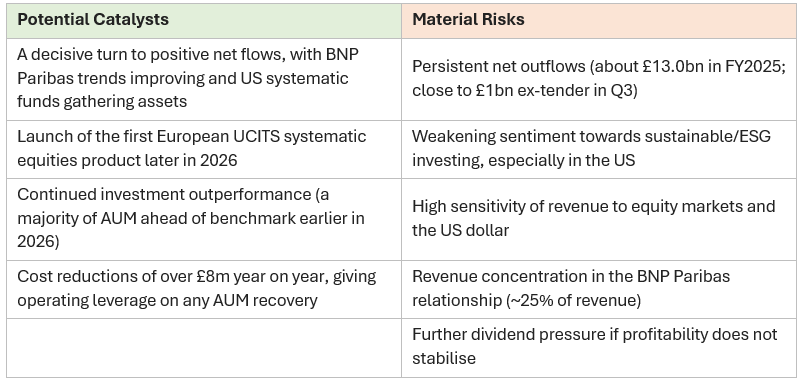
Several developments could support the shares if they play out. The most important is a decisive turn in net flows: with relative performance strong and BNP Paribas trends improving, even a modest swing to positive quarterly flows would materially change the narrative and, in time, the revenue trajectory. The launch of the European UCITS systematic equities product later in 2026 could open a new distribution channel at a point when systematic strategies are winning assets. Continued investment outperformance — a majority of AUM was ahead of benchmark earlier in the year — should strengthen Impax's position in consultant searches and retail platforms. Cost reductions already delivered, with adjusted costs running well below the prior year, mean that any recovery in AUM should feed through to profit with meaningful operating leverage. Finally, the balance sheet is clean: no debt, positive net assets and an ongoing, if reduced, dividend give management room to invest through the cycle and to keep returning cash. Each of these is a genuine potential catalyst, but none is guaranteed, and several depend on external market conditions.
Material Risks and Challenges
The risks are equally concrete and should not be understated. First and foremost, net outflows have persisted for two years — around £13.0bn left the business in FY2025 alone — and the latest quarter, tender aside, still saw close to £1bn of redemptions. Until that reverses, AUM growth depends on markets. Second, sentiment towards sustainable and ESG-labelled investing has weakened, particularly in the United States, where political and regulatory pushback has dampened demand for the kind of strategies Impax specialises in; a prolonged chill would directly constrain sales. Third, revenue is highly sensitive to equity markets and to the US dollar, so a market correction or adverse currency move would quickly reverse recent AUM gains. Fourth, the concentration of revenue in the BNP Paribas relationship is a structural vulnerability. Fifth, the dividend has already been cut twice and could face further pressure if profitability does not stabilise. None of these is fatal in isolation, but together they explain why the shares have de-rated so heavily from their former highs and why a recovery in the AUM figure alone is not sufficient to declare the story mended.
Catalysts versus Risks at a Glance
What Investors Should Monitor Next
The key data point to watch is the next quarterly AUM update, covering the final quarter to 30 September 2026, and in particular the net-flow line excluding one-off items such as investment-trust tenders. A move towards flat or positive underlying flows would be the single most convincing evidence of a turnaround. Investors should also look for the full-year 2026 results, due around late November or early December, for confirmation of the cost base, the fee margin and the board's dividend stance. Beyond the numbers, the launch and early traction of the European UCITS systematic product, the trajectory of BNP Paribas-related flows, and any shift in the tone of sustainable-investing demand, especially in the US, will shape the outlook. Commentary from covering analysts such as Equity Development can provide useful context, though readers should treat broker forecasts as estimates rather than facts.
Balanced Conclusion
Impax's third-quarter update is best read as a step in the right direction rather than a decisive turning point. Assets are higher, performance is strong, redemptions are moderating and the cost base has been reset — all genuine positives after a bruising two years. Yet the business is still shedding assets on a net basis, its fortunes remain tied to volatile equity markets and to sentiment towards sustainable investing, and its revenue leans heavily on a single distribution partner. For investors, the case hinges on whether improving flow trends convert into sustained net inflows. Until they do, Impax remains a genuine recovery story with real momentum but unfinished proof. This article is analysis for general information and does not constitute investment advice; the shares carry material risk and readers should form their own view.


 Nov 26, 2026





 Please wait processing your request...