
 CA
 NZ
 US
 AU
 IND

 UK

 Share
 X (Formerly Twitter)
 Whatsapp
 Facebook
 LinkedIn
 Telegram
 Email This Article
 Copy Link
 Summarize with AI
 Chat GPT
 Perplexity

Summary
Tern plc (LSE:TERN) is an AIM-listed investor in early-stage Internet of Things (IoT) companies. On 15 July 2026 it raised £450,000 by placing 50 million shares at 0.90p, roughly a 31% discount, taking shares in issue to 905,543,681. Proceeds support the portfolio and a possible further Talking Medicines convertible loan note, plus corporate costs. Its 2025 results showed net asset value of £6.9m (1.0p per share, down 36%), a £5.1m loss and only £49,385 of cash. Core holdings are Device Authority (£3.9m, 26.6%), Talking Medicines (£1.7m, 23.8%) and FundamentalVR/FVRVS (£1.6m, 10.3%). The central opportunity is portfolio monetisation via exits; the central risks are repeated dilutive placings, thin cash, unquoted-valuation uncertainty and small-cap illiquidity. This is a high-risk, speculative situation; nothing here is investment advice.
Five Key Takeaways
- Tern raised £450,000 (gross) at 0.90p per share on 15 July 2026, about 5.5% of enlarged capital and a roughly 31% discount to the prior close.
- The group ended 2025 with just £49,385 of cash and a net asset value of £6.9m, or 1.0p per share, down 36% year on year.
- Device Authority (£3.9m, 26.6%), Talking Medicines (£1.7m, 23.8%) and FundamentalVR (£1.6m, 10.3%) are the core holdings.
- Management has shifted emphasis towards monetising existing holdings rather than pursuing large new capital raises.
- Repeated discounted placings and slim cash cover make dilution and financing dependence the central risks for shareholders.
Company Overview
Tern plc is a London-listed investment company that takes minority equity stakes in early-stage, privately held businesses building Internet of Things (IoT) technology — software and systems that connect physical devices, sensors and machines to networks. Rather than operating these businesses, Tern provides capital, board-level input and strategic support, aiming to realise value through a trade sale, a listing or a later funding round led by larger investors. Because its holdings are unquoted, Tern's reported net asset value (NAV) rests largely on the directors' periodic valuations, which can move sharply as trading, funding conditions or comparable-company multiples change. The shares trade on AIM under the ticker TERN, and the company is led by chief executive Jane McCracken. Its concentrated portfolio is anchored by three names: Device Authority, a cybersecurity business securing connected devices and machine identities; Talking Medicines, an AI-driven healthcare data and analytics company; and FundamentalVR (operating as FVRVS), a virtual-reality surgical-training platform. This gives shareholders exposure to a small basket of unlisted technology ventures, with the illiquidity and valuation uncertainty that comes with private-company investing.
What Has Happened Recently?
On 15 July 2026 Tern announced a placing of 50,000,000 new ordinary shares at 0.90p each, raising £450,000 before expenses. The price represented approximately a 31% discount to the mid-market closing price of 1.30p on 14 July 2026, and the new shares equate to about 5.5% of the enlarged share capital. Admission to trading on AIM was expected on or around 20 July 2026, taking Tern's total issued shares — and therefore its total voting rights — to 905,543,681. The placing was arranged through CMC Markets UK's CMC CapX. Tern stated that the net proceeds would provide additional support to its portfolio "as appropriate", specifically flagging a potential further convertible loan note investment in Talking Medicines, alongside general corporate purposes including operating and legal expenses. The raise follows a run of similar financing steps. In late May 2026 Tern increased its Talking Medicines exposure, taking £270,000 in principal of unsecured convertible loan notes by converting roughly £87,000 of amounts owed to it and adding about £48,000 of new cash, lifting its convertible-note holdings in that company to around £0.79m. Those notes carry a 10% coupon, convert at a 20% discount on an exit or a fundraising of at least £2m by Talking Medicines, and otherwise mature on 21 November 2029. Earlier, in March 2026, Tern extended a short-term loan facility, leaving a £120,000 balance running to 11 September 2026 at 1% per calendar month, describing the extension as giving it greater negotiating flexibility over funding its investee companies.
Analysis of the Latest Development
The July placing is best read against Tern's 2025 results, published in June 2026, which set a candid tone. NAV fell 36% to £6.9m, equal to 1.0p per share, and the group closed the year with only £49,385 of cash. In that context, a £450,000 raise is less an expansion move than a working-capital and portfolio-support measure — enough to keep the entity funded and to participate selectively in follow-on investments such as the mooted Talking Medicines note, but not enough to change the strategic picture. The recurring pattern of modest, deeply discounted issuance is the crux of the investment debate: each placing at a discount transfers value from existing holders to new subscribers and enlarges the share count, and with roughly 905 million shares now in issue, per-share metrics are spread thinly. Set against that, management's stated direction has moved towards monetisation — converting value already built in the portfolio into cash returns — rather than repeatedly funding the holding company through equity. The tension between those two realities, ongoing cash needs versus a desire to stop diluting, is what shareholders must judge. The core question is not whether the individual portfolio companies have promise, but whether Tern can reach a value-crystallising event before further dilution offsets the upside. Any commentary suggesting recent financing enhances strategic flexibility should be weighed carefully: additional cash does widen options, but £450,000 provides a limited runway given the group's cost base and the capital appetite of early-stage ventures.
Financial Performance and Balance Sheet
Tern's audited results for the year ended 31 December 2025 showed a total comprehensive loss of about £5.1m, driven substantially by downward revaluations of portfolio holdings rather than cash outflows. The investment portfolio was carried at £7.3m at the year end, down from £10.7m, and NAV fell to £6.9m (1.0p per share) from £10.7m (2.0p) a year earlier. Cash dropped to £49,385 from £382,213. These figures explain the frequency of Tern's fundraising: with negligible cash reserves and no trading revenue of its own, the company relies on external financing — placings, open offers and short-term loans — to meet running costs and support investees. Management also pointed to operational tightening within the underlying companies, noting that annual recurring revenue across key holdings declined 27% while headcount fell 33% as those businesses cut costs. For a venture investor, the valuations of the unlisted stakes matter more than short-term losses, because reported losses are dominated by non-cash fair-value adjustments. The sharp 2025 write-downs are a reminder that these carrying values are estimates and can be revised in either direction. Investors should treat NAV as a directors' assessment rather than a realisable figure, and should note that the actual proceeds from any exit could differ materially from the balance-sheet carrying value.
Principal Assets, Products and Operations
Tern's portfolio is concentrated in a handful of holdings. The largest is Device Authority, carried at £3.9m and representing a 26.6% stake at the 2025 year end; it develops technology to secure connected devices and manage machine identities, an area of rising importance as more industrial and healthcare equipment is networked. Talking Medicines was valued at £1.7m (a 23.8% equity stake), and Tern has layered additional convertible loan notes on top of that equity, taking its note holdings to roughly £0.79m; the business applies artificial intelligence to pharmaceutical and healthcare data. FundamentalVR, trading as FVRVS, was carried at £1.6m for a 10.3% stake and provides immersive virtual-reality training for surgeons. Smaller positions include a holding in Sure Ventures valued at around £149,000 (2.9%) plus other minority interests worth roughly £200,000. This concentration cuts both ways: a strong outcome at Device Authority or FundamentalVR could move Tern's NAV meaningfully, but a disappointment at any single holding carries similar weight in the other direction. Because Tern typically holds minority positions, it does not control the timing or terms of exits; those depend on the boards, management teams and larger backers of each investee. The strategic emphasis in the 2025 report was on advancing these companies towards liquidity pathways that would allow Tern to convert paper value into cash.
Potential Growth Catalysts
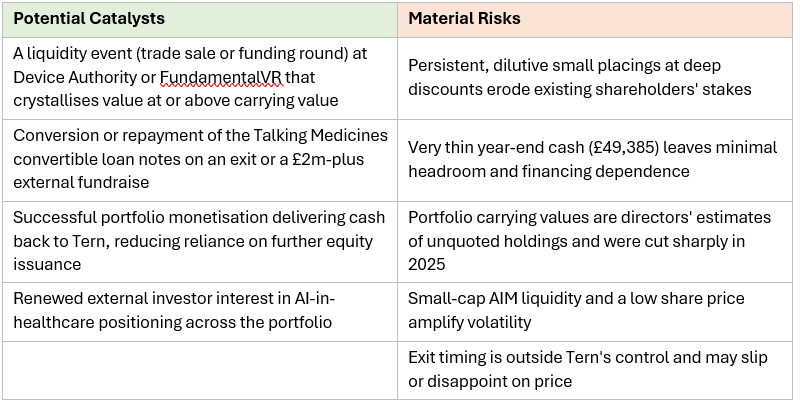
The clearest potential catalyst is a liquidity event at one of the larger holdings. Device Authority and FundamentalVR were both described as advancing towards liquidity pathways, and any trade sale or funding round involving them could crystallise value at or near carrying value and deliver cash to Tern. At Talking Medicines, the convertible loan notes are structured to convert on an exit or a fundraising of at least £2m, with a 20% conversion discount — so a substantial external raise or sale of that business would be a defined trigger. More broadly, growing interest in AI-enabled healthcare could support portfolio valuations, given Talking Medicines' positioning and Device Authority's healthcare-security use cases. Finally, any move that reduces Tern's dependence on discounted equity issuance — for example, cash returned from a portfolio realisation used to fund operations — would itself be a positive signal, easing the dilution overhang that has weighed on sentiment. None of these outcomes is assured, and their timing is largely outside Tern's direct control.
Material Risks and Challenges
The risks here are material and should not be understated. First is dilution: Tern has repeatedly issued new shares at discounts, and the July placing continued that pattern; further raises on similar terms would keep diluting existing holders. Second is the group's very thin liquidity — £49,385 of year-end cash leaves almost no buffer, making Tern dependent on continued access to financing and vulnerable if market conditions tighten. Third is valuation risk: the portfolio is unquoted, its carrying values are directors' estimates, and those estimates were cut sharply in 2025; realised proceeds on any exit could fall short of carried values. Fourth is concentration: with three holdings dominating NAV, a setback at any one would have an outsized effect. Fifth is liquidity in the shares themselves — as a low-priced AIM small-cap, TERN can be volatile and difficult to trade in size, and the wide bid-offer dynamics typical of such stocks can amplify losses. Investors should also note that exit timing depends on third parties, and that a short-term loan balance remains outstanding into September 2026. This is a high-risk, speculative situation in which the potential for value realisation sits alongside a genuine possibility of further dilution and value erosion.
Catalysts versus Risks at a Glance
What Investors Should Monitor Next
Several near-term signposts are worth watching. The first is whether the flagged further convertible loan note in Talking Medicines is actually made, and on what terms. The second is any news on the £120,000 loan facility due on 11 September 2026 — repayment, a further extension or refinancing would each say something about Tern's funding position. The third, and most important for the investment case, is concrete progress towards a liquidity event at Device Authority, FundamentalVR or Talking Medicines: a funding round, strategic-review outcome or trade sale. Investors should also monitor the cadence of any further placings, since continued reliance on discounted equity would confirm the dilution concern, whereas a pause funded by portfolio cash would support the monetisation narrative. Finally, watch for updated portfolio valuations at the next reporting point, and for any research updates, read with attention to who commissioned them.
Balanced Conclusion
Tern plc offers listed exposure to a small, concentrated basket of private IoT and technology ventures, with the July 2026 placing providing a further, modest tranche of capital to support the portfolio and keep the company funded. The investment case rests on whether one or more holdings — Device Authority, Talking Medicines or FundamentalVR — can reach a value-crystallising exit before continued discounted issuance dilutes that potential away. The 2025 accounts made the pressures plain: a sharply reduced NAV, minimal cash and a candid pivot towards monetisation. For risk-tolerant investors, the appeal lies in the possibility that carried portfolio value converts into cash; the counterweight is a real risk of further dilution, write-downs and thin liquidity. This is a speculative small-cap where outcomes are uncertain and financing dependence is high. Nothing here constitutes advice, and no share-price outcome should be assumed.


 Nov 24, 2026





 Please wait processing your request...