
 AU
AU
 CA
CA
 US
US
 NZ
NZ
 IND
IND

 UK
UK

 Share
Share
 X (Formerly Twitter)
 Whatsapp
 Facebook
 LinkedIn
 Telegram
 Email This Article
 Copy Link
 Summarize with AI
 Chat GPT
 Perplexity
1. Company Overview
System1 Group PLC is a marketing decision-making platform company headquartered in London, United Kingdom. Formerly known as BrainJuicer Group PLC, the company rebranded to System1 in 2017 to reflect its focus on the System 1 thinking framework popularised by Nobel laureate Daniel Kahneman. The company provides technology-driven market research and advertising testing services that help global brands make better marketing decisions by predicting the commercial effectiveness of their advertising and innovation investments. The rebranding signalled a strategic pivot toward a more technology-centric business model.
The company's proprietary platform leverages behavioural science principles and predictive analytics to evaluate advertising effectiveness, brand health, and innovation potential. System1's methodology is built on the insight that the vast majority of human decision-making is driven by fast, intuitive, and emotional processes rather than slow, deliberate, and rational thought. By measuring emotional responses to marketing stimuli, System1 claims to provide more accurate predictions of market performance than traditional research methods. This scientific foundation differentiates the company from competitors who rely on stated preference surveys and focus groups.
System1 serves a diverse client base of major global brands and advertising agencies across multiple sectors, including consumer goods, financial services, technology, and entertainment. The company operates internationally with offices in key markets including London, New York, and Sao Paulo, enabling it to support clients across geographies and provide culturally relevant insights for campaigns deployed in different markets around the world. The breadth of its client portfolio includes many of the world's largest advertisers, providing both revenue stability and credibility in the marketplace.
The marketing research industry is undergoing a fundamental transformation driven by digitalisation, the demand for faster insights, and the growing sophistication of predictive analytics. System1 is positioning itself at the forefront of this transformation by offering a technology-led alternative to traditional research approaches that are often slow, expensive, and subjective. The company's vision is to become the global standard for predicting marketing effectiveness, a goal that would represent a dramatic expansion from its current market share.
2. Business Model and Revenue Streams
System1's business model has evolved significantly in recent years as the company has transitioned from a traditional market research consultancy to a technology-led platform business. The company's flagship products include Test Your Ad, which predicts the commercial effectiveness of advertising content, and Test Your Brand, which measures brand health and emotional associations. These products are delivered through a scalable technology platform that enables rapid, cost-effective testing at a fraction of the time and expense required by traditional research methods, often delivering results within twenty-four hours.
The platform model offers significant advantages over the traditional consultancy approach. Revenue is increasingly recurring in nature, as clients adopt the platform for ongoing advertising testing programmes rather than commissioning one-off research projects. The technology-led delivery model also provides operating leverage, as the marginal cost of serving additional tests is low once the platform infrastructure is in place. This transition has been a key strategic priority for the company's management team and represents a fundamental shift in how the company creates and captures value.
System1 generates revenue through a combination of subscription-based platform access fees, per-test charges, and customised advisory services for clients requiring deeper strategic guidance. The company has invested heavily in building a normative database of advertising test results, which enhances the predictive power of its platform and creates a competitive barrier as the database grows over time. With each new test conducted on the platform, the normative database becomes richer and more statistically robust, creating a powerful network effect.
The economics of the platform transition are compelling when viewed over a multi-year horizon. Platform revenue carries significantly higher gross margins than traditional consultancy revenue, as it requires less human capital per unit of revenue. The shift also improves revenue predictability, as subscription-based pricing provides better forward visibility than project-based consulting engagements. However, the transition period involves investment in technology development, customer acquisition, and organisational change that can weigh on near-term profitability.
3. Financial Performance and Valuation
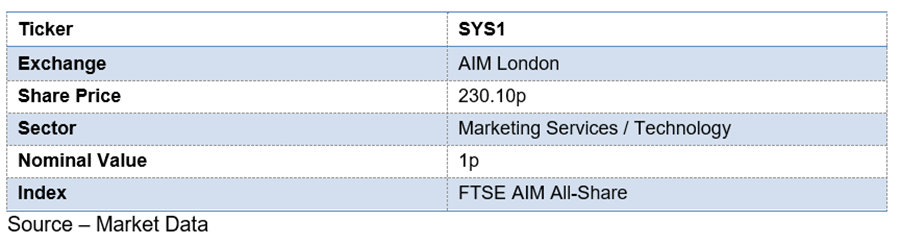
At a share price of 230.10 pence, System1 Group commands a relatively modest market capitalisation for a technology-enabled marketing services company, reflecting both the AIM listing environment and the company's transitional stage. The company has demonstrated revenue growth as it scales its platform offerings, though the pace of growth has varied as the transition from legacy consultancy revenue to platform revenue has progressed in a somewhat uneven fashion. Revenue mix has been steadily shifting toward higher-margin platform income.
The company's financial profile is characterised by improving gross margins as platform revenue increases as a proportion of total revenue. Operating expenses reflect ongoing investment in technology development, data science capabilities, and sales and marketing to drive platform adoption. Profitability has been inconsistent during the transition period, though the underlying economics of the platform model suggest significant profit leverage once the business achieves sufficient scale. The company's management has indicated that the business is approaching an inflection point in terms of platform economics.
System1's valuation should be assessed in the context of comparable technology-enabled market research and marketing analytics businesses, many of which trade at significant premiums to traditional market research companies. If System1 can successfully complete its platform transition and demonstrate sustained revenue growth with expanding margins, the current valuation could prove attractive. However, execution risk during the transition period remains a key consideration for potential investors who must weigh the promise of future growth against near-term uncertainty.
Cash flow generation is an important metric to monitor as the company progresses through its transformation. The platform model should ultimately be significantly cash-generative due to low marginal costs and advance payment terms typical of subscription businesses. However, during the investment phase, free cash flow may be constrained by technology development spending and customer acquisition costs. The company's cash position and burn rate should be monitored closely to ensure the business can self-fund its transition without recourse to dilutive equity financing.
4. Market Position and Competitive Landscape
System1 operates within the rapidly evolving marketing effectiveness measurement industry, competing with both traditional market research firms and newer technology-led entrants. Traditional competitors include major research agencies that offer advertising testing as part of broader service portfolios. Technology-led competitors include a growing number of companies that use artificial intelligence, neuroscience, and behavioural analytics to predict advertising effectiveness. The competitive landscape is dynamic, with new entrants regularly emerging from both the technology and marketing services sectors.
The company's competitive differentiation rests on its proprietary methodology, which combines behavioural science principles with large-scale predictive analytics. The normative database, which benchmarks test results against thousands of previously tested advertisements, provides a significant competitive advantage that strengthens as more tests are conducted. System1 also benefits from academic validation of its approach and the growing acceptance among marketers of the importance of emotional response in driving commercial outcomes. Published case studies demonstrating the predictive accuracy of its methodology further reinforce its market credibility.
The market for marketing effectiveness measurement is expanding as companies face increasing pressure to demonstrate return on investment for marketing expenditure. Digital transformation, the fragmentation of media channels, and the growing complexity of the marketing landscape are all driving demand for more sophisticated and rapid testing solutions. System1 is well-positioned to benefit from these trends, though competition is intensifying as established players and new entrants invest in technology-enabled solutions that promise similar benefits of speed, accuracy, and scalability.
5. Risk Factors
Key risks for System1 include the execution risk associated with the platform transition, competitive pressure from both established and emerging players, and customer concentration risk. The company's success is dependent on its ability to convince a critical mass of marketers to adopt its platform-based approach, which requires overcoming both budgetary constraints and institutional resistance to changing established research practices. Market adoption of new research methodologies can be slow, particularly among large organisations with entrenched procurement processes.
Technology risk is also relevant, as advances in artificial intelligence and machine learning could enable competitors to develop alternative approaches to advertising effectiveness prediction. The company must continue to invest in its technology platform and data science capabilities to maintain its competitive edge. Additionally, macroeconomic factors that impact marketing budgets, such as recession or economic uncertainty, could adversely affect demand for the company's services, as marketing research spending is often one of the first categories cut during downturns.
The relatively small size of the company means it has limited resources to deploy against larger, better-capitalised competitors. Key person risk is also a consideration, as the company's strategic direction and intellectual leadership have been closely associated with its founding team. Changes in management or the departure of key technical talent could impact the company's competitive positioning and growth trajectory. Additionally, the AIM market listing may limit the company's access to institutional investors who have minimum market capitalisation requirements.
6. Investment Outlook and Conclusion
System1 Group represents an intriguing investment opportunity at the intersection of behavioural science, technology, and marketing services. The company's platform transition, if successfully executed, could transform its financial profile from a low-margin consultancy to a scalable, high-margin technology business with significant recurring revenue. At the current price of 230.10 pence, the shares offer exposure to this transformation at a valuation that does not appear to fully price in the potential upside scenario, though the downside risk in a failed transition is also meaningful.
The near-term outlook is dependent on the pace of platform adoption and the company's ability to grow its subscriber base while maintaining or improving unit economics. The medium-term outlook is supported by secular growth in demand for marketing effectiveness measurement and the company's differentiated positioning within this market. The long-term investment thesis rests on System1 establishing itself as an essential platform for marketing decision-making across the global advertising industry, a vision that would imply a dramatically higher valuation than today's level.
In conclusion, System1 Group offers a differentiated investment proposition for investors seeking exposure to the growing marketing technology sector. The behavioural science foundations of its approach provide intellectual credibility, while the platform business model offers the potential for scalable, high-margin growth. However, the investment carries meaningful execution risk, and investors should carefully consider the company's progress on key platform metrics, including subscriber growth, average revenue per customer, and the platform revenue mix, before establishing or adding to positions.


 Jun 05, 2026




 Please wait processing your request...