
 AU
AU
 CA
CA
 US
US
 NZ
NZ
 IND
IND

 UK
UK

 Share
Share
 X (Formerly Twitter)
 Whatsapp
 Facebook
 LinkedIn
 Telegram
 Email This Article
 Copy Link
 Summarize with AI
 Chat GPT
 Perplexity
Key Takeaways
- The FTSE Russell index ecosystem covers everything from global blue chips to nano-cap firms worth under £5 million.
- The smallest companies are concentrated on the Alternative Investment Market and lower tiers of the London Stock Exchange.
- These stocks offer extreme upside potential—but also extreme risk, including illiquidity and dilution.
- Retail investors dominate this segment, making it one of the few markets where individuals can still find inefficiencies.
- Tax advantages like ISA eligibility and inheritance tax relief make AIM particularly attractive in the UK.
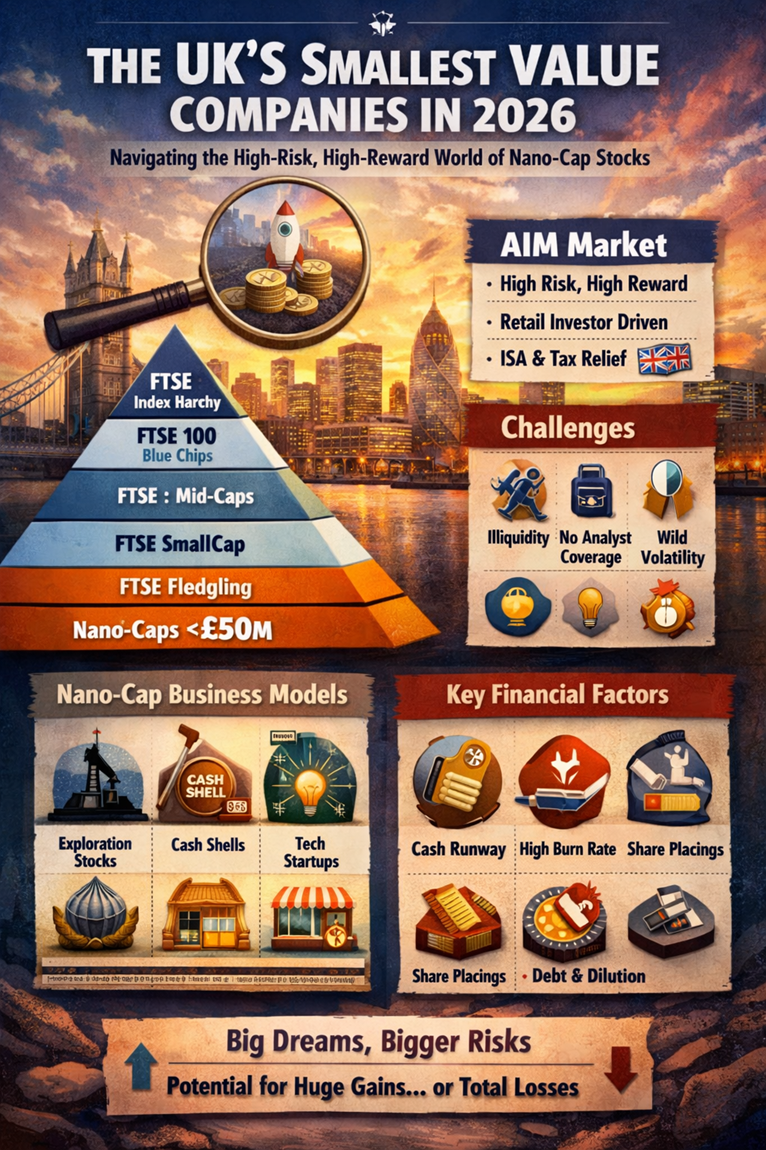
Source: Kalkine Group
Introduction
The UK stock market is often defined by its giants—multinational banks, pharmaceutical leaders, and energy companies. But beneath that layer lies a vast and largely ignored universe of ultra-small listed firms.
These are the FTSE smallest value companies—businesses with market capitalisations so small they barely register on institutional radars. In 2026, many of these companies are valued at less than £10 million, and some even below £1 million.
For retail investors, this segment presents a paradox. It is one of the riskiest areas of the market—but also one of the few places where genuine alpha still exists.
Understanding the FTSE Structure
How the FTSE Index Family Works
The UK equity market is structured into tiers:
- FTSE 100: Largest 100 companies
- FTSE 250: Mid-sized firms
- FTSE SmallCap: Smaller companies outside FTSE 350
- FTSE Fledgling: Even smaller and less liquid firms
- FTSE AIM indices: Companies listed on AIM
The smallest value companies sit at the very bottom of this hierarchy.
Market Capitalisation Breakdown
- Large-cap: £5B+
- Mid-cap: £1B–£5B
- Small-cap: £300M–£1B
- Micro-cap: £50M–£300M
- Nano-cap: Below £50M
Most FTSE “smallest value companies” are nano-caps.
The UK Small-Cap Ecosystem in 2026
Main Market vs AIM
The London Stock Exchange operates:
- Main Market: Highly regulated, institutional focus
- AIM: Flexible, growth-oriented, lower entry barriers
AIM remains the core hub for micro-cap investing.
The Role of Nomads
Every AIM company must have a Nominated Adviser (Nomad).
They act as regulators, advisors, and gatekeepers—but quality varies.
Retail Investor Influence
Retail investors account for a significant share of AIM ownership.
This results in:
- Higher volatility
- Faster sentiment shifts
- Greater pricing inefficiencies
What Makes Smallest Value Companies Different
Illiquidity
Many stocks barely trade. Selling can be difficult.
No Coverage
No analysts = no consensus valuation.
High Volatility
Price swings of 20–50% in days are common.
Founder-Led
Strong vision—but governance risks.
High Failure Rates
Many companies will not survive long term.
Business Models in UK Nano-Caps
Exploration Companies
Mining, oil, biotech
High risk, binary outcomes
Cash Shells
Waiting for acquisitions
Highly speculative
Technology Startups
Early-stage growth, often loss-making
Energy & Resources
Commodity exposure + geopolitical risk
Niche Profitable Firms
Rare but valuable—often overlooked
Financial Characteristics
What Actually Matters
- Cash runway
- Burn rate
- Revenue growth
- Margins
- NAV
Funding Reality
Most rely on:
- Share placings
- Convertible debt
- External funding
Key Risks Investors Must Understand
Liquidity Risk
You may not be able to exit positions.
Dilution Risk
Frequent share issuance destroys value.
Failure Risk
Many companies go to zero.
Fraud Risk
Higher than large-cap markets.
Management Risk
Leadership quality is critical.
Macroeconomic Context (2026)
Interest Rates
The Bank of England base rate is around 3.75%.
Expected cuts could support valuations.
Economic Growth
UK GDP growth remains modest (~1%).
Inflation
Still influenced by global energy markets.
Investor Sentiment
After a multi-year downturn, small caps remain undervalued.
Why Investors Target Smallest Value Companies
Asymmetric Upside
Potential for 10x–100x returns.
Information Edge
Less institutional competition.
Takeover Potential
Small firms often acquired.
Tax Efficiency
ISA, SIPP, and inheritance tax benefits.
Bull vs Bear Case
Bull Case
- Deep undervaluation
- Recovery cycle potential
- Strong innovation pipeline
Bear Case
- Structural decline in AIM listings
- Persistent dilution
- Liquidity challenges
How to Evaluate a Nano-Cap Stock
Step-by-Step Process
- Read annual report
- Check cash runway
- Review RNS announcements
- Assess management
- Value conservatively
- Size position carefully
Common Investor Mistakes
- Lack of diversification
- Ignoring dilution
- Following hype
- Not reading reports
- Overtrading illiquid stocks
Future Outlook
Short-Term (2026–2027)
Dependent on rate cuts and sentiment recovery.
Medium-Term
Driven by:
- AI
- Energy transition
- Critical minerals
Long-Term
Small-cap premium likely persists.
What are the best indicators of success?
- Strong balance sheet
- Growing revenue
- Credible management
Should beginners invest in nano-caps?
Generally no. Start with larger, more stable companies.
How do I spot a potential multi-bagger?
Look for:
- Scalable business model
- Large addressable market
- Strong execution
What is the exit strategy?
Sell when:
- Thesis breaks
- Better opportunity arises
- Valuation becomes excessive
Final Verdict
FTSE smallest value companies are not for the faint-hearted. They represent a high-risk, high-reward segment where fortunes can be made—or lost.
But for disciplined investors, they offer something increasingly rare: inefficiency.
With the right approach—diversification, research, patience, and risk control—this segment can play a valuable role in a broader portfolio.
The key is not chasing hype—but building a repeatable process.


 Jun 19, 2026




 Please wait processing your request...