
 AU
AU
 CA
CA
 US
US
 NZ
NZ
 IND
IND

 UK
UK

 Share
Share
 X (Formerly Twitter)
 Whatsapp
 Facebook
 LinkedIn
 Telegram
 Email This Article
 Copy Link
 Summarize with AI
 Chat GPT
 Perplexity
Introduction
The FTSE 100 has long been recognised as one of the highest-yielding major equity indices globally, and that reputation continues in 2026. While US indices such as the S&P 500 offer relatively modest yields, the UK’s flagship index still delivers significantly higher income, with several individual stocks offering very elevated yields.
For income-focused investors, this makes the FTSE an attractive hunting ground. However, a high yield alone does not guarantee a good investment. Dividend yield is simply a function of dividend per share relative to the share price, meaning it can rise either because payouts increase or because share prices fall.
Understanding the difference between these drivers is essential. A rising yield due to strong earnings is positive, while a rising yield caused by falling share prices can signal underlying problems. This guide explains how high yields arise, why certain sectors dominate, and how investors can identify sustainable income opportunities while avoiding potential pitfalls.
What Counts as a High-Yield FTSE 100 Stock?
There is no strict definition of a high-yield stock, but general market conventions provide a useful framework.
In 2026, FTSE 100 stocks typically fall into three broad categories:
- Low yield (below ~2%), often seen in growth-oriented or cyclical sectors
- متوسط yield (3–5%), common among banks, energy companies, and consumer staples
- High yield (above ~6%), typically concentrated in insurance, tobacco, and certain financial or property-related sectors
Yields above 9–10% are generally considered elevated and require closer scrutiny.
Given that the FTSE 100 average yield is around 4%, a practical definition of a high-yield stock is one offering a yield meaningfully above this level—typically 5.5% or higher.
Why Some FTSE 100 Companies Offer Very High Yields
Low growth expectations
Companies with limited growth opportunities often distribute a larger share of their earnings to shareholders. Mature sectors such as tobacco, insurance, and traditional energy fall into this category, resulting in higher yields.
Sector-specific payout structures
Certain industries are structurally designed to return capital. Insurers, for example, distribute surplus capital under regulatory frameworks, while tobacco companies generate steady cash flows that exceed reinvestment needs.
Share price declines
A falling share price can mechanically increase a stock’s yield. However, this often reflects investor concerns about future earnings or dividend sustainability, making it a potential warning sign.
Currency effects
Some FTSE companies declare dividends in US dollars. When sterling weakens, the converted dividend appears higher for UK investors, boosting reported yields.
How to Tell a Durable High Yield From a Value Trap
- Dividend cover
A healthy dividend is supported by earnings. Coverage ratios above 1.5x generally indicate a sustainable payout, while lower levels may signal risk.
- Free cash flow yield
Comparing free cash flow to dividends helps assess whether payouts are supported by real cash generation. Strong alignment between the two is a positive sign.
- Debt trends
Rising debt alongside stable dividends can indicate that payouts are being funded unsustainably. A stable or improving balance sheet is preferable.
- Management guidance
Company statements often provide early clues about dividend changes. Language suggesting adjustments to capital allocation may indicate future reductions.
- Sector-specific risks
Each sector carries unique risks, from regulatory pressures to pension liabilities or legal challenges. Understanding these factors is essential when evaluating high-yield stocks.
High-Yield FTSE 100 Sectors Examined
Insurance
The UK insurance sector is a major source of high-yield stocks. Companies such as Legal & General, Aviva, Phoenix Group, and M&G generate strong capital flows and regularly return surplus capital to shareholders.
Tobacco
Tobacco companies continue to offer high and stable yields due to strong cash generation. However, long-term risks related to declining demand and regulation remain important considerations.
Integrated Energy
Energy majors like Shell and BP provide solid income supported by cash flows and supplemented by share buybacks. Dividend growth is expected to remain moderate.
Banking
UK banks have re-emerged as attractive income providers following dividend resets in recent years. However, their cyclical nature means dividends can fluctuate with economic conditions.
Telecoms and Support Services
The telecom sector has seen dividend reductions in recent years, reducing its prominence among high-yield FTSE sectors. While still offering income opportunities, it is no longer a dominant source of high yields.
Indicative High-Yield FTSE 100 Snapshot
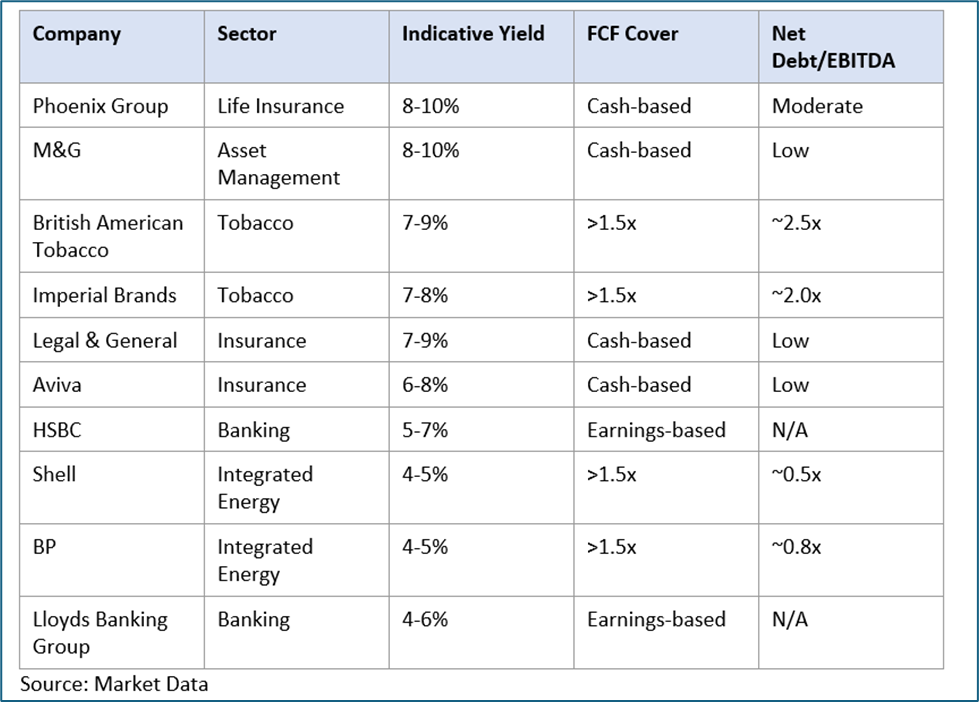
The table below provides an indicative view of the forward dividend yield, free cash flow cover and net debt to EBITDA profile of selected high-yield FTSE 100 stocks as of early 2026. These numbers are provided for illustration and investors should always verify the latest published figures before making investment decisions.
The Mathematics of High Yield
A frequent misconception is that a 9% yield is automatically far superior to a 5% yield. Over time, this can be true—but only if the higher-yielding stock can sustain and grow its payouts.
Consider two scenarios. Company A offers a 9% yield with minimal growth of 1% annually. Company B provides a 5% yield but grows its dividend at 5% per year. While Company A delivers more income initially, Company B’s compounding effect can lead to a significantly higher yield on cost and stronger share price appreciation over the long term.
This is why experienced investors often adopt a “barbell” strategy—combining high-yield stocks for immediate income with lower-yield, high-growth companies for future income expansion. This approach balances present cash flow with long-term purchasing power.
Tax Considerations for UK Investors
Dividend income in the UK is subject to taxation when held outside tax-efficient accounts, once the annual allowance is exceeded. This allowance has been reduced in recent years, making tax planning increasingly important.
Dividend tax rates vary by income bracket, making ISAs and SIPPs particularly valuable. ISAs allow tax-free income, while SIPPs defer taxation until withdrawal, potentially offering additional benefits depending on individual circumstances.
For investors with larger portfolios, alternative structures such as investment trusts or other tax-efficient vehicles may help manage tax exposure, though they come with their own considerations.
Risks and Considerations
The most obvious risk in high-yield investing is that exceptionally high yields may not be sustainable. History has shown that even well-known companies can reduce dividends when earnings decline or external pressures increase.
Regulatory risk is another key factor. Industries such as utilities and financial services are subject to oversight that can influence capital allocation and dividend policies.
Currency fluctuations also play a role. Many FTSE dividends are linked to foreign currencies, meaning exchange rate movements can impact the income received by UK investors.
Finally, concentration risk should not be overlooked. High-yield portfolios often cluster in a few sectors, increasing exposure to sector-specific shocks. Diversification across industries and revenue sources helps mitigate this risk.
Future Outlook for High-Yield FTSE 100 Stocks
Looking ahead, several macro trends will shape the outlook for high-yield stocks.
Interest rates, while lower than recent peaks, remain above the ultra-low levels seen in the previous decade. This reduces the relative attractiveness of dividend stocks compared to bonds but also supports higher yields across equities.
Share buybacks are becoming an increasingly important component of shareholder returns. By reducing the number of shares in circulation, buybacks enhance per-share earnings and support dividend growth over time.
Additionally, ongoing structural changes in sectors such as insurance are improving transparency and capital efficiency, reinforcing their role as key sources of income in the UK market.
How to Use High-Yield FTSE 100 Stocks in a Portfolio
A balanced income portfolio typically allocates a portion—often between 30% and 50%—to high-yield stocks, with the remainder invested in dividend growth companies.
Within the high-yield segment, diversification is essential. Limiting exposure to individual stocks and sectors helps reduce risk.
Regular monitoring is also important. Investors should review financial results, dividend coverage, and sector developments periodically to ensure the investment thesis remains intact.
Conclusion
High-yield FTSE 100 stocks remain a compelling option for investors seeking income in sterling. The UK market’s structure—dominated by mature, cash-generative industries—supports strong dividend payouts.
However, high yield alone is not sufficient. Successful investing requires distinguishing between sustainable income and potential value traps, supported by careful analysis of cash flow, balance sheets, and sector dynamics.
For investors willing to take a disciplined approach, the FTSE 100 continues to offer significant opportunities for generating reliable income over the long term.


 Jun 15, 2026




 Please wait processing your request...