
 AU
AU
 CA
CA
 US
US
 NZ
NZ
 IND
IND

 UK
UK

 Share
Share
 X (Formerly Twitter)
 Whatsapp
 Facebook
 LinkedIn
 Telegram
 Email This Article
 Copy Link
 Summarize with AI
 Chat GPT
 Perplexity
Why Is LON: AV. Aviva Stock Down 2.6% on 6 March 2026?
Key Takeaways – March 2026
- LON: AV. Aviva shares fell around 2.6% on 6 March 2026 amid broader FTSE 100 weakness and insurance sector rotation.
• Investor caution around UK interest rate outlook, GBP volatility and global financial sector sentiment weighed on the stock.
• Profit taking after a strong dividend-led rally in early 2026 also contributed to the pullback.
• Analysts still see solid cash generation, strong Solvency II ratio and attractive dividend yield supporting long-term fundamentals.
• The UK insurance sector outlook remains stable to moderately bullish driven by higher rates and structural savings demand.
Why Are Investors Searching “Why Is LON: AV. Aviva Stock Down Today” in March 2026?
The LON: AV. Aviva share price decline of roughly 2.6% on 6 March 2026 has caught the attention of investors across Google, Twitter, LinkedIn and financial platforms as traders analyze whether the drop signals a deeper correction or a short-term pullback.
Search interest around “Aviva stock forecast 2026”, “FTSE 100 dividend stocks”, “Aviva dividend yield UK”, and “why Aviva shares falling today” has surged as investors try to understand the current drivers behind the move.
Despite the decline, Aviva remains one of the most widely held UK income stocks, known for its strong dividend payout, robust capital return program and stable insurance earnings. The company’s transformation strategy over the past few years has simplified the business and strengthened its balance sheet.
However, the latest price movement reflects a combination of macro market pressures, sector sentiment, and technical profit-taking rather than any major deterioration in company fundamentals.
What Are the Immediate Reasons Behind the Aviva Share Price Drop?
Several factors likely triggered the short-term decline.
Broad FTSE 100 market weakness
- Financial stocks pulled back across the FTSE 100
• Global equity markets showed risk-off sentiment
• Investors rotating from defensive dividend plays
Profit taking after strong rally
- Aviva shares have performed strongly over the past year
• Dividend investors locking in gains
• Institutional portfolio rebalancing
Interest rate uncertainty
- Bank of England policy expectations shifting
• Insurance valuations sensitive to yield curve outlook
• Rising uncertainty around UK economic growth
Currency and global macro pressures
- GBP volatility against USD and EUR
• Concerns around global financial sector outlook
• Global asset management flows affecting insurers
How Is the UK Economy Influencing Aviva Stock in 2026?
The UK macroeconomic environment remains a key driver for insurance stocks like Aviva.
Interest Rates
Higher interest rates typically benefit insurers because:
- Investment portfolios generate higher yields
• Liability discount rates improve
• Long-term profitability increases
However, if markets expect rate cuts, insurance stocks sometimes retrace.
UK Economic Growth
Moderate growth in the UK economy supports:
- pension savings products
• retirement solutions
• insurance demand
But slower economic momentum can affect premium growth expectations.
Inflation
Insurance companies must manage:
- rising claims costs
• operational expenses
• pricing adjustments
Overall, the macro environment for insurers remains relatively supportive despite short-term volatility.
How Is the FTSE 100 and FTSE 250 Market Environment Affecting Aviva?
Aviva’s movement also mirrors broader market trends.
FTSE 100 Trends
- Dividend and value stocks facing rotation
• Financial sector consolidation
• Global macro uncertainty impacting sentiment
FTSE 250 Trends
- Mid-cap financial companies experiencing volatility
• Domestic economic exposure increasing investor caution
The combination of these factors creates short-term fluctuations even for fundamentally strong dividend stocks.
What Is Aviva’s Current Business Model and Financial Position?
Aviva operates across several core segments.
Key Business Segments
- UK & Ireland Life Insurance
• General Insurance
• Wealth Management
• Retirement and Pensions
Financial Strength Indicators
- Strong capital generation
• Solid Solvency II ratio above regulatory levels
• Consistent dividend policy
Recent company updates highlighted:
- continued cost efficiency improvements
• stable insurance underwriting performance
• growing demand for retirement products
(Source: Aviva financial updates and investor reports)
How Does Aviva Compare With Other UK Insurance Peers?
Peer Benchmarking
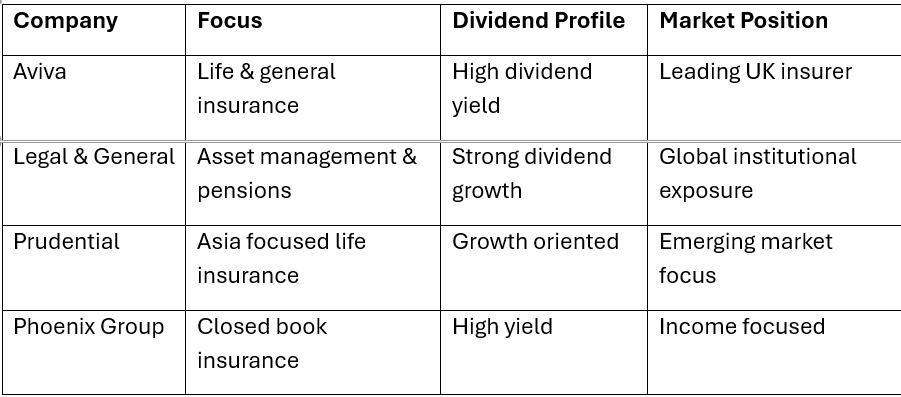
Aviva sits between income stability and moderate growth, making it popular among dividend investors.
What Is the Dividend Outlook for Aviva in 2026?
Aviva remains a top FTSE 100 dividend stock.
Dividend drivers include:
- strong cash generation
• disciplined capital allocation
• growing retirement solutions market
Many investors view Aviva as a core income holding because of its:
- stable earnings
• reliable payout policy
• capital return programs
What Do Analysts Forecast for Aviva Shares?
Latest broker consensus suggests steady long-term upside potential.
Analyst Ratings (Latest Market Consensus)
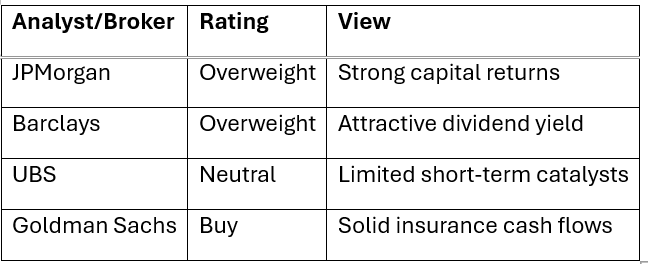
Analysts broadly believe Aviva remains fundamentally undervalued relative to its dividend strength and balance sheet.
Is Aviva Stock Bullish or Bearish Right Now?
Short-Term Outlook (3–6 months)
Neutral to slightly bearish
Reasons:
- market volatility
• profit taking
• macro uncertainty
Medium-Term Outlook (1–3 years)
Neutral to bullish
Reasons:
- structural retirement demand
• strong insurance margins
• capital return potential
Long-Term Outlook (3–10 years)
Bullish
Reasons:
- ageing population
• pension savings growth
• insurance market expansion
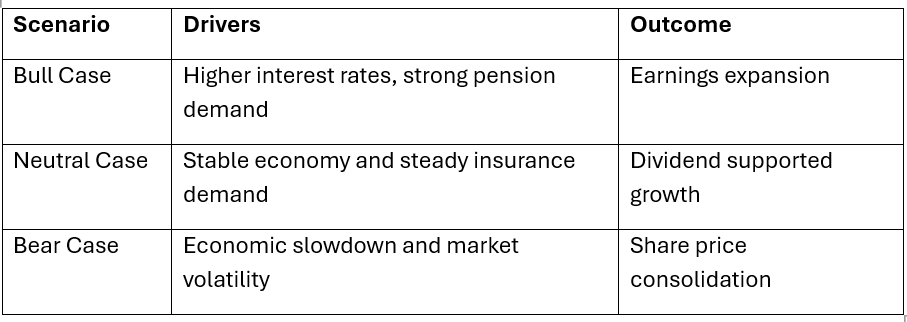
What Bull and Bear Scenarios Could Play Out for Aviva?
What Risks Should Investors Monitor?
Key risks include:
- UK recession risks
• interest rate fluctuations
• regulatory changes in insurance sector
• investment portfolio volatility
• competition from global insurers
What ESG Factors Influence Aviva’s Long-Term Strategy?
Aviva has been positioning itself as a leading ESG-focused insurer.
Key initiatives include:
- climate-aligned investment strategy
• sustainable insurance products
• responsible asset management
Strong ESG credentials can attract long-term institutional investors.
What Strategies Could Investors Consider for Aviva Stock?
Short Term Strategy
- Monitor interest rate expectations
• watch FTSE 100 financial sector momentum
• potential buying opportunities during dips
Medium Term Strategy
- accumulate gradually for dividend income
• focus on macro interest rate trends
Long Term Strategy
- hold for dividend compounding
• benefit from pension and retirement growth trends
Could Aviva Remain One of the Best UK Dividend Stocks?
Aviva continues to rank among top UK dividend stocks due to:
- consistent payouts
• strong balance sheet
• improving operational efficiency
For many investors, the stock remains a core income investment within FTSE 100 portfolios.
Final Investment Conclusion: Is Aviva Stock a Buy, Hold or Sell?
The 2.6% decline in LON: AV. Aviva shares on 6 March 2026 appears to be driven more by macro market sentiment and profit taking rather than any major deterioration in company fundamentals.
Aviva’s strong dividend profile, improving operational efficiency and exposure to long-term retirement savings trends continue to support its investment case.
Short-term volatility may persist as markets adjust to interest rate expectations and global financial sector sentiment, but long-term structural drivers remain intact.
For retail investors focused on dividend income, defensive financial exposure and long-term wealth compounding, Aviva may still represent an attractive component of a diversified portfolio.
FAQ – Aviva Stock
Why is Aviva stock down today?
Aviva shares fell around 2.6% due to broader FTSE 100 weakness, profit taking and interest rate uncertainty.
Is Aviva a good dividend stock?
Yes, Aviva is widely considered one of the stronger dividend stocks in the FTSE 100 due to its stable cash flow.
What sector does Aviva operate in?
Aviva operates in the global insurance and wealth management sector.
Is Aviva stock bullish long term?
Long-term prospects remain supported by retirement demand, insurance growth and capital returns.


 Jun 05, 2026




 Please wait processing your request...