
 AU
AU
 CA
CA
 US
US
 NZ
NZ
 IND
IND

 UK
UK

 Share
Share
 X (Formerly Twitter)
 Whatsapp
 Facebook
 LinkedIn
 Telegram
 Email This Article
 Copy Link
 Summarize with AI
 Chat GPT
 Perplexity
Key Takeaways: What Investors Must Know Immediately
- The UK economy is diverging sharply from its stock market
The FTSE 100 strength is driven by global earnings and currency effects — not domestic economic health. - Business confidence has entered a structural downtrend
This is not a short-term dip — it reflects deeper issues in policy, costs, and competitiveness. - The real economy is weakening across multiple fronts
Rising insolvencies, slowing hiring, weak consumer demand, and falling investment all point to underlying fragility. - Energy and labour costs are eroding competitiveness
These are structural disadvantages, not temporary shocks — and they are worsening in 2026. - Global risks are amplifying domestic weakness
The Iran conflict, oil price volatility, and trade fragmentation are adding external pressure to an already fragile system. - Policy flexibility is limited
High debt and inflation constraints mean the government and central bank have less room to stimulate growth. - This is a structural, not cyclical, slowdown
Recovery will likely be slow, uneven, and dependent on reforms — not just rate cuts. - Markets are pricing resilience — but risks are rising
The disconnect between perception and reality cannot persist indefinitely. - Investment strategy must adapt
Favor global earners, pricing power, and defensive sectors — avoid purely domestic exposure.
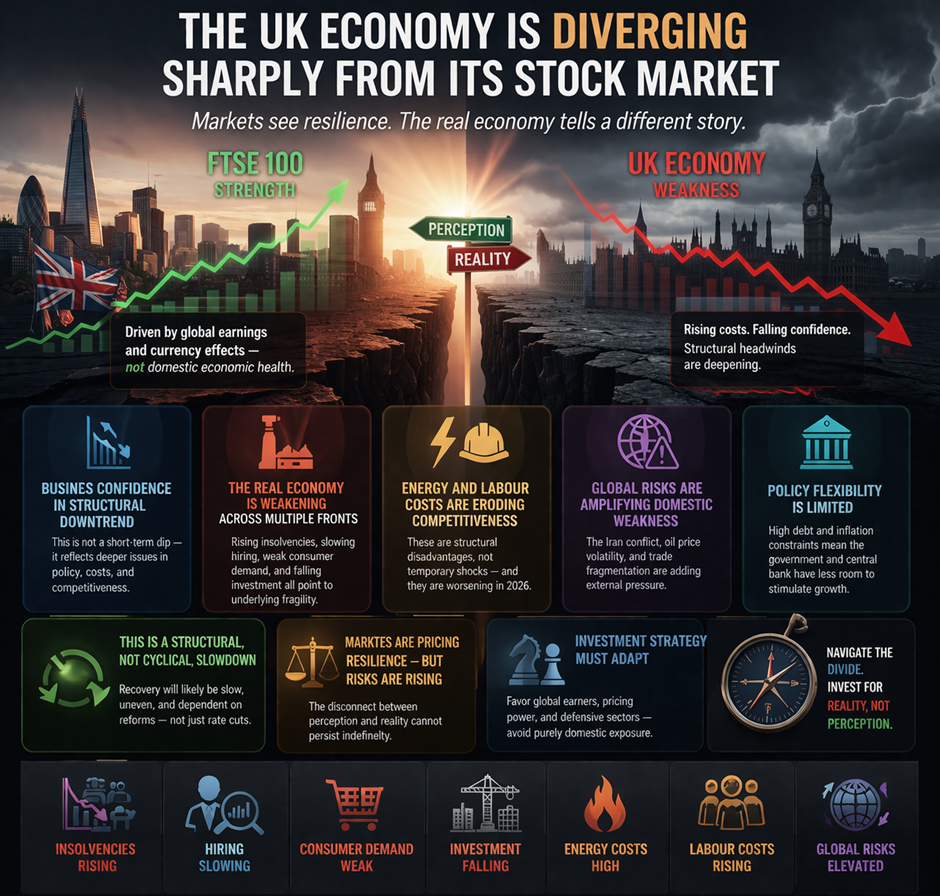
Source: Kalkine Group
Introduction: The Most Dangerous Economic Illusion in 2026
The UK economy in 2026 is telling two completely different stories — and both cannot be true at the same time.
On one side, financial markets are booming. The FTSE 100 is hovering near record highs, supported by global earnings, defence stocks, and commodity strength. To a surface-level observer, Britain appears resilient, even strong.
But beneath the surface, the real economy is weakening rapidly.
Business confidence has collapsed. Investment is slowing. Insolvencies are rising. Hiring momentum is fading. Consumers are under pressure.
As highlighted in the base analysis , the UK is facing a rare and dangerous divergence:
A strong market sitting on top of a weakening economic foundation.
This is not a normal cyclical slowdown. It is a multi-layered structural challenge, shaped by policy shocks, global instability, and long-standing inefficiencies.
Understanding this divergence is critical — because when perception and reality diverge, markets eventually adjust.
Section 1: The Collapse in Business Confidence – A Systemic Breakdown
Business confidence is the engine of economic momentum.
- High confidence → investment → hiring → growth
- Low confidence → caution → cuts → stagnation
In 2026, UK business sentiment has deteriorated sharply across surveys and sectors.
This collapse is:
- Broad-based
- Persistent
- Forward-looking
Businesses are no longer just cautious — they are defensive.
And when businesses turn defensive:
- Investment slows
- Hiring freezes
- Expansion stops
This is how economic slowdowns begin — not with headlines, but with sentiment.
Section 2: The Policy Shock That Triggered the Downturn
The fiscal reset of 2024 marked a turning point.
Rising employer taxes and regulatory pressure altered the economics of doing business in the UK.
Key impacts:
- Hiring costs surged
- Profit margins compressed
- Expansion plans were delayed
- Investment returns weakened
But the deeper issue was policy perception.
Businesses began to question:
- Stability
- Predictability
- Alignment with growth
Confidence is built slowly — but lost quickly. And once lost, it is difficult to rebuild.
Section 3: Energy Costs – The Structural Competitiveness Crisis
Energy is now one of the UK’s biggest structural disadvantages.
Drivers include:
- High infrastructure costs
- Policy levies
- Limited domestic advantages
- Exposure to global volatility
The 2026 Iran conflict has amplified the problem:
- Oil prices surged
- Shipping routes disrupted
- Energy markets destabilized
For businesses:
- Costs rise
- Margins shrink
- Competitiveness declines
Energy is no longer just a cost — it is a strategic constraint.
Section 4: Labour Market Dysfunction – A Broken System
The UK labour market is facing a paradox:
It is:
- Expensive
- Constrained
- Inefficient
Challenges include:
- Wage inflation
- Skills shortages
- Low mobility
- High employer contributions
Result:
- Firms can’t afford hiring
- But can’t find talent either
This leads to:
- Hiring freezes
- Automation
- Productivity stagnation
A structurally inefficient labour market is a major growth barrier.
Section 5: Insolvencies – The Real Economy Breaking Point
Rising insolvencies are the clearest sign of stress.
Drivers:
- Cost pressures
- Weak demand
- High borrowing costs
Most impacted:
- Retail
- Hospitality
- Construction
- SMEs
Each failure creates ripple effects:
- Job losses
- Supply chain disruption
- Reduced consumption
This is how localized stress becomes systemic.
Section 6: Consumer Weakness – The Demand Shock
The UK consumer is under pressure from:
- Inflation
- Mortgage costs
- Energy bills
This leads to:
- Lower discretionary spending
- Weak retail demand
- Slower services activity
Demand weakness compounds supply challenges — creating a double-sided slowdown.
Section 7: The FTSE 100 Illusion – Why Markets Are Misleading
The FTSE 100 is not a domestic index.
It is:
- Globally driven
- Commodity-heavy
- Currency-supported
Key reality:
- Majority of earnings come from overseas
This creates a disconnect:
Markets rise → Perception of strength
Economy weakens → Reality deteriorates
This illusion is central to understanding the UK’s current situation.
Section 8: Brexit – The Persistent Structural Drag
Brexit continues to shape the UK economy through:
- Trade friction
- Compliance costs
- Reduced labour mobility
- Lower investment inflows
These effects are gradual but cumulative.
Brexit is not a shock — it is a slow structural drag.
Section 9: Global Macro Shock – Iran War & Trade Fragmentation
The global environment is increasingly unstable.
Key risks:
- Iran conflict disrupting oil flows
- Rising geopolitical tensions
- Trade fragmentation
For the UK:
- Costs rise
- Demand becomes volatile
- Uncertainty increases
Global instability is now structural — not temporary.
Section 10: Interest Rates, Credit & Investment Freeze
Interest rates remain elevated relative to the past decade.
Impact:
- Higher borrowing costs
- Lower investment viability
- Refinancing risks
Business investment — critical for growth — is slowing.
This is one of the most dangerous trends in the economy.
Section 11: Productivity Crisis – The Core Structural Weakness
The UK’s long-term problem is productivity.
Without productivity growth:
- Wages stagnate
- Competitiveness declines
- Growth weakens
The confidence collapse is worsening this issue by reducing investment.
This creates a negative feedback loop.
Section 12: Sector-Level Breakdown
Most Vulnerable
- Retail
- Hospitality
- Construction
- SMEs
Resilient
- Defence
- Energy
- Pharmaceuticals
- Global exporters
Emerging Opportunities
- AI
- Automation
- Green infrastructure
Section 13: Capital Flight – The Silent Risk
Capital is quietly shifting away from the UK.
Trends:
- Reduced domestic exposure
- Increased global allocation
- Preference for stronger growth markets
Implications:
- Lower investment
- Reduced innovation
- Weak domestic expansion
This is a slow-moving but critical structural risk.
Section 14: Currency Dynamics – The Pound as Shock Absorber
A weaker pound:
- Supports exports
- Boosts FTSE earnings
But also:
- Increases inflation
- Raises import costs
- Weakens consumers
This creates a loop:
Weak economy → weaker currency → higher inflation → weaker demand
Section 15: Fiscal Constraints – Limited Policy Flexibility
The government faces:
- High debt
- Fiscal deficits
- Market sensitivity
This limits:
- Stimulus capacity
- Tax cuts
- Broad support measures
This is a policy-constrained crisis.
Section 16: Monetary Policy Dilemma
The Bank of England must balance:
- Inflation
- Growth
- Currency stability
Cut rates → inflation risk
Hold rates → growth risk
Policy is now about managing downside — not driving growth.
Section 17: Corporate Behaviour Shift – Survival Mode
Businesses are shifting from growth to defense:
Focus areas:
- Cost control
- Cash flow
- Efficiency
Impacts:
- Lower hiring
- Reduced investment
- Slower innovation
This shift signals a deeper economic transition.
Section 18: SME Crisis – The Backbone Under Pressure
SMEs face:
- Limited capital access
- High cost sensitivity
- Weak demand exposure
Risks:
- Job losses
- Regional weakness
- Economic fragmentation
SMEs are the most vulnerable — and the most critical.
Section 19: Structural vs Cyclical – Why This Matters
This is not just cyclical.
It is structural:
- Productivity issues
- Energy disadvantage
- Labour inefficiency
This means:
Recovery will be slow and uneven.
Section 20: Scenario Analysis – What Happens Next
Base Case
- Slow growth
- Gradual stabilization
Bear Case
- Oil shock escalation
- Recession
Bull Case
- Energy stability
- Policy clarity
Scenario-based thinking is critical in this environment.
Section 21: Global Comparison – UK vs World
US
- Stronger growth
- Tech-driven
Europe
- Similar challenges
Emerging Markets
- Higher growth
UK sits in a difficult middle position.
Section 22: Long-Term Opportunities
Despite challenges:
- AI
- Energy transition
- Defence
But require:
- Investment
- Policy clarity
- Skills
Section 23: Sentiment vs Reality – The Core Disconnect
Markets reflect:
- Global earnings
- Currency effects
Economy reflects:
- Domestic stress
This disconnect cannot persist indefinitely.
Section 24: Policy Roadmap – What Needs to Change
Key reforms:
- Stable taxation
- Energy reform
- Labour improvements
- Trade facilitation
Without reform, stagnation risk rises.
Section 25: Investment Strategy – Navigating the Crisis
Short-Term
- Energy
- Defence
- Commodities
Medium-Term
- Financials
- Recovery plays
Long-Term
- Tech
- Productivity sectors
Section 26: Final Investment Framework
Avoid
- Domestic consumption-heavy sectors
- Highly leveraged firms
Prefer
- Global revenue companies
- Pricing power businesses
Monitor
- Oil prices
- Policy changes
- Insolvencies
Conclusion: The UK Economy Is at a Structural Inflection Point
The UK economy in 2026 is not simply navigating a difficult cycle — it is confronting a deeper structural transition.
What makes this moment particularly critical is not any single factor, but the convergence of multiple pressures:
- A collapse in business confidence
- Structural cost disadvantages in energy and labour
- Weak domestic demand
- Rising insolvencies
- Policy constraints
- And an increasingly unstable global environment
As outlined throughout the analysis , these forces are not isolated — they are interconnected, reinforcing each other in ways that amplify downside risks.
At the heart of this crisis lies a fundamental truth:
Confidence is the foundation of economic growth.
When confidence deteriorates:
- Businesses stop investing
- Hiring slows or reverses
- Consumers reduce spending
- Productivity weakens
- Growth stalls
This is precisely the dynamic now unfolding in the UK.
At the same time, financial markets continue to project resilience. The FTSE 100 remains elevated, supported by global earnings, commodities, and currency weakness.
But this strength is misleading.
It reflects:
- External revenue exposure
- Sector concentration
- Currency dynamics
—not domestic economic health.
This creates a dangerous illusion:
A strong market masking a weakening economy.
History suggests such divergences do not persist indefinitely.
Eventually, one of two outcomes emerges:
- The economy stabilizes and improves, validating market strength
- Or markets reprice downward, aligning with economic reality
At present, the balance of risks suggests the latter cannot be ignored.
Looking ahead, the trajectory of the UK economy will depend on three critical variables:
- Policy Direction
Can the government restore confidence through stability, clarity, and pro-growth reforms? - Energy and Cost Dynamics
Will structural cost pressures ease, or continue to erode competitiveness? - Global Environment
Will geopolitical risks — particularly the Iran conflict and energy markets — stabilize or escalate?
Without meaningful progress across these fronts, the UK risks entering a prolonged period of:
- Low growth
- Weak investment
- Structural stagnation
However, this is not a foregone conclusion.
The UK retains significant strengths:
- A globally competitive financial sector
- Strong multinational companies
- Deep capital markets
- Innovation potential in technology and energy transition
The challenge is not capability — it is execution and alignment.
For investors, the key takeaway is clear:
This is not an environment for passive positioning or index-driven assumptions.
It requires:
- Selectivity
- Global diversification
- Focus on resilience and pricing power
- Continuous monitoring of macro and policy signals
For policymakers, the message is even more urgent:
Restoring confidence is not optional — it is essential.
Because without confidence:
There is no investment.
Without investment:
There is no productivity.
And without productivity:
There is no sustainable growth.
The UK is now at a defining economic moment.
The decisions made over the next 12–24 months will determine whether this period becomes:
- A temporary slowdown
or - The beginning of a prolonged era of economic stagnation.


 Jun 19, 2026




 Please wait processing your request...