
 AU
AU
 CA
CA
 US
US
 NZ
NZ
 IND
IND

 UK
UK

 Share
Share
 X (Formerly Twitter)
 Whatsapp
 Facebook
 LinkedIn
 Telegram
 Email This Article
 Copy Link
 Summarize with AI
 Chat GPT
 Perplexity
Key Takeaways — March 2026
- Rio Tinto (LON: RIO) stock declined 5.61% on 5 March 2026, becoming one of the biggest FTSE 100 fallers.
• Weak iron ore prices and China demand concerns are pressuring global mining stocks.
• Broader FTSE 100 mining sector sell-off is impacting Rio Tinto alongside peers.
• Strong dividend yield remains attractive despite near-term volatility.
• Analysts remain mixed but broadly constructive on long-term commodity demand tied to energy transition metals.
Why Did Rio Tinto Stock Drop Sharply Despite Strong Long-Term Fundamentals?
The Rio Tinto stock price decline of 5.61% on 5 March 2026 reflects broader weakness across the FTSE 100 mining sector, falling iron ore prices, concerns over China’s steel demand, and short-term volatility in global commodity markets. As one of the world’s largest diversified mining companies, Rio Tinto (LON: RIO) remains heavily exposed to iron ore, copper, aluminium, lithium, and critical minerals, meaning its share price often reacts quickly to global macroeconomic signals.
In March 2026, the FTSE 100 mining stocks including Rio Tinto, Anglo American, Antofagasta, and Glencore saw profit-taking after a strong commodities rally earlier in the year. Investors are reassessing the global demand outlook for iron ore and industrial metals, particularly as China’s construction and steel sectors remain uneven, which directly impacts Rio Tinto’s largest revenue stream.
At the same time, currency fluctuations in GBP/USD, commodity market volatility, and cautious sentiment toward global growth have pressured UK mining equities. Despite this drop, Rio Tinto continues to generate strong cash flows, robust dividends, and long-term exposure to the global energy transition, which keeps the stock on investors’ radar.
What Are the Key Reasons Behind Rio Tinto’s Share Price Decline?
Weak Iron Ore Prices
Iron ore accounts for over 60% of Rio Tinto’s earnings. Any fluctuation in iron ore prices immediately impacts investor sentiment.
Recent market data shows iron ore prices softening amid lower Chinese steel production expectations, triggering selling pressure in mining stocks.
China Demand Uncertainty
China remains the largest consumer of iron ore globally.
- Slower property sector recovery
• Lower infrastructure stimulus expectations
• Steel production cuts
These factors have raised concerns about short-term demand for iron ore shipments from Australia, where Rio Tinto operates major mines.
Commodity Sector Profit Taking
After a strong commodities rally in late 2025, investors have begun locking profits across mining stocks.
Large institutional funds often rebalance cyclical commodity exposures, which can trigger temporary stock declines.
Strong Pound and Currency Effects
Mining companies generate revenue largely in US dollars, while Rio Tinto trades in GBP on the London Stock Exchange.
Currency fluctuations can affect earnings translation and investor sentiment in the UK market.
How Is the Global Mining Sector Performing in March 2026?
The global mining industry in March 2026 is navigating a complex environment shaped by:
- Commodity price volatility
• Energy transition demand for metals
• China economic uncertainty
• Infrastructure spending cycles
• Supply constraints in key minerals
While traditional commodities like iron ore and coal face cyclical pressures, future-facing metals such as copper, lithium, and aluminium remain in strong demand due to electrification and renewable energy projects.
Rio Tinto is strategically shifting towards energy transition metals, including copper and lithium, which may drive long-term growth.
How Are the UK Economy and FTSE 100 Influencing Rio Tinto Stock?
UK Economy
The UK economy in 2026 faces moderate growth with:
- Persistent inflation pressures
• High interest rates compared to pre-2022 levels
• Slower consumer spending
Commodity companies listed in London often react more to global growth trends than domestic economic conditions.
FTSE 100 and FTSE 250 Trends
The FTSE 100 index remains heavily weighted toward:
- Energy companies
• Mining giants
• Financial institutions
Mining stocks play a major role in FTSE 100 performance, meaning sector declines often impact the index broadly.
The FTSE 250, which includes more domestically focused companies, has been relatively stable compared with the commodity-sensitive FTSE 100.
What Does Rio Tinto’s Current Business Model Look Like?
Rio Tinto operates a diversified global mining portfolio including:
- Iron Ore (Australia)
• Copper (Oyu Tolgoi, Mongolia)
• Aluminium (global operations)
• Lithium projects
• Industrial minerals
According to the company’s latest financial updates, Rio Tinto continues investing in future-facing commodities essential for the energy transition, including lithium and copper (Rio Tinto investor releases).
How Attractive Is Rio Tinto’s Dividend?
Rio Tinto has historically been one of the highest dividend-paying stocks in the FTSE 100.
Key highlights:
- Strong cash generation from iron ore
• Shareholder return policy tied to earnings
• Special dividends during commodity booms
However, dividends remain cyclical and tied to commodity prices.
How Does Rio Tinto Compare With Its Mining Peers?
Peer benchmarking shows Rio Tinto competing with global mining giants:
- BHP Group
• Anglo American
• Glencore
• Antofagasta
Key strengths versus peers:
- Lower operating costs in iron ore
• Strong balance sheet
• Diversification into energy transition metals
Peer weakness:
- Heavy reliance on iron ore revenues.
What Are Analysts Saying About Rio Tinto Stock?
Latest broker views suggest mixed but generally positive long-term sentiment.
Consensus Analyst Targets
- Goldman Sachs — Neutral outlook (source: GS commodities research)
• UBS — Positive long-term view on copper exposure (source: UBS mining outlook)
• JPMorgan — Cyclical pressure short term (source: JPM global metals report)
• Barclays — Long-term structural demand bullish (source: Barclays mining sector review)
Analysts generally agree that short-term commodity cycles may pressure shares, but long-term demand for metals remains strong.
What Are the Bull and Bear Cases for Rio Tinto?
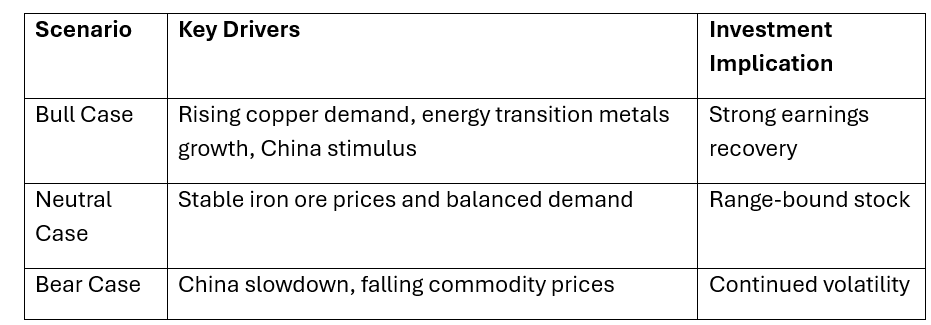
Source: Kalkine Group
What Is the Short-Term Outlook for Rio Tinto Stock?
Short term (3–6 months), the stock appears neutral to slightly bearish.
Reasons include:
- Commodity price volatility
• China demand uncertainty
• Mining sector profit-taking
However, strong dividends may limit downside.
What Is the Medium-Term Outlook for Rio Tinto?
Medium term (1–3 years), outlook is constructive.
Key drivers:
- Infrastructure spending globally
• Energy transition metals demand
• Copper and lithium growth
What Is the Long-Term Outlook for Rio Tinto?
Long term, Rio Tinto remains strategically positioned for the energy transition.
Metals critical for electrification include:
- Copper
• Lithium
• Aluminium
These are expected to see structural demand growth through 2030.
What Strategies Could Investors Consider?
Short-Term Strategy
- Monitor commodity price trends
• Watch China economic data
• Expect volatility
Medium-Term Strategy
- Accumulate during commodity cycles
• Focus on dividend income potential
Long-Term Strategy
- Hold exposure to critical minerals
• Benefit from energy transition demand
What Key Risks Should Investors Watch?
- Commodity price crashes
• China economic slowdown
• Mining project execution risks
• Environmental regulations
How Does Rio Tinto Perform on ESG Metrics?
Rio Tinto has increased focus on:
- Decarbonizing mining operations
• Renewable energy use in mining
• Responsible resource development
However, the mining industry still faces environmental and regulatory scrutiny globally.
What Are Investors Frequently Asking About Rio Tinto Stock?
Why is Rio Tinto stock falling today?
Weak iron ore prices and broader mining sector profit-taking.
Is Rio Tinto a good dividend stock?
Historically yes, though dividends are cyclical.
Is Rio Tinto exposed to energy transition metals?
Yes, particularly copper and lithium.
Does China affect Rio Tinto stock?
Yes, China demand heavily influences iron ore prices.
Is Rio Tinto Stock a Buy After the Dip?
Rio Tinto’s 5.61% decline in March 2026 appears driven more by cyclical commodity sentiment rather than structural weakness.
Short term, volatility may continue due to global growth uncertainty and China demand trends.
However, over the long term, Rio Tinto’s strong balance sheet, high dividend yield, and strategic exposure to future metals position it as a key player in the global energy transition and critical minerals supply chain.
For investors seeking FTSE 100 dividend stocks with exposure to global commodities, Rio Tinto remains one of the most closely watched mining companies.


 Jun 05, 2026




 Please wait processing your request...