
 CA
 NZ
 US
 AU
 IND

 UK

 Share
 X (Formerly Twitter)
 Whatsapp
 Facebook
 LinkedIn
 Telegram
 Email This Article
 Copy Link
 Summarize with AI
 Chat GPT
 Perplexity

Summary
ECO Animal Health Group plc (LSE:EAH), an AIM-listed UK veterinary medicines company, reported results for the year ended 31 March 2026 on 15 July 2026 that came in ahead of expectations. Revenue rose 10% to £87.5m, adjusted EBITDA increased 16% to £8.5m, profit before tax grew 35% to £5.4m, and earnings per share reached 3.26p. North America was the key driver, up 22% to £26.1m and about 30% of group sales, while China and Japan grew 5% and Latin America 15%. Gross margin widened to 49%. The group ended with £25.4m net cash and recommended no dividend, reinvesting in R&D. Strategically, it launched the ECOVAXXIN MS poultry vaccine after early EU approval, with US approval expected by end-2026. Risks include generic competition to flagship antibiotic Aivlosin, regional concentration and pipeline execution.
Five Key Takeaways
- Revenue increased 10% to £87.5m, with adjusted EBITDA up 16% to £8.5m and profit before tax up 35% to £5.4m.
- North America was the standout, with revenue up 22% to £26.1m and now around 30% of the group.
- Gross margin widened to 49% from 45%, reflecting a richer sales mix and operational discipline.
- The ECOVAXXIN MS poultry vaccine gained early EU approval and launched commercially, marking a move into preventative healthcare.
- The balance sheet remains debt-free with £25.4m net cash, but no dividend was recommended as cash is reinvested in R&D.
Company Overview
ECO Animal Health Group plc is a London-headquartered developer and marketer of medicines for farmed animals, quoted on London's AIM market under the ticker EAH. Its business has historically centred on Aivlosin, a macrolide antibiotic based on the active ingredient tylvalosin, used to treat and control respiratory and enteric (gut) diseases in pigs and poultry, two of the largest livestock categories in global protein production. The product is registered in more than 70 countries, and the group operates through a network of local subsidiaries and distribution partners rather than owning large-scale manufacturing itself, outsourcing much of its production and focusing its own resources on regulatory approvals, product development and commercial relationships. Revenue is spread across several regions, with North America, China and Japan, and Latin America the largest contributors, which gives the group geographic breadth but also exposes it to swings in individual national markets. In recent years management, led by chief executive David Hallas, has sought to broaden the business beyond a single flagship antibiotic by investing in a pipeline of vaccines and other products, positioning the company for what it describes as its next phase of growth. The wider industry backdrop matters here: livestock producers and regulators are placing greater emphasis on responsible antibiotic use and disease prevention, which raises the strategic value of vaccines relative to therapeutic antibiotics over the long term. That strategic shift, from a predominantly therapeutic antibiotic supplier towards preventative animal health, frames how the latest results should be read.
What Has Happened Recently?
On 15 July 2026 ECO Animal Health published results for the year ended 31 March 2026. The headline was a set of numbers that the company and commentators characterised as ahead of expectations. Total revenue reached £87.5m, up roughly 10% on the prior year's £79.6m, while adjusted EBITDA — earnings before interest, tax, depreciation and amortisation, adjusted for one-off items and a common proxy for underlying operating profitability — rose 16% to £8.5m. Statutory profit before tax advanced 35% to £5.4m, and the group reported a statutory profit of £3.6m, up from £2.6m. Earnings per share increased 31% to 3.26p. Alongside the financial figures, the company confirmed the commercial launch of its ECOVAXXIN MS poultry vaccine following early European Union marketing authorisation, and reported that a first commercial order had been received after the year-end. Independent research house Equity Development, in a note titled around the FY26 results being ahead of expectations, dated 15 July 2026, was among those flagging the beat; such broker views should be treated as the analyst's own opinion rather than fact. In a further sign of confidence, a director share purchase by the chief executive was disclosed shortly after results.
Analysis of the Latest Development
The most important theme in these results is the changing shape of the revenue base. North America grew 22% to £26.1m and now represents close to 30% of group sales, making it the single largest region and the principal engine of growth. That matters because it reduces the group's historical dependence on China, a market that has proven volatile. China and Japan grew a more modest 5% to £24.1m, a recovery from earlier weakness but not a return to rapid expansion. Latin America was solid, up 15% to £18.8m. Set against these gains, South and Southeast Asia fell 7% to £11.1m and Europe slipped 2% to £4.8m, a reminder that growth is not uniform. The second theme is margin. Gross margin — the share of revenue left after the direct cost of goods — widened to 49% from 45%, which is the mechanism translating relatively steady top-line growth into faster profit growth. The third theme is strategic: the ECOVAXXIN launch is the first tangible evidence of the pivot towards vaccines and preventative products, an area with different competitive dynamics from off-patent antibiotics. Taken together, the picture is of a business improving its quality of earnings while beginning to diversify its product base, albeit from an early stage.
Financial Performance and Balance Sheet
The balance sheet remains a clear strength. ECO ended the year with net cash of £25.4m, marginally higher than the prior year's £25.0m, and reported that 61% of that cash was held outside China — a relevant detail given periodic restrictions on moving capital out of that market. The company carries no material debt, which affords it flexibility to fund research and development from internal resources. That funding priority explains the board's decision not to recommend a dividend; management has chosen to reinvest cash into its pipeline rather than return it to shareholders, so income-seeking investors will find nothing here for now. On profitability, the combination of a 10% revenue increase and a four-percentage-point improvement in gross margin drove the 16% rise in adjusted EBITDA and the sharper 35% increase in pre-tax profit, illustrating the operational leverage in the model when revenue mix improves. Cash generation supported the pipeline investment without eroding the net cash position. Investors should note that reported growth can be flattered or dampened by currency movements, since ECO sells across many territories; at the interim stage the company had highlighted a gap between constant-currency and reported growth, so exchange rates remain a factor to watch when comparing periods.
Principal Assets, Products and Operations
Aivlosin remains the commercial backbone of the group, and management described demand as resilient during the year despite increasing generic competition across its markets. As the active ingredient tylvalosin has come off patent in various territories, lower-cost rivals have entered, which over time can pressure both volumes and pricing — one reason the diversification strategy carries such weight. The operational highlight of the year was ECOVAXXIN MS, a vaccine targeting Mycoplasma synoviae, a bacterial infection in poultry. It secured EU marketing authorisation ahead of schedule and launched commercially, with the company citing a 44-week duration of immunity as a competitive attribute. US Department of Agriculture approval is anticipated by the end of 2026, and dossiers have been submitted in markets including Thailand and Argentina. A related product, ECOVAXXIN MG, has received a favourable USDA safety assessment, with final submission anticipated in the first half of 2028, while a PCV2/Mhyo bivalent vaccine is expected to reach marketing authorisation around 2028. Management framed the wider pipeline as potentially delivering up to nine product approvals in the US or EU over the next five to six years, though such timelines are inherently uncertain and depend on regulatory outcomes. The commercial appeal of vaccines is that they tend to command firmer pricing and face less direct generic substitution than an off-patent antibiotic, so a successful pipeline could gradually improve the durability of group margins. Achieving that, however, requires ECO to navigate multiple regulatory jurisdictions, each with its own dossier requirements and review timetables, and to build or extend distribution for products that are new to its salesforce.
Potential Growth Catalysts
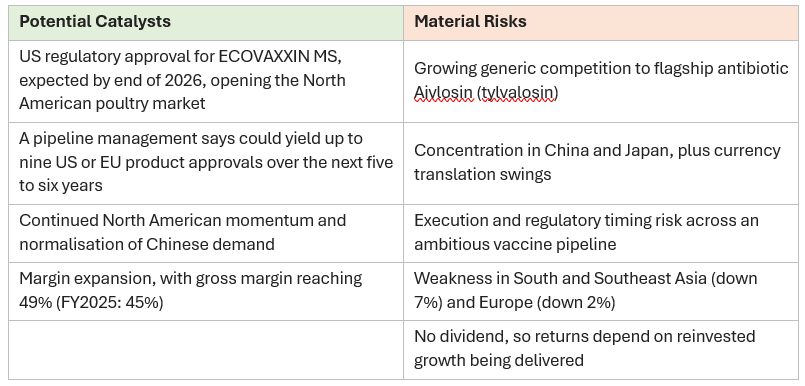
Several identifiable events could support the investment case over the coming year to eighteen months. The clearest near-term catalyst is US regulatory approval for ECOVAXXIN MS, expected by year-end 2026, which would open the sizeable North American poultry market to a product already validated in Europe. Beyond that, the broader pipeline — including the ECOVAXXIN MG vaccine and the PCV2/Mhyo bivalent product — offers a sequence of potential approval milestones through 2028, each representing an incremental revenue opportunity distinct from the legacy antibiotic business. Continued momentum in North America, where new business activity has been building, could sustain group growth even if other regions remain subdued. A more durable recovery in Chinese demand would provide additional upside, given how much that market has weighed on past performance. Finally, the demonstrated ability to expand gross margin suggests further profit growth is achievable if the sales mix continues to improve, without necessarily requiring dramatic revenue acceleration.
Material Risks and Challenges
The risks are material and should be weighed carefully. Generic competition to Aivlosin is the most fundamental: as an off-patent antibiotic, it faces structural pricing and volume pressure that could erode the group's core earnings if newer products do not scale quickly enough to compensate. Geographic concentration is another concern; China and Japan still account for a substantial share of revenue, and Chinese sales have historically been erratic, while currency translation across many territories adds volatility to reported figures. The vaccine strategy, while promising, carries execution and regulatory-timing risk — approvals can slip, and commercial uptake of new products is never guaranteed. The year also showed pockets of weakness, with South and Southeast Asia down 7% and Europe down 2%, indicating that growth remains unevenly distributed. Finally, the absence of a dividend means shareholder returns depend entirely on management successfully converting reinvested cash into future growth, a bet that may not suit all investors. None of these observations should be read as advice on whether to hold the shares.
Catalysts versus Risks at a Glance
What Investors Should Monitor Next
Investors following ECO Animal Health should watch for confirmation of USDA approval for ECOVAXXIN MS, expected by the end of 2026, and any disclosure of early sales traction from its EU launch. Progress reports on the wider vaccine pipeline, particularly regulatory submissions in Thailand, Argentina and the US, will indicate whether the group's approval ambitions are on track. On the financials, the next interim results will reveal whether North American momentum has persisted and whether Chinese demand continues to normalise. It is also worth monitoring Aivlosin volumes and pricing commentary for signs of intensifying generic competition, the trajectory of gross margin, and the net cash position as pipeline investment continues. Currency effects are worth tracking, since much of the group's sales is generated outside the United Kingdom and reported figures can diverge from constant-currency growth. Any change to the group's capital-allocation stance — including a future decision on dividends, or a first commercial contribution from the newly launched vaccines feeding into revenue — would be a meaningful signal for the market.
Balanced Conclusion
ECO Animal Health's FY2026 results depict a company making measurable progress on two fronts: improving the quality and geographic balance of its earnings, and taking its first commercial steps into vaccines. Double-digit revenue growth, wider margins, sharply higher profit and a robust debt-free balance sheet with £25.4m of net cash provide a credible foundation, and the North American acceleration is genuinely encouraging. Yet the investment case rests on the group successfully offsetting long-term pressure on its legacy antibiotic with a pipeline that remains largely unproven in the market and subject to regulatory timing. The next twelve to eighteen months, and the ECOVAXXIN regulatory approvals in the United States in particular, will test whether the strategic pivot can genuinely deliver. This article is informational and does not constitute investment advice.


 Nov 16, 2026





 Please wait processing your request...