
 CA
 NZ
 US
 AU
 IND

 UK

 Share
 X (Formerly Twitter)
 Whatsapp
 Facebook
 LinkedIn
 Telegram
 Email This Article
 Copy Link
 Summarize with AI
 Chat GPT
 Perplexity

Summary
Sareum Holdings plc (LSE:SAR) is a UK pre-revenue, clinical-stage biotechnology company developing SDC-1801, an oral selective dual TYK2/JAK1 inhibitor aimed initially at psoriasis and other autoimmune conditions. In June 2026 it published first-in-human Phase 1 data — a study of 95 healthy adults reporting no deaths and no treatment-related serious adverse events — in the British Journal of Clinical Pharmacology. On 20 July 2026 it completed dosing in the Phase 2-enabling toxicology programme, targeting a full regulatory package by the fourth quarter of 2026. Sareum reported £3.5m cash at 30 June 2025 and an FY2025 loss before tax of £3.06m. A Phase 2 patient trial would require substantially more funding, so partnering or fundraising is pivotal. The investment case is speculative and binary, dependent on unproven clinical efficacy, financing and a competitive TYK2 market. This is not investment advice.
Five Key Takeaways
- SDC-1801 Phase 1 data in 95 healthy adults were published in the British Journal of Clinical Pharmacology, reporting no deaths and no treatment-related serious adverse events.
- Dosing in the Phase 2-enabling toxicology programme was completed on 20 July 2026, with the full regulatory package targeted for the fourth quarter of 2026.
- Sareum reported cash of £3.5m at 30 June 2025; a Phase 2 patient trial would require materially more funding than the company currently holds.
- The Phase 1 tested safety and pharmacology only; therapeutic efficacy in patients with autoimmune disease remains entirely unproven.
- The investment case is high-risk and binary, hinging on clinical results, competitive positioning against approved TYK2 drugs, and Sareum's ability to fund or partner the next stage.
Company Overview
Sareum Holdings plc (LSE:SAR) is a small UK drug-discovery company developing selective kinase inhibitors for autoimmune, inflammatory and cancer indications. Its lead asset is SDC-1801, an oral small molecule designed to inhibit two enzymes, tyrosine kinase 2 (TYK2) and Janus kinase 1 (JAK1). These enzymes sit within signalling pathways that drive inflammation; blocking them is an established therapeutic approach, validated commercially by Bristol Myers Squibb's approved TYK2 inhibitor deucravacitinib (Sotyktu). Sareum's stated rationale is that dual, selective TYK2/JAK1 inhibition may offer a differentiated balance of activity and tolerability. The company operates a capital-light, virtual model, outsourcing laboratory and clinical work to contract organisations and retaining a small in-house team. Historically Sareum also advanced an oncology asset, the Chk1 inhibitor SRA737, and it retains an earlier-stage TYK2/JAK1 oncology programme referred to as SDC-1802. As a pre-revenue business, Sareum has no marketed products and funds itself through equity issuance and UK and Australian research and development tax credits. Its equity is therefore a speculative, development-stage holding whose value rests almost entirely on future clinical and commercial outcomes rather than current trading.
What Has Happened Recently?
Two announcements frame the current picture. On 22 June 2026 Sareum reported that the first-in-human Phase 1 results for SDC-1801 had been published in the British Journal of Clinical Pharmacology, a peer-reviewed title. The paper, a first-in-human, randomised safety, pharmacokinetic, food-effect and pharmacodynamic study, described a study of 95 healthy adults conducted on a randomised, double-blind, placebo-controlled basis across doses from 5mg to 150mg. Then, on 20 July 2026, the company announced completion of dosing in the Phase 2-enabling toxicology programme for SDC-1801. That programme had been restarted in February 2026 after an earlier preclinical toxicology study was discontinued owing to findings the company stated were considered unrelated to the drug. Executive Chairman Dr Stephen Parker said the toxicology programme completed on schedule, using existing cash resources, while Chief Scientific Officer Dr John Reader described the completion of dosing as an important milestone towards completing the full Phase 2-enabling regulatory package. Sareum said data analysis, together with chemistry, manufacturing and controls and formulation work, is ongoing, with the full Phase 2-enabling package targeted for the fourth quarter of 2026. Separately, Edison Group published an executive-interview note dated 16 July 2026; readers should treat any Edison commentary as the broker's own view rather than independent fact.
Analysis of the Latest Development
For a company of Sareum's size, achieving a peer-reviewed publication of Phase 1 results is a meaningful credibility marker: external reviewers have scrutinised the data, and the findings are now part of the scientific record rather than a company presentation. The reported pharmacokinetics — a half-life of roughly 15 to 27 hours, which the authors noted supports once- or twice-daily oral dosing — are commercially relevant, because convenient dosing matters in chronic autoimmune conditions. The pharmacodynamic biomarker analysis was described as providing evidence of sustained engagement of both TYK2 and JAK1, with dose-dependent reductions in inflammatory markers including IP-10 and high-sensitivity C-reactive protein. The paper also reported that modelling suggested 70mg twice daily achieved blood exposure comparable to a reference dose of the competitor compound brepocitinib. These are encouraging signals, but they must be read for exactly what they are. This was a healthy-volunteer study designed to establish safety, tolerability and pharmacology; it was not designed to, and did not, demonstrate that SDC-1801 improves any disease. Biomarker movement in healthy people is supportive but is not clinical efficacy. The genuinely value-determining questions — whether the drug reduces disease severity in patients, how it compares head-to-head with entrenched competitors, and whether its safety profile holds up over longer exposure — remain open and will only be answered by a properly powered Phase 2 study that has not yet begun.
Financial Performance and Balance Sheet
Sareum's finances reflect its stage. In its preliminary results for the year ended 30 June 2025, announced 23 October 2025, the company reported cash reserves of £3.5m, up from £1.5m a year earlier, a loss before tax of £3.06m, and R&D tax credits of £1.2m. At the prior half-year, 31 December 2024, cash stood at £4.1m. The company has not, in the sources reviewed here, published a specific cash-runway date, and this article does not attempt to estimate one; investors should look to the interim results — the half-year report covering the six months to 31 December 2025 was released on 12 March 2026 — and subsequent statements for the latest balance-sheet position. What is clear is the direction of travel: recurring operating losses funded by periodic equity raises and tax credits. Share count has grown, with roughly 138.6m shares reported in mid-June 2026 against about 124.7m referenced in a late-2024 Edison note, illustrating the dilution that accompanies this funding model. The Executive Chairman's remark that the toxicology programme was completed using existing cash resources is reassuring for the near term, but completing a Phase 2-enabling package is far cheaper than running a Phase 2 trial. On any realistic reckoning, a mid-stage patient study would cost multiples of Sareum's current cash, so additional capital — via a fundraise, a partnership, or both — is the central financial question facing the company.
Principal Assets, Products and Operations
SDC-1801 is the value driver. Sareum positions it as a selective oral inhibitor of TYK2 and JAK1 with high selectivity over the related JAK2 and JAK3 kinases, a profile the company argues is important for tolerability. The initial target indication is psoriasis, a common chronic inflammatory skin disease, and the company has framed the broader opportunity across autoimmune and inflammatory conditions. The programme has moved through a completed Phase 1 in Australia, now published, and the Phase 2-enabling toxicology and manufacturing work described above. Behind SDC-1801, Sareum has referenced an earlier-stage TYK2/JAK1 asset directed at oncology (SDC-1802), which remains preclinical, and it has a legacy interest in the Chk1 inhibitor SRA737. Operationally, Sareum runs a lean outsourced model, which keeps fixed costs low but leaves it dependent on third-party contractors and on the availability of financing to trigger each new phase of work. The strategic logic many small biotechs of this type pursue is to generate a robust clinical and regulatory data package and then secure a larger partner to fund and commercialise late-stage development; whether Sareum can achieve such a deal, and on what terms, is unknowable in advance and cannot be assumed.
Potential Growth Catalysts
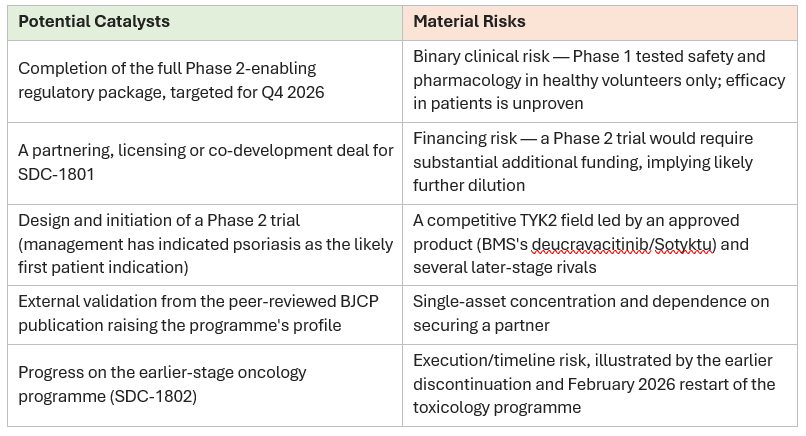
Several identifiable events could move sentiment over the coming quarters. The nearest is completion of the full Phase 2-enabling regulatory package, which the company targets for the fourth quarter of 2026; a clean package would remove a key technical hurdle to starting patient studies. Beyond that, any announcement of a partnering, licensing or co-development agreement for SDC-1801 would be significant, both as external validation and as a potential source of non-dilutive funding. Confirmation of a Phase 2 trial design, indication and start — management has pointed to psoriasis as the likely first patient setting — would mark the programme's transition from pharmacology to therapeutic proof. The recent peer-reviewed publication may itself raise the asset's visibility among potential partners and specialist investors. Progress on the SDC-1802 oncology programme could add optionality, though it is much earlier and less material near term. Each of these is a genuine catalyst, but none is guaranteed to occur on any particular timetable, and several depend on securing funding first.
Material Risks and Challenges
The risks here are substantial and should not be understated. First, clinical risk is binary: SDC-1801 has never been tested for efficacy in patients, and the great majority of drugs that clear Phase 1 still fail to demonstrate a viable benefit-risk profile in later trials. Encouraging healthy-volunteer pharmacology does not de-risk that outcome. Second, financing risk is acute. Sareum's cash is modest relative to the cost of a Phase 2 programme, meaning it will likely need to raise equity — probably at whatever price the market dictates — or find a partner; failure to do either on acceptable terms could stall the programme. The steady rise in share count shows dilution is a live feature of the story. Third, the competitive landscape is demanding: the TYK2 mechanism is already validated by an approved, marketed product, and several other companies are pursuing TYK2 or related pathways, so SDC-1801 would enter as a late mover needing clear differentiation. Fourth, the business is heavily concentrated in a single lead asset and reliant on external contractors and, potentially, on a future partner it does not yet have. Finally, execution and timeline risk is real, as shown by the discontinuation and February 2026 restart of the toxicology work. This is a speculative holding that could result in a total loss of invested capital; it is not suitable for investors who cannot tolerate high volatility and binary outcomes.
Catalysts versus Risks at a Glance
What Investors Should Monitor Next
Investors following the name should watch for a defined sequence of disclosures. The most immediate is confirmation, expected around the fourth quarter of 2026, that the full Phase 2-enabling regulatory package is complete and that the toxicology and manufacturing data support progression. Alongside that, any update on funding strategy — a placing, subscription, or news of partnering discussions — will indicate how Sareum intends to bridge to a Phase 2 trial. The interim and annual financial statements will reveal the current cash balance and the pace of spend, allowing a clearer read on runway. Finally, any communication on Phase 2 trial design, chosen indication, geography and timing would signal that the programme is genuinely advancing into patients rather than remaining in preparatory work. The absence of such news, or repeated slippage in timelines, would itself be informative.
Balanced Conclusion
Sareum has reached a credible technical checkpoint. Publishing SDC-1801's Phase 1 data in a peer-reviewed journal and completing dosing in the Phase 2-enabling toxicology programme are real, verifiable steps that strengthen the asset's foundations. Yet the company stands exactly where the science says it does: it has a well-characterised molecule with a plausible mechanism and a clean early safety readout, but no evidence yet that the drug helps patients, and not enough cash to prove it alone. The coming months should clarify both the regulatory package and, crucially, how Sareum intends to fund or partner the next stage. The opportunity is a differentiated shot at a large autoimmune market; the risks are clinical failure, dilution and competition. Both sides of that ledger are material, and neither should be discounted. This article is general information and does not constitute investment advice.


 Nov 16, 2026





 Please wait processing your request...