
 CA
 NZ
 US
 AU
 IND

 UK

 Share
 X (Formerly Twitter)
 Whatsapp
 Facebook
 LinkedIn
 Telegram
 Email This Article
 Copy Link
 Summarize with AI
 Chat GPT
 Perplexity

Summary
Capita (LSE:CPI) is a UK outsourcing and business process services group midway through a lengthy turnaround. Rising margins, deep cost cuts, disposals and strong contract wins point to genuine progress, but higher net debt, a widened statutory loss and a fresh pensions profit warning mean the recovery is not yet proven sustainable.
Five Key Takeaways
- Capita's 2025 results showed adjusted operating profit up more than a third and margins widening, even as reported revenue fell and the statutory loss deepened sharply.
- The group has delivered around 250 million pounds of annualised cost savings and is simplifying its structure by selling its private sector contact centre business to Inspirit Capital.
- Net financial debt rose to 143.4 million pounds at the end of 2025, underlining that the balance sheet remains a central pressure point for the turnaround.
- Contract momentum is strong, with total contract value won up sharply and roughly one billion pounds of new work secured in the first half of 2026.
- A Civil Service Pension Scheme remediation issue is set to reduce 2026 adjusted operating profit, showing how quickly delivery risks can offset progress.
Company Overview
Capita (LSE:CPI) is one of the United Kingdom's best-known outsourcing and business process services groups, providing back-office administration, customer management, pensions services and technology-enabled operations for government departments, local authorities and large private sector clients. For decades it has run some of the plumbing of British public life, from collecting the BBC licence fee to administering vast pension schemes and staffing contact centres, making it a bellwether for the health of the wider outsourcing sector.
The company has spent several years working through a demanding restructuring after a period of over-expansion, accounting problems and reputational damage, including the fallout from a 2023 cyber incident. Under chief executive Adolfo Hernandez, the strategy has centred on simplifying a sprawling group, cutting costs, disposing of non-core businesses and steering the remaining operations towards higher-margin, technology-led services with a growing emphasis on artificial intelligence.
A leaner, more focused group
Capita today is organised around a smaller set of core divisions, principally Public Service, Pension Solutions and its contact centre operations, the private sector part of which is being sold. Management frames the goal as becoming a more focused provider of complex, differentiated middle and back-office services, rather than a low-margin generalist competing on price across every corner of the outsourcing market.
What Has Happened Recently?
The most significant recent milestone was the full-year 2025 results, published in March 2026, which crystallised both the progress and the pressures within the turnaround. Adjusted operating profit rose sharply and margins improved, but reported revenue declined and the group booked a much larger statutory operating loss, partly reflecting goodwill impairment and settlement costs.
Alongside the numbers, Capita announced in March 2026 that it had agreed to sell its private sector contact centre business to Inspirit Capital. The structure was unusual, with only a nominal initial consideration but a substantial performance-linked earn-out, and it was designed to remove a lower-margin, capital-intensive operation while preserving upside if the business performs. Management said completion was expected before the August 2026 half-year results.
A fresh pensions setback
In July 2026 the company delivered a less welcome update. It warned that remediation work and service backlogs on the newly launched Civil Service Pension Scheme contract would weigh on profitability, even as it continued to win new business. The warning was a reminder that, in outsourcing, a single large, complex contract can materially move group results in either direction.
Why the Stock Is Attracting Attention
Capita attracts attention because it is a genuine turnaround situation with a recognisable name and a long operating history. Recovery stories of this kind can appeal to investors who believe the market has been too pessimistic and that visible operational improvement, if sustained, could eventually be reflected in a re-rating of the shares.
The improving quality of the order book has sharpened that interest. Capita reported a large increase in total contract value won during 2025 and secured roughly one billion pounds of new work in the first half of 2026, with a much higher win rate and its best customer satisfaction score in years. For a company long dogged by contract losses and execution failures, evidence that clients are once again trusting it with major mandates is an important shift in sentiment.
The artificial intelligence angle
Management has leaned heavily into an artificial intelligence and automation narrative, positioning technology as a way to lift margins and differentiate its services. Investors drawn to the theme see Capita as a large, data-rich operator that could use automation to transform the economics of back-office processing. That potential is real, but it is also unproven at scale, and the market will want to see it translate into durable profit rather than presentation slides.
Principal Projects, Products or Operations
Capita's Public Service division sits at the heart of the group, delivering administration and citizen-facing services for central and local government. These are typically long-duration contracts covering areas such as pensions administration, personal independence payment assessments, and support services for public bodies. They provide relatively predictable revenue but carry heavy delivery obligations.
The Pension Solutions business administers workplace and public sector pension schemes, a specialist, regulation-heavy field where scale and systems matter. This division has been a source of both opportunity and difficulty in 2026: it has won new mandates, including major public schemes, yet the Civil Service Pension Scheme transition has generated remediation costs and disruption that spilled into the wider pensions operation.
Simplifying the portfolio
The contact centre operations, which handle customer management for a range of clients, are being reshaped through the disposal of the private sector arm to Inspirit Capital. The disposed unit generated substantial revenue but at lower margins, and its sale is intended to lift group profitability, reduce complexity and free management to concentrate on more differentiated services.
Latest Financial Position
The 2025 accounts show a business making real operational headway while still carrying financial strain. Adjusted operating profit reached 113.5 million pounds, up more than 34 per cent, and the adjusted operating margin widened to 5.2 per cent from 3.8 per cent, driven by the roughly 250 million pounds of annualised cost savings delivered. At the same time, reported revenue fell to 2,312.3 million pounds, and the group posted a statutory operating loss of about 129.6 million pounds, hit by a large goodwill impairment and settlement costs.
The balance sheet is the crux of the debate. Net financial debt, measured before lease liabilities, rose to 143.4 million pounds at the end of 2025 from 66.5 million pounds a year earlier, and free cash flow excluding business exits remained negative, albeit less so than in 2024. Capita has extended its revolving credit facility to 325 million pounds, giving it headroom, but relatively high leverage against a limited equity base leaves little margin for error if trading disappoints.
Cash flow the key test
For 2026, management guided to positive free cash flow excluding business exits, though the July pensions warning is expected to reduce both adjusted operating profit and cash generation, and the group has indicated that a return to positive group free cash flow, before disposal effects, is more likely in 2027. Converting improving profitability into consistent cash generation, and using it to bring net debt down, is the key test of a sustainable turnaround.
Potential Growth Catalysts
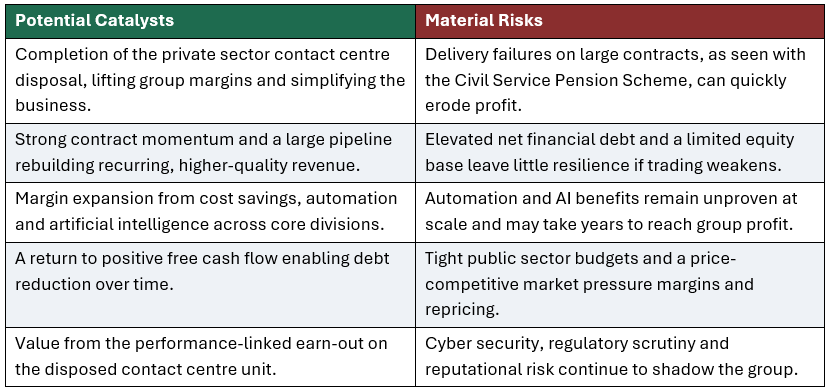
The clearest near-term catalyst is completion of the private sector contact centre disposal. Removing a large, low-margin operation is expected to lift the group margin meaningfully, deliver annualised savings and simplify the story that management tells investors, and any eventual earn-out would add value over the following years.
Sustained contract momentum is a second catalyst. With a very large pipeline and a markedly improved win rate, Capita has the opportunity to rebuild recurring revenue on more disciplined terms. Converting that pipeline into signed, profitable, well-executed contracts, particularly in pensions and public services, would strengthen confidence that the commercial engine is genuinely repaired rather than temporarily flattering the numbers.
Margins and automation
Longer term, the biggest potential prize is margin expansion through automation and artificial intelligence. If Capita can demonstrably use technology to process work more cheaply and reliably, it could reset the economics of a business that has historically struggled with thin margins. Evidence of this feeding through to higher, more durable profit, alongside falling net debt, would be the combination most likely to change how the market values the shares.
Material Risks and Challenges
The most immediate risk is execution on complex contracts, as the Civil Service Pension Scheme episode illustrates. Large public sector transitions are difficult, and remediation of service backlogs can be costly and reputationally damaging. Because a handful of big contracts can swing group results, any further delivery problems could quickly offset the benefits of cost cutting and undermine confidence in the recovery.
Leverage is the second major challenge. With net financial debt having risen and the equity base limited, Capita has less resilience than a stronger balance sheet would provide. If cash generation disappoints, the group could face pressure to accelerate disposals, cut investment or, in a worse scenario, consider other funding measures, any of which could weigh on the shares and dilute the recovery thesis.
Structural and market pressures
Capita also operates in a competitive, price-sensitive outsourcing market where public sector budgets are tight and clients increasingly wary after high-profile industry failures. Regulatory scrutiny, contract repricing, cyber security exposure and the sheer difficulty of turning around a large, complex organisation all remain live challenges.
What Investors Should Monitor Next
The August 2026 half-year results will be an important checkpoint. Investors should look for confirmation that the contact centre disposal has completed, an early read on the scale of the Civil Service Pension Scheme profit impact, and evidence that the cost savings and margin gains seen in 2025 are being sustained rather than eroded by remediation spending.
Net debt and cash flow deserve particularly close attention. The market will want to see whether Capita is on track to generate positive free cash flow and, crucially, whether it can begin to reduce net financial debt. Commentary on the revolving credit facility, working capital and any further disposals will help gauge the group's real financial headroom.
Contracts and delivery
Finally, contract news flow and delivery quality will shape sentiment. Watch for major new wins, renewals of existing mandates and, equally, any signs of further slippage or remediation on large contracts.
Balanced Conclusion
Capita (LSE:CPI) has clearly moved beyond the crisis phase of its restructuring. Margins are widening, cost savings are substantial, the portfolio is being simplified through the contact centre sale, and contract momentum has returned with a stronger win rate and a large pipeline. For a group once defined by profit warnings and contract losses, that represents real, measurable progress towards a more focused and profitable business.
Yet the question posed in the headline, whether the turnaround is finally sustainable, cannot yet be answered with confidence. Net debt has risen, the statutory loss widened in 2025, and the July 2026 pensions warning shows how easily a single complex contract can knock the recovery off course.
The honest conclusion is that Capita is a turnaround that is progressing but not complete. The direction of travel is encouraging and the strategy is coherent, yet sustainability will only be demonstrated through consistent cash generation, falling debt and reliable delivery over several reporting periods. Investors weighing the shares should treat them as a recovery play still carrying meaningful execution and balance-sheet risk rather than a finished success story.
Catalysts and Risks at a Glance


 Nov 17, 2026





 Please wait processing your request...