
 CA
 NZ
 US
 AU
 IND

 UK

 Share
 X (Formerly Twitter)
 Whatsapp
 Facebook
 LinkedIn
 Telegram
 Email This Article
 Copy Link
 Summarize with AI
 Chat GPT
 Perplexity

Summary
Cohort plc (LSE:CHRT), an AIM-listed UK defence and security technology holding company, reported record results for the year to 30 April 2026 on 15 July 2026. Revenue rose 13% to £306.4m, adjusted operating profit rose 32% to £36.3m and the adjusted margin reached 11.8%. The closing order book was a record £618.8m, covering close to 88% of expected FY2027 revenue, with order intake of £314.2m. The dividend was raised around 10%, a twentieth consecutive annual increase, and net funds were a modest £2.9m. Cohort owns seven subsidiaries across the UK, Germany, Portugal and Australia, including MASS, MCL, SEA, EID, ELAC Sonar, EM Solutions and Chess Dynamics. Management guided to double-digit earnings growth over three years. Key risks include defence-budget dependence, uneven divisional margins and contract-timing volatility.
Five Key Takeaways
- FY2026 revenue rose 13% to £306.4m and adjusted operating profit jumped 32% to £36.3m, lifting margin to 11.8%.
- The closing order book reached a record £618.8m, covering close to 88% of expected FY2027 revenue.
- Order intake of £314.2m modestly exceeded revenue, so the book-to-bill ratio remained above one.
- The dividend was raised by around 10%, marking a twentieth consecutive year of increases.
- Management guided to double-digit earnings growth over three years, but defence budget dependence and low Sensors margins remain key risks.
Company Overview
Cohort plc is a holding company that owns a portfolio of specialist defence and security technology businesses. Rather than operating as a single integrated manufacturer, it acts as a parent that acquires and develops autonomous subsidiaries, each with its own management, markets and technology. The group is listed on London's AIM market under the ticker CHRT and traces its origin to a 2006 flotation. Today it comprises seven trading subsidiaries across the United Kingdom, Australia, Germany and Portugal: Chess Dynamics (surveillance and fire-control systems); EID, a Portuguese maker of naval and military communications systems; ELAC Sonar, a German sonar and underwater-communications supplier; EM Solutions, an Australian producer of high-end satellite communications terminals for navies; MASS (electronic warfare, digital services and training); MCL, which sources and supports electronic and surveillance technology for UK government end users including the Ministry of Defence; and SEA, which provides technology products for defence and transport markets plus research and training. For reporting purposes Cohort now groups these into two divisions: Communications & Intelligence, and Sensors & Effectors. The model rests on decentralised operating companies benefiting from central capital allocation, governance and cross-selling, while retaining the agility of smaller specialist firms.
What Has Happened Recently?
On 15 July 2026 Cohort published results for the year ended 30 April 2026, describing another record year and a positive outlook, accompanied by a dividend timetable notice. The figures were slightly ahead of the preliminary numbers flagged in an earlier pre-close trading update. The headline audited numbers were revenue of £306.4m, up 13%, and adjusted operating profit of £36.3m, up 32%, lifting the adjusted operating margin to 11.8%. Statutory profit before tax rose 27% to £32.6m, and adjusted earnings per share increased 14% to 61.9p. The board raised the total dividend by around 10%, extending an unbroken run of annual increases to twenty years. The most closely watched figure, given the group's order-driven model, was the closing order book of £618.8m — a record and only marginally below the roughly £620m signalled at the trading update. Order intake of £314.2m was modestly above reported revenue, so the group continued to add to its backlog faster than it consumed it. Management also reported that the order book underpinned close to 88% of expected FY2027 revenue, a level of cover rare among smaller industrial companies.
Analysis of the Latest Development
The investment case for Cohort rests on two linked pillars: a structurally supportive end market and a business model designed to convert that demand into compounding cash generation. Defence budgets across the United Kingdom, wider Europe and NATO have been on a rising trajectory, reflecting a deteriorating security environment. That backdrop has fed through into higher enquiry levels, larger contract awards and, ultimately, the record order intake reported for FY2026. What distinguishes Cohort from a simple defence-demand play is the quality of its earnings visibility. A closing order book worth more than twice reported annual revenue, combined with roughly 88% cover of the following year's expected sales, means the group enters FY2027 with the majority of its revenue already contracted. That reduces execution risk and, in principle, supports the board's guidance of double-digit earnings growth over the coming three years and cumulative cash generation of approximately £120m before capital expenditure and dividends over that period. The results also show the benefit of Cohort's acquisitive strategy. The Communications & Intelligence division led growth, helped by the first full-year contribution from EM Solutions, the Australian satellite-communications business acquired in the prior year, and carried a margin of roughly 20%. That performance illustrates how well-chosen bolt-ons can lift group profitability. The counterpoint is the Sensors & Effectors division, whose revenue was broadly stable and whose margin remained comparatively thin. The divergence between the two divisions is the central tension in the current story: strong momentum in higher-margin communications and intelligence work is offsetting a more subdued sensors performance, and investors will want evidence that the sensors side can recover.
Financial Performance and Balance Sheet
The FY2026 financials point to genuine operational leverage rather than revenue growth alone. A 13% increase in revenue translated into a 32% rise in adjusted operating profit, lifting the adjusted margin to 11.8%. That gearing reflects both the higher-margin mix within Communications & Intelligence and the absorption of fixed costs across a larger revenue base. Adjusted earnings per share of 61.9p, up 14%, grew more slowly than operating profit, a gap that typically reflects tax, interest and share-count effects. Cash and balance-sheet strength deserve careful reading. According to its trading commentary, the group ended the year with modest net funds of around £2.9m, down from £5.3m the previous year. For a business of Cohort's scale that is a slim cushion, and it underlines how working capital in long-cycle defence contracts can swing between reporting dates as milestone payments and inventory build move in and out. To provide headroom, the group renewed and expanded its banking facilities to £175m, with an additional £50m accordion option, giving it substantial capacity to fund both organic growth and further acquisitions. The dividend remains a signal of confidence. A roughly 10% increase, taking the record to twenty consecutive years of growth, is consistent with a management team that expects continued profit and cash progression. Investors should nonetheless weigh the dividend commitment against the group's appetite for acquisitions and the periodic working-capital demands of its contracts. None of these figures should be read as a guarantee of future returns; defence contracting is inherently uneven.
Principal Assets, Products and Operations
Cohort's principal assets are its seven operating subsidiaries and the intellectual property, contracts and skilled workforces they contain. Geographically the group is anchored in the United Kingdom but has meaningful operations in Germany through ELAC Sonar, in Portugal through EID and in Australia through EM Solutions. This spread offers diversification across national defence budgets and reduces reliance on any single procurement cycle, while also introducing currency translation exposure. Operationally the businesses address a range of naval, land and electronic-warfare requirements. Naval and maritime work features prominently, spanning sonar, satellite communications, shipboard communications and surveillance. On land and across the intelligence domain, MASS and MCL provide electronic warfare, secure data services, training and specialist equipment support, much of it for UK government customers. SEA and Chess Dynamics extend the group into fire control, transport technology and research services. The common thread is technology-led products embedded in long-life defence platforms, which tends to generate recurring support and upgrade revenue over many years. The two-division reporting structure is designed to make these capabilities easier to assess. It also reflects how Cohort increasingly seeks collaboration between subsidiaries — for example combining sensing, communications and data capabilities on larger programmes — while preserving each company's operational independence.
Potential Growth Catalysts
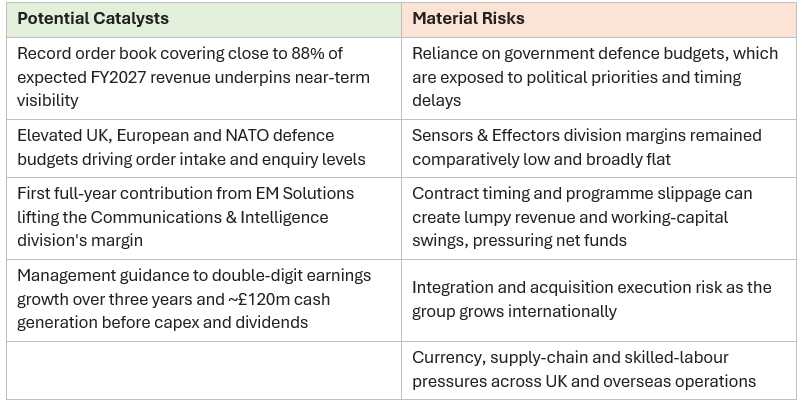
Several potential catalysts could support the investment case over the medium term. The most immediate is the record order book itself: with close to 88% of expected FY2027 revenue already covered, the group has unusual visibility, and further large contract awards would extend that cover into FY2028 and beyond. The elevated defence-spending environment across the UK, Europe and NATO provides a supportive demand backdrop, and any formal increases in national budgets could accelerate order intake. Management's own guidance is a second catalyst. The board has pointed to double-digit earnings growth over the next three years and to substantial cash generation, which, if delivered, would underpin continued dividend growth and acquisition capacity. The expanded £175m banking facility gives the group firepower for further bolt-on deals of the kind that have historically lifted margins, as the EM Solutions acquisition has demonstrated. Commissioned and independent research houses, including Equity Development and SQC Research, published positive notes following the results; SQC Research, for example, set a target price of 1,550p, a view that is theirs and not a recommendation reproduced here as advice. Continued margin recovery in the Sensors & Effectors division would be a further, company-specific catalyst.
Material Risks and Challenges
The risks are material and should be weighed alongside the opportunity. Cohort's fortunes are closely tied to government defence budgets, which are subject to political priorities, spending reviews and the timing of procurement decisions. A change in policy, a delayed programme or a budget reallocation could slow order intake even against a generally supportive backdrop. Contract timing is itself a risk: defence work is lumpy, and milestone slippage can move revenue and profit between periods and cause working capital to swing, as the reduction in net funds this year illustrates. Divisional performance is uneven. The Sensors & Effectors business delivered broadly flat revenue at a comparatively low margin, and a failure to improve there would cap group profitability even if Communications & Intelligence continues to perform. Acquisitions, while a source of growth, carry integration and execution risk, and paying full prices for future targets could dilute returns. The group's international footprint exposes it to currency movements, and, like the wider sector, it faces supply-chain constraints and competition for skilled engineers. Finally, the slim net-funds position leaves less margin for error should several contracts see payments delayed simultaneously. This is not a risk-free holding, and no defence contractor's earnings are fully predictable.
Catalysts versus Risks at a Glance
What Investors Should Monitor Next
Investors should watch the interim results, typically published around December, for evidence that first-half order intake and margins remain on track, particularly any recovery in the Sensors & Effectors division. New contract announcements via regulatory news will indicate whether the order book continues to grow, while the net-funds position at the half-year will show how working capital is trending. Beyond company-specific news, UK and European defence-budget decisions and any strategic defence review outcomes are worth monitoring, as is progress integrating EM Solutions and any further acquisition activity funded by the expanded banking facility. Taken together, these markers will show whether Cohort is sustaining the momentum that produced its record FY2026, or whether the sensors weakness and contract-timing effects begin to weigh more heavily on the group's trajectory.
Balanced Conclusion
Cohort's FY2026 results extend a consistent record of growth, combining a record order book, rising margins and a twentieth consecutive dividend increase against a supportive defence-spending backdrop. The high level of revenue cover and management's medium-term guidance give the story unusual visibility for a company of its size. Set against that are genuine risks: dependence on government budgets, uneven divisional margins, lumpy contract timing and a slim net-funds cushion. The result is a business with a credible growth pathway that nonetheless demands careful attention to execution. Investors are, in effect, being asked to back a proven acquirer and integrator of specialist defence businesses at a time when demand is strong but valuations across the sector already reflect much of that optimism. This article is analysis, not investment advice, and readers should form their own view.


 Nov 17, 2026





 Please wait processing your request...