
 CA
 NZ
 US
 AU
 IND

 UK

 Share
 X (Formerly Twitter)
 Whatsapp
 Facebook
 LinkedIn
 Telegram
 Email This Article
 Copy Link
 Summarize with AI
 Chat GPT
 Perplexity

Summary
Defence Holdings (LSE:ALRT) is a London-listed, software-led defence technology company that recently pivoted from esports and signed its first revenue-generating Ministry of Defence contract. Rising European defence spending offers a large market, but the group is early stage, tiny and loss-making, so execution and funding will decide whether demand translates into durable growth.
Five Key Takeaways
- Defence Holdings rebranded from Guild Esports in May 2025, adopting the ALRT ticker and a strategy focused on software-led, AI-driven defence capabilities.
- In July 2026 the group secured its first revenue-generating UK Ministry of Defence contract worth roughly £226,000 over three months.
- Its five-year plan targets drone warfare, AI, information warfare and critical infrastructure protection via a product-studio and buy-and-build model.
- The company remains small, with a market value around £33m, modest cash and losses, leaving it reliant on further fundraising to scale.
- Surging European defence budgets provide a supportive backdrop, but Defence Holdings must prove it can win and deliver larger contracts.
Company Overview
Defence Holdings (LSE:ALRT) describes itself as the United Kingdom's first listed software-led defence technology company. It trades on the London Stock Exchange's Main Market within the aerospace and defence sector, but its history is unusual. The business is the successor to Guild Esports plc, the competitive gaming company part-backed by the footballer David Beckham. After the esports venture struggled to secure sustainable financing, the group divested those operations and reinvented itself, completing a full strategic pivot into defence teschnology and adopting the Defence Holdings name and ALRT ticker in May 2025.
The company's ambition is to build a portfolio of software-defined, artificial-intelligence-driven defence capabilities rather than to manufacture traditional hardware such as vehicles, ships or munitions. Management frames this as addressing modern, asymmetric security threats, where software and autonomy increasingly determine national-security outcomes. The stated focus areas span drone warfare, AI agents for defence operations, information and influence warfare, and the protection of critical national infrastructure.
Board and positioning
Defence Holdings is led by chief executive Andrew Roughan, with James Norwood as chairman, whose background includes Royal Navy service and experience at Raytheon. The group positions itself as a sovereign UK player able to bridge private capital, emerging technology and government requirements across the European defence ecosystem.
What Has Happened Recently?
The most significant recent development came in July 2026, when Defence Holdings announced its first revenue-generating contract with the UK Ministry of Defence. Valued at approximately £226,000 over an initial three-month period, the engagement covers testing and deployment of an integrated intelligence, decision-support and operational-effects capability designed to combine open-source and classified information into a single analytical platform. Although modest in cash terms, the company presented it as a pivotal moment marking its transition into a revenue-generating business.
The contract followed a UK Government transparency notice published in June 2026 that had identified Defence Holdings in connection with a proposed Ministry of Defence technology engagement. Earlier in 2026 the group set out a detailed operating model and, separately, entered its first strategic partnership under that framework with OM Defence Systems, a developer of software-defined autonomous defence systems and counter-drone technology informed by operational experience in Ukraine.
Building the platform
Across 2025 and 2026 the company published a five-year strategic plan covering 2025 to 2030, appointed its executive leadership and used an at-the-market facility to raise incremental equity. These steps have shifted Defence Holdings from a shell-like transition story towards an operating business with an early contract.
Why the Stock Is Attracting Attention
Defence Holdings has captured investor attention primarily because of the powerful macro backdrop. Governments across Europe have committed to sharply higher defence spending in response to the war in Ukraine and heightened geopolitical tension, and NATO members are lifting budgets beyond long-standing targets. The global defence market is measured in trillions of dollars, and a growing share is flowing towards software, autonomy, drones and digital capability rather than legacy platforms. A small, software-focused UK company is an appealing way for investors to gain exposure to that theme.
The stock's dramatic story adds to the interest. Having pivoted from a struggling esports venture, the shares have been highly volatile, rising many-fold at points over the past year before retreating. That volatility, combined with a low share price and a compelling narrative, has made ALRT a popular name among retail investors and on share-chat forums, where speculation about future contracts can move the price sharply.
Sovereign capability angle
There is also a strategic-narrative appeal. The United Kingdom has emphasised sovereign defence and technology capability, and Defence Holdings pitches itself at that agenda as a home-grown, listed platform. Securing an actual Ministry of Defence contract gives the story a tangible reference point that many pre-revenue peers lack.
Principal Projects, Products or Operations
Defence Holdings is structured around a small number of interconnected capability pillars rather than a single flagship product. The first is drone warfare and aggregation, encompassing uncrewed systems, drone interception and counter-unmanned-aerial-system technology. The second is artificial intelligence for defence, including the AI agents and decision-support tools that underpin its first Ministry of Defence engagement. The third and fourth pillars cover information and influence warfare and the defence of critical national infrastructure.
Operating model
Rather than build everything in-house, the company operates what it calls a product-studio and buy-and-build model. Its published operating framework integrates three elements: customer requirements, emerging technology capabilities and private capital. The aim is to identify strategically relevant defence technologies, support their commercialisation, and take strategic, often equity-linked, positions in specialist businesses across the European defence ecosystem.
The partnership with OM Defence Systems illustrates the approach in practice. Under that arrangement, Defence Holdings takes a strategic equity-linked position and shares in revenue from customer contracts it introduces, while supporting capital strategy, operational scaling and market access. OM Defence Systems focuses on software-defined autonomous systems, including drone interception and counter-drone infrastructure. The Ministry of Defence intelligence contract, meanwhile, provides an early, real-world deployment of the group's software-led proposition.
Latest Financial Position
Defence Holdings remains a very small, early-stage company, and its financial position must be read in that light. It has a market value of roughly £33m, many shares in issue and a penny-stock price that has swung violently over the past year. Reported revenue over the trailing period largely reflected declining legacy income rather than the new defence strategy, and the group has been loss-making as it builds its platform.
Funding has come from equity rather than operations. When the company relaunched in 2025 it raised about £3.45m through an oversubscribed placing, with non-executive directors contributing additional funds, taking the total to close to £3.8m before expenses. It has since used an at-the-market facility to raise further capital in tranches, a structure that allows flexible fundraising but can be dilutive over time.
Cash and dilution
As an early-stage business with minimal recurring revenue, Defence Holdings depends on its cash resources and continued access to capital markets to fund growth. The newly signed Ministry of Defence contract provides its first meaningful revenue, but at roughly £226,000 over three months it is not yet transformational. Investors should therefore watch the cash balance, the pace of further equity issuance and the extent of dilution closely.
Potential Growth Catalysts
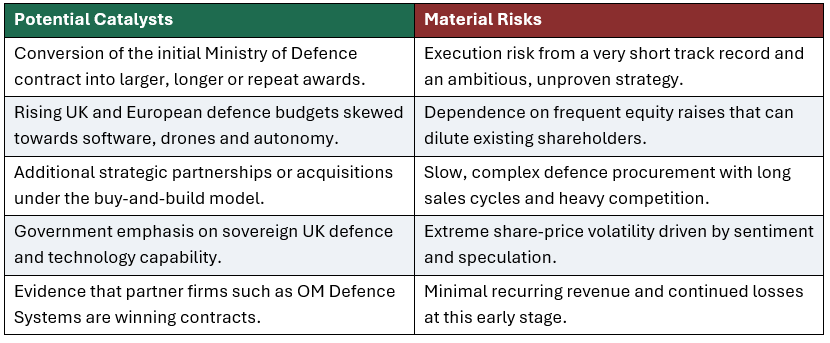
The most important catalyst is conversion of the current Ministry of Defence engagement into larger, longer or repeat work. If the initial three-month contract demonstrates the platform's value, it could open the door to follow-on awards and relationships with other parts of the UK security and defence establishment. Each incremental contract would help validate the business model and provide a firmer revenue base than the group has today.
A second catalyst is the broader spending environment. Sustained increases in UK and European defence budgets, with a rising share directed towards software, drones and autonomy, would expand the addressable market for a company positioned as Defence Holdings is. Government emphasis on faster procurement could particularly benefit smaller, agile suppliers.
Partnerships and acquisitions
The buy-and-build model offers a third avenue. Additional strategic partnerships along the lines of the OM Defence Systems arrangement, or selective acquisitions of promising defence-technology businesses, could add capability, revenue and credibility. Any well-received transaction or evidence that portfolio companies are winning their own contracts would represent a potential catalyst, provided such moves are funded without excessive dilution.
Material Risks and Challenges
The central risk is execution. Defence Holdings is an early-stage company with a very short track record in defence, a single small revenue contract and an ambitious multi-year plan. Building a credible defence-technology group, winning government business at scale and integrating acquired capabilities are all difficult, and there is no guarantee the strategy will succeed. The pivot from esports also means current management has limited history operating together in this sector.
Funding and dilution are closely related risks. With minimal recurring revenue, the company depends on capital markets to finance its plans. Continued use of at-the-market issuance and any future placings could dilute existing shareholders, and weaker appetite for speculative small-caps could make raising money harder or costlier.
Sector and competitive risks
Defence procurement is slow, complex and heavily regulated, with long sales cycles and intense competition from established primes and well-funded specialists. Political priorities and budgets can shift, and reliance on government customers concentrates risk. As a micro-cap, Defence Holdings has limited resources relative to larger rivals, and any delay in winning further contracts could quickly weigh on its share price.
What Investors Should Monitor Next
The clearest thing to watch is contract news. Investors will want to see whether the initial Ministry of Defence engagement leads to an extension, a larger follow-on award or additional customers. The scale, duration and visibility of any new contracts will be the most direct evidence of whether defence technology demand is genuinely translating into revenue rather than remaining a narrative.
Financial disclosures are equally important. Future results should reveal the cash position, the rate at which the company is spending, and how much new equity is being issued. A clear path towards recurring, growing revenue and a stabilising share count would strengthen the case, whereas persistent losses funded by heavy dilution would raise concerns.
Strategy delivery
Finally, investors should monitor delivery against the five-year plan. Progress on the drone, AI, information-warfare and infrastructure pillars, further partnerships or acquisitions, and evidence that portfolio companies such as OM Defence Systems are winning work would all indicate momentum. Commentary on UK and European defence budgets and procurement reform will also help investors judge whether the supportive backdrop is being converted into tangible business.
Balanced Conclusion
Defence Holdings (LSE:ALRT) offers a high-risk way to play one of the strongest structural themes in markets: rising defence spending and the shift towards software, autonomy and AI in national security. Its reinvention from a struggling esports company into a listed, software-led defence group is bold, and the first revenue-generating Ministry of Defence contract gives the strategy an early, tangible anchor that many speculative peers lack.
Against that, the company is tiny, loss-making and dependent on capital markets, with a single small contract and an unproven ability to scale in a demanding, slow-moving industry. The share price has been extremely volatile, and dilution is a real consideration. The gap between the size of the opportunity and the current size of the business is very wide, and closing it will take time, capital and consistent execution.
On balance, whether defence technology demand can drive Defence Holdings' next growth phase depends less on the market backdrop, which is clearly supportive, and more on delivery. Turning early engagement into larger contracts, funding growth without excessive dilution and executing the buy-and-build model will determine the outcome. For now, it remains an early-stage, speculative story to watch closely.
Catalysts and Risks at a Glance


 Nov 17, 2026





 Please wait processing your request...