
 CA
 NZ
 US
 AU
 IND

 UK

 Share
 X (Formerly Twitter)
 Whatsapp
 Facebook
 LinkedIn
 Telegram
 Email This Article
 Copy Link
 Summarize with AI
 Chat GPT
 Perplexity

Summary
Smiths News plc (LSE:SNWS) is the UK's largest newspaper and magazine wholesaler. On 17 July 2026 it won exclusive magazine distribution contracts with publishers Frontline and Seymour worth about £105m in annual revenue, effective April 2030 and running to April 2037. These followed June 2026 newspaper awards from News UK (17 June) and Associated Newspapers (29 June, to July 2037); combined with News UK, Smiths News will cover roughly 36% of the national newspaper and magazine market from January 2028. First-half FY2026 results (26 weeks to 28 February 2026) showed revenue of £515.7m, down 3.9%, adjusted operating profit of £18.3m, net cash of £7.8m and an unchanged 1.75p interim dividend. FY2025 revenue was £1,064.0m with an 8.55p total dividend. The contracts extend revenue visibility beyond 2030 but do not reverse the structural decline in print volumes. Full-year results are due on 4 November 2026
Five Key Takeaways
- On 17 July 2026 Smiths News won exclusive magazine wholesale contracts with Frontline and Seymour, adding roughly £105m of annual revenue and running from April 2030 to April 2037.
- These follow June 2026 newspaper awards from News UK and Associated Newspapers; together with News UK the group will cover about 36% of the national newspaper and magazine market from January 2028.
- H1 FY2026 (26 weeks to 28 February 2026) showed revenue of £515.7m, down 3.9%, and adjusted operating profit of £18.3m, down 5.7% — a reminder that print volumes keep falling.
- The balance sheet is in net cash (£7.8m at end-H1), free cash flow was £21.2m, and the interim dividend was held at 1.75p.
- Structural decline in physical print remains the defining risk; the contracts improve visibility and defend share, but do not create new demand.
Company Overview
Smiths News plc (LSE:SNWS) is the largest wholesale distributor of newspapers and magazines in the United Kingdom. Based in Swindon, it sits in the middle of the print supply chain: publishers hand titles to Smiths News, which breaks bulk, sorts and delivers copies overnight to tens of thousands of retailers — supermarkets, convenience stores, forecourts and independent newsagents — usually before they open, and handles returns. The company operates through exclusive regional and national contracts, meaning that within a territory it is the sole wholesaler for a given publisher's titles. That model gives Smiths News unusual protection for a business exposed to a declining product: because distribution is exclusive and the logistics are hard to replicate, publishers tend to renew with incumbents on long-dated contracts. The trade-off is that printed newspapers and magazines are in long-term structural decline as readers migrate to digital. Smiths News's task, in effect, is to manage that decline profitably, extract network efficiencies, hold its contracted share, and build adjacent growth verticals such as recycling and collectables that use the same delivery infrastructure. The group demerged from the former Connect Group and trades as a focused, cash-generative small-cap.
What Has Happened Recently?
The most eye-catching development came on 17 July 2026, when Smiths News was appointed exclusive national wholesale distributor for two major magazine publishers, Frontline and Seymour. According to the company's regulatory announcement, the awards add approximately £105m of incremental annual revenue across expanded Great Britain territories, take effect from April 2030 and run to April 2037. Frontline and Seymour between them represent more than 60% of the UK magazine market, so the deals materially reinforce Smiths News's position in magazines. An Edison note the same day used the pun "Now we can Seymour revenue in 2030", and Proactive and others noted the shares rose on the news. The magazine contracts follow two newspaper awards earlier in the summer. On 17 June 2026 the company confirmed a contract with News UK, publisher of The Sun and The Times; then on 29 June 2026 it was named Associated Newspapers Limited's exclusive national distribution partner across Great Britain, covering the Daily Mail, The Mail on Sunday and The i Paper, running from January 2028 to July 2037, with delivery service charges frozen for the contract's duration. Smiths News said the News UK and Associated Newspapers awards combined represent roughly 36% of the national newspaper and magazine market from January 2028. Together, the June and July wins amount to a concerted re-contracting of the group's largest publisher relationships on long-dated terms, with further financial detail promised at the preliminary results on 4 November 2026.
Analysis of the Latest Development
The investment question for Smiths News has always been the tension between a structurally shrinking end-market and a resilient, cash-generative model. This summer's contract flurry speaks to the second half of that equation. By locking in its largest publishers on contracts stretching to 2037, management has substantially de-risked the medium-term revenue base; where the H1 FY2026 statement cited 96% of existing publisher contract revenues secured to 2029, the News UK, Associated Newspapers, Frontline and Seymour awards push visibility several years further out. It is important to read these wins for what they are and are not. They are a defence — and in the magazine case an expansion — of Smiths News's contracted share of a declining market, secured on long terms that reduce the risk of a sudden competitive loss. They are not, by themselves, a source of net new print demand. The roughly £105m of incremental magazine revenue reflects expanded territories and additional publisher volumes moving onto the network rather than growth in readership. Investors should therefore treat the contracts as improving the durability of revenue, not as reversing the volume trend; the H1 numbers make that plain, with revenue and adjusted profit both down year on year. The longer-run question is whether Smiths News can grow its non-print verticals fast enough to matter; they grew 35% in H1, but from a small base, so for now the print contracts remain the core of the story.
Financial Performance and Balance Sheet
For the full year to 30 August 2025, Smiths News reported revenue of £1,064.0m, down 3.6%, with adjusted operating profit broadly flat at £39.1m. Adjusted profit before tax rose 7.8% to £35.8m and adjusted earnings per share were 11.1p. The board declared a total dividend of 8.55p — a 5.55p ordinary dividend plus a 3.0p special — up from 7.15p. The group ended the year in a net cash position of £3.3m, having reversed net debt, with free cash flow of £36.1m that included a £5.4m recovery relating to the McColl's administration. The first half of FY2026, covering the 26 weeks to 28 February 2026, showed the structural pressure continuing: revenue of £515.7m, down 3.9%, and adjusted operating profit of £18.3m, down 5.7%. Encouragingly for income-focused holders, free cash flow rose sharply to £21.2m from £13.3m and the group moved to net cash of £7.8m, against £12.4m of net debt a year earlier. The interim dividend was held at 1.75p, paid on 3 July 2026. Management said the results were in line with expectations and pointed to consensus full-year FY2026 adjusted operating profit of around £36.7m, with second-half demand supported by the Pokémon 30th anniversary collectables range and the men's football World Cup. Readers should note that £36.7m is a consensus market expectation, not company guidance, and actual results may differ.
Principal Assets, Products and Operations
Smiths News's principal assets are not factories or intellectual property but a national logistics network: distribution depots, a fleet and delivery routes engineered to move time-critical print from publishers to retailers overnight, seven days a week. That network is the company's competitive moat — the reliability, coverage and cost efficiency needed to serve national newspaper deadlines are difficult to replicate, which is why publishers renew rather than switch. The same infrastructure is the platform for diversification. The group is layering additional activities onto its rounds and depots — recycling, distribution of collectables and card products, and other physical-distribution work — that share the network's fixed cost. Because these verticals ride on existing assets, incremental revenue can be attractive at the margin, and management has flagged growth here, with verticals up 35% in H1. The frozen delivery service charges in some new contracts place a premium on extracting further efficiency over the contract life. Managing an ageing but essential logistics estate, while keeping unit costs down as volumes decline, is the operational heart of the business.
Potential Growth Catalysts
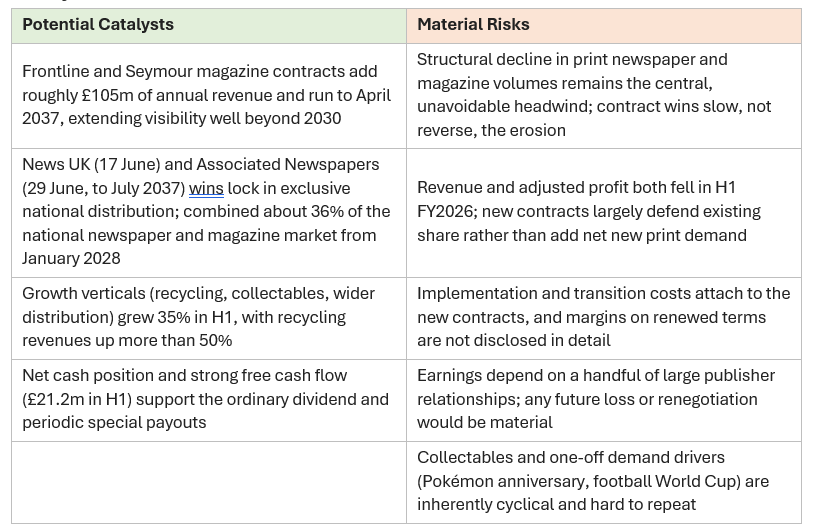
The clearest near-term catalyst is the strategic re-contracting itself. The Frontline and Seymour magazine awards, worth about £105m a year to 2037, on top of the News UK and Associated Newspapers wins, give the market a materially longer runway of visible revenue than a year ago, and management has said further financial detail will come with the 4 November 2026 preliminary results. Beyond that, continued double-digit growth in the recycling and collectables verticals would strengthen the case that Smiths News can build a modest offset to print decline. Cash generation is itself a catalyst for total return: the group has a track record of paying an ordinary dividend and topping it up with specials when cash allows, and the net cash balance sheet gives the board flexibility. Finally, specific second-half demand drivers — the Pokémon anniversary range and the football World Cup — could support the period, though these are one-off in nature.
Material Risks and Challenges
The central risk is structural and cannot be wished away: printed newspapers and magazines are in long-term volume decline, and Smiths News's revenue base shrinks a little each year as a result. The H1 FY2026 figures — revenue down 3.9%, adjusted operating profit down 5.7% — are the plain evidence. The new contracts defend that decline within Smiths News's share of the market; they do not create new readers. There is concentration risk, too: earnings hinge on a few very large publisher relationships, so any future loss, renegotiation or publisher consolidation would be material. The new contracts also carry implementation costs, and the group has not disclosed the margins on renewed terms, so the profit contribution of the £105m of magazine revenue from 2030 is not yet quantified publicly. Some recent demand tailwinds — collectables crazes and major sporting events — are cyclical and hard to repeat. And while the balance sheet is in net cash, the equity remains a small-cap exposed to a declining structural market, which typically limits the rating investors will pay. None of this constitutes advice on whether to own the shares.
Catalysts versus Risks at a Glance
What Investors Should Monitor Next
The next scheduled milestone is the preliminary full-year FY2026 results on 4 November 2026, at which management has promised further detail on the new contracts — watch for any indication of the margin and phasing of the £105m magazine revenue from 2030, and confirmation of the full-year outturn against the roughly £36.7m consensus. Beyond the headline figures, useful signals include the trajectory of the growth verticals, the pace of print-volume decline versus contracted share, progress on operational efficiencies, and the dividend decision — specifically whether the board repeats a special payout. Any further publisher contract news, renewals or losses would also move the investment case given the concentration of the revenue base.
Balanced Conclusion
The summer of 2026 has been a strategically important one for Smiths News. In the space of a month the company re-contracted its largest newspaper and magazine publishers on long-dated terms, culminating in the Frontline and Seymour awards worth roughly £105m a year to 2037. That is a genuine achievement in a declining market: it improves revenue visibility well beyond 2030, reinforces the group's role as the UK's largest print wholesaler, and does so from a net cash balance sheet that continues to fund dividends. Yet the investment case remains a study in managing decline. The first-half results confirm that print volumes keep falling, the new contracts defend rather than grow the underlying market, and the profit contribution of the 2030 magazine revenue is not yet spelled out. For investors, Smiths News is best understood as a cash-generative, contractually well-protected business in a structurally shrinking industry — durable cash flows balanced against an unavoidable long-term headwind. This article is for information only and is not investment advice.


 Nov 18, 2026





 Please wait processing your request...