
 CA
 NZ
 US
 AU
 IND

 UK

 Share
 X (Formerly Twitter)
 Whatsapp
 Facebook
 LinkedIn
 Telegram
 Email This Article
 Copy Link
 Summarize with AI
 Chat GPT
 Perplexity

Summary
Forgent plc (LSE:FORG), the AIM-quoted company formerly named EQTEC, is transforming from a waste-to-value gasification technology business into an Australian critical and precious-metals explorer. Whether its next move triggers a powerful re-rating depends on drilling results, shareholder approval and its ability to fund an ambitious pivot as a micro-cap.
Five Key Takeaways
- Forgent plc is the renamed EQTEC, an AIM-listed company shifting from advanced gasification technology towards critical and precious-metals exploration in Western Australia.
- Its emerging mining portfolio spans the Peak Hills gold-copper project, the Green Rock copper-gold prospect and an option over the Mount Sholl nickel-copper-PGE deposit in the Pilbara.
- The legacy EQTEC gasification and waste-to-value business is under strategic review, having taken longer than expected to generate meaningful revenue.
- As a micro-cap with continued losses and negative cash flow, the pivot is high-risk and depends heavily on drilling success and further fundraising.
- Investors should watch drill results, the shareholder vote on the new strategy, cash and dilution, and the fate of the legacy technology assets.
Company Overview
Forgent plc (LSE:FORG) is an AIM-quoted company undergoing one of the more dramatic reinventions on the junior market. Until 2026 it was known as EQTEC plc, a technology-led energy-transition business built around advanced gasification, converting waste into syngas for renewable energy and biofuels. After shareholder approval, the company rebranded as Forgent, before moving decisively towards critical and precious-metals mining in Australia.
The change of name is more than cosmetic. It marks a pivot from a European clean-technology developer, whose route to meaningful revenue proved longer and harder than hoped, to an aspiring resources company chasing metals tied to electrification and resource security. The legacy gasification business, and its intellectual property, has been placed under strategic review as management concentrates capital on the new mining direction.
A junior in transition
Forgent is a small, early-stage company rather than an established producer or a proven technology group. Its market capitalisation is measured in low single-digit millions of pounds, and it has a history of losses, leverage and negative cash flow. That makes it a speculative, high-risk proposition. The central question for investors is whether the pivot can create durable value or simply swap one difficult business model for another.
What Has Happened Recently?
The most consequential recent development is the wholesale repositioning of the company. Having rebranded from EQTEC to Forgent, the group announced a shift from a pure energy-transition focus towards an Australian mining-led strategy, assembling a portfolio of exploration projects through acquisitions and options.
During 2026 Forgent moved quickly. It secured a controlling interest in the Peak Hills gold-copper project, took an option over the Mount Sholl nickel-copper-PGE deposit in the Pilbara, and reported early results, including what it described as high-grade copper and gold from Green Rock. A drill rig was mobilised to Peak Hills and a maiden Phase 1 drilling programme was completed, marking the group's first substantive exploration activity as a would-be miner.
Corporate housekeeping
Alongside the operational pivot, Forgent has undertaken significant corporate activity. It completed an equity raise, including a placing to fund the acquisitions and working capital, described the corporate relaunch as removing near-term refinancing risk, and resolved a legacy litigation matter. It also published a circular and convened a shareholder meeting to approve the new strategy. These steps illustrate a board attempting to stabilise the balance sheet while executing a rapid change of direction.
Why the Stock Is Attracting Attention
Forgent is attracting attention because transformational pivots on the junior market can, occasionally, produce outsized moves. A company that swaps a slow-burning technology story for a portfolio of drill-ready mining prospects offers a fresh narrative, and micro-cap resource stocks are prone to sharp re-ratings when exploration newsflow turns positive.
The commodities themselves add to the appeal. Copper, gold, nickel and platinum group metals sit at the heart of two powerful themes: the electrification of the global economy and the search for secure supplies of critical minerals. Western Australia is a stable, well-understood mining jurisdiction, lowering some of the political risk that dogs exploration elsewhere, so a junior assembling these metals there has a clear, marketable story.
The re-rating question
The re-rating argument is straightforward in theory. The market currently values Forgent as a tiny, loss-making company in transition. If drilling defines meaningful mineralisation, investor perception could shift quickly from distressed technology relic to credible explorer, and the valuation could respond. Equally, exploration is unforgiving: most drill programmes do not deliver company-making results, so a re-rating is a possibility, not a promise. The next moves, drilling outcomes and the shareholder vote, will shape which way sentiment turns.
Principal Projects, Products or Operations
Forgent's emerging identity is built around three Western Australian exploration assets. The Peak Hills gold-copper project, in which the company holds a controlling interest, is the current focus of activity and the site of its first drilling campaign. Green Rock is a copper-gold prospect where early sampling returned encouraging high-grade results. Mount Sholl, held under an option agreement, is a nickel-copper-platinum group elements deposit in the Pilbara offering exposure to battery and industrial metals.
Together these projects give Forgent exposure across precious metals, base metals and the platinum group, aligned with electrification and critical-minerals demand. As an early-stage explorer, however, the company's assets are prospective rather than proven: value will depend on systematic drilling and, ultimately, the definition of resources capable of supporting development. None of the projects is in production, and the path from prospect to mine is long, capital-intensive and uncertain.
The legacy technology business
Forgent also retains the EQTEC gasification and waste-to-value technology platform, including proprietary intellectual property and involvement in projects designed to convert waste into energy. This legacy business is under strategic review, with the board assessing options. It could provide additional value, partnerships or disposal proceeds, but management has made clear that the future emphasis lies with the Australian mining strategy rather than the technology that originally defined the company.
Latest Financial Position
Forgent's financial profile is that of a stretched micro-cap in the middle of a costly transformation. The company has reported continued losses, leverage and negative operating cash flow, a legacy of the long, expensive effort to commercialise its gasification technology. Its market capitalisation has been very small, in low single-digit millions of pounds, reflecting caution about both the old business and the unproven new one.
To fund the pivot, Forgent completed an equity raise, including a placing, and characterised the resulting corporate relaunch as removing near-term refinancing risk. That capital is intended to fund the acquisitions, initial exploration and working capital. As with most junior explorers, the group is pre-revenue in its new guise and will almost certainly require further funding, so shareholders should anticipate additional dilution.
A balance sheet to watch
Because Forgent is so small and is spending on exploration while its legacy business generates little cash, the balance sheet is central to the investment case. The key financial questions are how far the recent fundraising stretches, what the legacy assets are worth, and on what terms any future capital is raised. For a company of this size, financing risk is arguably as important as geology.
Potential Growth Catalysts
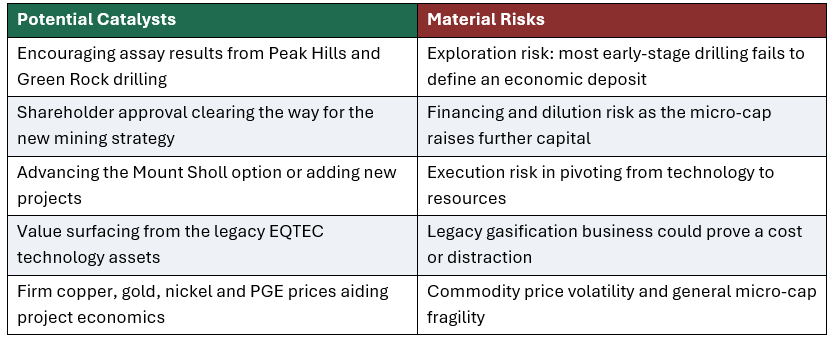
The most immediate catalyst is drilling. Assay results from the completed Peak Hills programme could be pivotal: encouraging grades and widths would lend credibility to the pivot and could drive a re-rating, while further high-grade results from Green Rock would reinforce the story. On the junior market, exploration newsflow is often the single biggest driver of share-price moves.
Corporate milestones provide further catalysts. Shareholder approval of the new strategy would remove uncertainty and let management press ahead, while advancing the Mount Sholl option, or adding projects, could broaden the portfolio. Monetising or partnering the legacy EQTEC assets could also surface value the current share price appears to attribute little weight to.
Commodity tailwinds
Longer term, the macro backdrop could work in Forgent's favour. Sustained strength in copper, gold, nickel or platinum group metal prices, underpinned by electrification and critical-minerals security, would improve the economics of any discovery and lift sentiment towards explorers generally. None of these tailwinds substitutes for exploration success, but together they could amplify the impact of good drilling results and support a more constructive view of the shares.
Material Risks and Challenges
The risks facing Forgent are substantial and characteristic of a transforming micro-cap explorer. Exploration risk is foremost: most early-stage drilling does not lead to a viable mine, and the projects are prospective rather than proven. Disappointing assays could quickly undermine the investment case and the share price.
Financing and dilution risk is equally serious. Forgent is a very small, loss-making company that will need further capital to fund exploration and development. Each raise can dilute existing shareholders, and the terms will depend on market conditions and progress on the ground. There is also execution risk in pivoting from technology to mining, which requires different skills and disciplines.
Transition and legacy uncertainty
The abrupt change of strategy carries its own hazards. Management is building a resources company almost from scratch, and the legacy gasification business remains an uncertain factor, potentially a source of value, cost or distraction. Broader risks include commodity price volatility, permitting and operational challenges in Australia, key-person dependence, and the general fragility of micro-cap equities, whose shares can be illiquid and highly volatile.
What Investors Should Monitor Next
The clearest signals to watch are exploration results. Investors should look closely at assay data from Peak Hills and any subsequent programmes, together with further work at Green Rock, as these will indicate whether the projects host mineralisation of genuine interest. Consistent, encouraging results would be the strongest evidence that the pivot has substance rather than merely a compelling narrative.
Corporate and financial developments matter just as much. The outcome of the shareholder meeting, the cash position after the recent raise, and any further fundraising will all shape the risk profile. Announcements on the Mount Sholl option, additional acquisitions, or the review of the legacy EQTEC assets should be read carefully for their impact on value and focus.
Governance and cadence
Investors should also monitor board composition, management's track record in resources, and the clarity and frequency of the company's disclosure as it establishes its new identity. For a micro-cap in transition, credibility is built through consistent delivery against stated plans. Watching how Forgent sequences drilling, funding and communication will help investors judge whether the transformation is progressing in a disciplined way or simply generating headlines without underlying substance.
Balanced Conclusion
Forgent plc (LSE:FORG) is a company mid-transformation: the former EQTEC, once a waste-to-value gasification technology developer, is reinventing itself as an Australian critical and precious-metals explorer. With projects spanning gold, copper, nickel and platinum group metals and a completed maiden drill programme, it offers a speculative, catalyst-rich story that could, in the right circumstances, re-rate sharply from a very low base.
Yet the case is finely balanced and unmistakably high-risk. Forgent is a tiny, loss-making company attempting a wholesale change of direction while managing an uncertain legacy business. Exploration success is far from guaranteed, further dilution appears likely, and the pivot demands skills and capital the company must still prove it can marshal. A powerful re-rating is conceivable, but so too is disappointment.
For investors, the sensible posture is to treat Forgent as the speculative micro-cap it is, weighing the genuine optionality of its new mining portfolio against substantial exploration, financing and execution risks. Whether its next move triggers a re-rating will hinge on drilling outcomes, the shareholder vote and disciplined funding, and no single announcement should be read as decisive.
Catalysts and Risks at a Glance


 Nov 24, 2026





 Please wait processing your request...