
 CA
 NZ
 US
 AU
 IND

 UK

 Share
 X (Formerly Twitter)
 Whatsapp
 Facebook
 LinkedIn
 Telegram
 Email This Article
 Copy Link
 Summarize with AI
 Chat GPT
 Perplexity

Summary
KEFI Gold and Copper (LSE:KEFI) is an AIM-quoted gold and copper developer whose flagship Tulu Kapi project in Ethiopia held a groundbreaking ceremony in February 2026 after securing more than US$400 million of funding. With construction now underway and Saudi Arabian interests progressing, the long-delayed breakthrough appears, at last, to be materialising rather than merely approaching.
Five Key Takeaways
- KEFI Gold and Copper held a groundbreaking ceremony at its Tulu Kapi gold project in Ethiopia on 18 February 2026, attended by the country's Prime Minister, marking the move into construction.
- The company has assembled a funding package exceeding US$400 million, anchored by US$240 million of secured project-finance debt, alongside contractor commitments, equity and a royalty.
- Management is following a 27-month development schedule, with first gold targeted for mid-2028 and KEFI retaining an expected beneficial interest of around 86 per cent.
- In Saudi Arabia, KEFI holds roughly 13 per cent of GMCO, whose Hawiah and Jibal Qutman assets provide a second growth avenue backed by government exploration support.
- KEFI reported cash of about 8.77 million pounds at end-2025 and later raised further equity, though execution, financing and country risks remain significant.
Company Overview
KEFI Gold and Copper plc (LSE:KEFI) is a London-quoted, AIM-listed mineral development company focused on gold and copper in the Arabian-Nubian Shield, a prospective belt stretching across the Red Sea from Ethiopia into Saudi Arabia. Its purpose has long been to convert well-defined resources into producing mines, and its story over the past decade has been dominated by the effort to finance and build its flagship Ethiopian asset.
The company operates across two jurisdictions. In Ethiopia it controls the Tulu Kapi gold project through Tulu Kapi Gold Mines, in which the federal government and regional interests also participate. In Saudi Arabia it holds a minority stake in Gold and Minerals Company, known as GMCO, a joint venture advancing copper-gold and gold discoveries in a jurisdiction the Kingdom has prioritised.
A developer at an inflection point
For years KEFI was characterised chiefly by delay, as security, permitting and financing hurdles repeatedly pushed back construction at Tulu Kapi. The significance of 2026 is that the company has moved from planning into building, transforming from a perennial developer-in-waiting into an asset genuinely under construction, with Saudi exposure alongside.
What Has Happened Recently?
The defining recent event is that construction of Tulu Kapi has begun. On 18 February 2026 KEFI held a groundbreaking ceremony at the site in the Oromia region, attended by Ethiopia's Prime Minister and senior regional officials, underlining the project's national importance. The company has described the mine as following a full 27-month schedule, placing first gold in mid-2028.
This milestone followed the assembly of the funding package that had eluded the company for so long. In early 2026 KEFI confirmed a financing structure exceeding US$400 million, combining secured project-finance debt of around US$240 million with contractor commitments, equity and an equity-ranking royalty, including a US$20 million agreement with Chancery Royalty Limited and participation by the Ethiopian government.
On the corporate side, KEFI has continued to strengthen its balance sheet through equity issuance. Having raised roughly 22.6 million pounds across 2025, it completed a further placing of about 35.6 million pounds in April 2026, supporting its share of development costs as construction ramps up.
Saudi progress in parallel
In Saudi Arabia, GMCO has continued to advance. It has been finalising a definitive feasibility study on Jibal Qutman, with a development launch targeted during 2026, while its Hawiah copper-gold discovery has been described as among the more significant in the region. GMCO was also selected for a Saudi government exploration support programme.
Why the Stock Is Attracting Attention
KEFI is attracting attention because it appears to be crossing the threshold that separates speculative developers from companies actually building mines. Markets have historically discounted Tulu Kapi heavily, reflecting years of postponement. A funded package, a formal groundbreaking and an active construction schedule change the narrative, because the central question shifts from whether the mine will be built to whether it can be delivered on time and on budget.
The commodity backdrop reinforces the interest. Gold has traded at historically elevated levels, and a project of Tulu Kapi's grade and scale becomes materially more valuable when bullion prices are high. Management has pointed to a project net present value well over a billion US dollars at KEFI's beneficial interest under elevated gold-price assumptions, a figure that dwarfs the company's market capitalisation.
A re-rating candidate?
For a developer, the transition from financing to construction is often when the market begins to close the gap between a heavily risk-adjusted valuation and the underlying project economics. If KEFI can demonstrate steady progress, debt drawdown and clear timelines toward first gold, investors may progressively de-risk the story. The Saudi assets offer an additional, less-appreciated source of value.
Principal Projects, Products or Operations
Tulu Kapi is KEFI's cornerstone. Located in western Ethiopia, it hosts maiden ore reserves of around 1.05 million ounces of gold within a broader resource of roughly 1.7 million ounces, at an average grade of about 2.7 grams per tonne and expected metallurgical recovery near 94 per cent. The open-pit operation is planned to produce an average of approximately 166,000 ounces of gold a year over an initial life of seven years or more.
The economics are underpinned by all-in sustaining costs management estimates broadly around US$1,100 to US$1,250 an ounce, comfortably below prevailing gold prices. KEFI has also flagged an underground expansion beneath the planned pit that could lift annual output toward 200,000 ounces, extending mine life if it proves economic once the surface operation is established.
The Saudi Arabian joint venture
KEFI's second pillar is its roughly 13 per cent interest in GMCO, whose portfolio includes the Hawiah copper-gold discovery and the Jibal Qutman gold project. GMCO has expanded its licences and secured government backing through Saudi Arabia's exploration enablement initiative. Although KEFI's stake was diluted as it prioritised Tulu Kapi funding, these assets provide meaningful optionality entirely independent of Ethiopia.
Latest Financial Position
KEFI's financial profile is that of a developer investing heavily ahead of revenue. In its 2025 results, published in June 2026, the group reported cash of about 8.77 million pounds at 31 December 2025, up sharply from roughly 185,000 pounds a year earlier, reflecting successful equity raising. As a pre-production company it generated no operating revenue and reported a net loss of around 9.69 million pounds for the year.
The pivotal financial development is the Tulu Kapi funding structure itself. The package of more than US$400 million comprises secured project-finance debt of approximately US$240 million, around US$60 million of contractor commitments and over US$100 million of equity-type contributions, leaving KEFI an expected beneficial interest of about 86 per cent. This layered structure spreads risk across lenders, contractors, government and royalty partners.
Company-level funding
At the corporate level, KEFI has funded its equity contribution and overheads through placings, including approximately 35.6 million pounds in April 2026, and is considering a possible move to the London Stock Exchange's Main Market. Investors should nonetheless treat all figures with care: a developer's position is defined less by present cash than by whether its funding plan carries the project reliably through to production without value-eroding surprises.
Potential Growth Catalysts
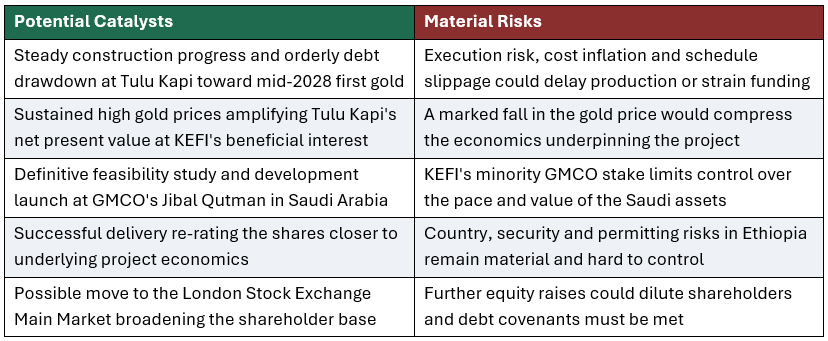
The clearest catalyst is demonstrable construction progress at Tulu Kapi. Each verifiable step, from earthworks and resettlement completion to plant fabrication and eventual commissioning, should progressively de-risk the timeline toward the targeted mid-2028 first gold. Confirmation that project-finance debt is being drawn down on schedule would signal that the funding package is functioning as intended.
A high gold price is a second, external catalyst. Because Tulu Kapi is a relatively high-grade, moderate-cost operation, sustained elevated bullion prices would materially enhance projected cash flows and net present value at KEFI's beneficial interest, so the macro environment could amplify the benefits of delivery.
Saudi value crystallisation
Progress within GMCO offers a further catalyst that is easy to overlook. A completed feasibility study and development decision at Jibal Qutman, resource growth at Hawiah, or an event that establishes a clearer value for the Saudi joint venture could each highlight upside only partially reflected in KEFI's rating. A Main Market listing, if pursued, might also broaden the shareholder base.
Material Risks and Challenges
The risks are substantial and characteristic of a single-asset developer building in an emerging jurisdiction. Execution risk is foremost: large mine construction routinely encounters cost inflation, schedule slippage, contractor issues and commissioning difficulties, any of which could delay first gold beyond mid-2028 or strain the funding package.
Country and security risk in Ethiopia cannot be ignored. The project has been delayed in the past by regional instability, and while conditions have supported the move into construction, the operating environment remains sensitive. Currency, permitting, community relations and resettlement all add complexity harder to manage than in established mining jurisdictions.
Financing and dilution risk
Although the headline funding is in place, developers frequently require additional capital, and KEFI has relied heavily on equity issuance, which dilutes shareholders. The debt component brings servicing obligations and covenants that must be met as construction proceeds. Gold-price weakness would compress the economics underpinning the structure, while the minority Saudi stake limits KEFI's control over GMCO's decisions.
What Investors Should Monitor Next
The most important things to monitor are the construction milestones that show whether Tulu Kapi is advancing to plan. Investors should look for updates on earthworks, resettlement completion, procurement of long-lead items, plant construction and, in due course, commissioning, alongside confirmation that the project remains aligned with its schedule and budget. Evidence of orderly debt drawdown would be especially reassuring.
Financing cadence is the second area to watch. Any further equity raises, changes to the funding structure, or news on the potential Main Market listing will shape both dilution and the cost of capital. Commentary on facility conditions, cost contingencies and the cash runway will matter as construction spending accelerates through 2026 and 2027.
Saudi and macro signals
Investors should also track developments at GMCO, including the Jibal Qutman feasibility study, any development launch, and exploration results from Hawiah, as these speak to the value of the second growth pillar. Finally, the gold price remains critical: sustained strength would bolster the case, while a marked decline would pressure the economics that justify the entire effort.
Balanced Conclusion
KEFI Gold and Copper (LSE:KEFI) has reached a genuine turning point. After years in which Tulu Kapi seemed perpetually on the horizon, the company has secured a funding package exceeding US$400 million, held a groundbreaking attended by Ethiopia's Prime Minister and moved into active construction toward first gold in mid-2028. To that extent, the long-awaited breakthrough is not merely approaching but has, in an important sense, begun.
Yet a groundbreaking is a beginning rather than a guarantee. The value now depends on delivery: building a substantial mine on time and on budget, in a jurisdiction that has previously tested the company's patience, while servicing project debt and managing exposure to gold prices. The Saudi interests add a promising but minority-held dimension whose value will take time to crystallise, and the company remains loss-making and reliant on funding.
For investors, the sensible posture is to weigh a materially de-risked, funded and commenced project against the considerable execution, country and financing risks that remain. Whether KEFI's breakthrough translates into a durable re-rating will be decided over the coming quarters by construction progress, disciplined funding and the gold price, judged patiently.
Catalysts and Risks at a Glance


 Nov 27, 2026





 Please wait processing your request...