
 AU
AU
 CA
CA
 US
US
 NZ
NZ
 IND
IND

 UK
UK

 Share
Share
 X (Formerly Twitter)
 Whatsapp
 Facebook
 LinkedIn
 Telegram
 Email This Article
 Copy Link
 Summarize with AI
 Chat GPT
 Perplexity
Executive Summary: The Healthcare Wealth Compounders of 2026
The FTSE healthcare sector in 2026 presents a bifurcated opportunity: the stability of global giants leveraging massive scale to compound wealth, and the explosive potential of undervalued biotech innovators trading at deep discounts. With the global "Smart Money" pivoting back to risk-on assets following the rate stabilizations of late 2025, fund managers are aggressively targeting companies with clear paths to profitability or massive revenue catalysts.
The three equities selected below represent a balanced "barbell" approach to wealth compounding: one "Anchor" (Steady Compounder), one "Deep Value" play (Asset Arbitrage), and one "Disruptive Growth" (Tech-Bio) candidate. Each has been selected based on January 2026 institutional sentiment, operational updates from the J.P. Morgan Healthcare Conference, and robust fundamental drivers.
Source: Kalkine Group
AstraZeneca (LSE: AZN) – The "Anchor" Compounder
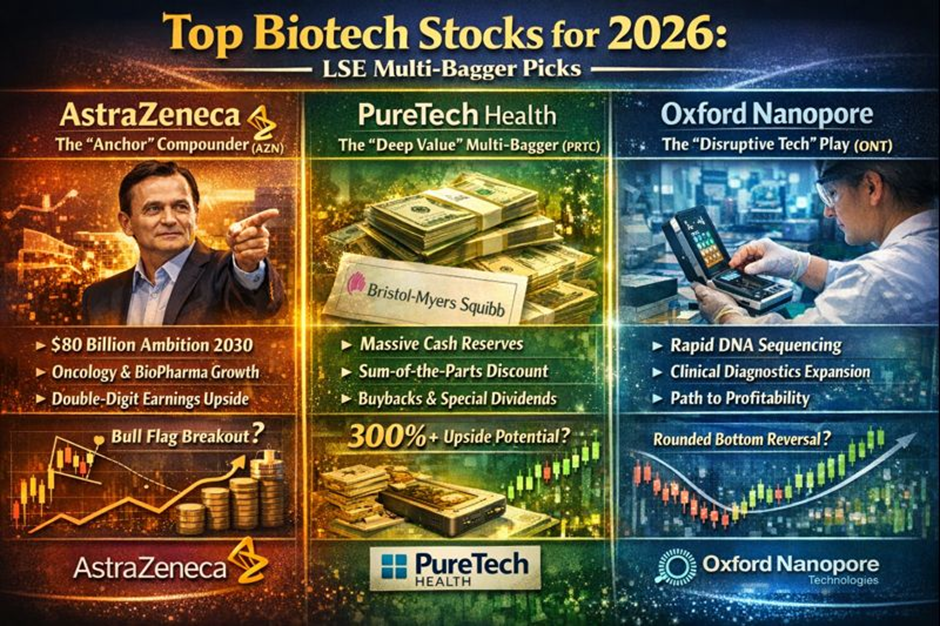
Key Reasons & Drivers AstraZeneca remains the definitive "sleep well at night" wealth compounder on the FTSE 100. The primary investment thesis revolves around CEO Pascal Soriot’s aggressive "Ambition 2030" strategy, which targets $80 billion in revenue by the end of the decade. The key driver is the relentless execution in Oncology (specifically Enhertu and Tagrisso) and the rapid expansion of the Biopharmaceuticals division. Unlike speculative biotech, AZN offers visible, double-digit earnings growth backed by a pipeline that is arguably the deepest in Big Pharma.
Latest Financial & Operational Updates During the January 2026 J.P. Morgan Healthcare Conference, management doubled down on the $80 billion revenue target, describing it as "very much within reach." Operational updates highlighted the successful integration of recent acquisitions in the cell therapy space and the expansion of their ADC (Antibody Drug Conjugate) platforms. Revenue growth for the trailing 12 months remains robust at approximately 18%, significantly outpacing the industry average.
Valuation & Technical Analysis Trading at a forward P/E of roughly 16x-18x, the stock is currently valued below its historic average and significantly cheaper than US peers like Eli Lilly. Technical indicators show the stock consolidating after a 31% run-up over the last year, forming a "bull flag" pattern that technically suggests a breakout toward new highs. Discounted Cash Flow (DCF) models from major aggregators suggest the stock is potentially 40-45% undervalued relative to its future free cash flow generation.
Analyst Consensus & Smart Money Global brokerage firms including Guggenheim have reiterated "Buy" ratings as of mid-January 2026, citing the favourable risk/reward profile ahead of upcoming Phase III data readouts. Institutional ownership remains high, with major hedge funds increasing exposure to "high-quality growth" as a defensive play against broader economic volatility.
Risks & Outlook The outlook is overwhelmingly positive, centered on execution. Risks include potential drug pricing reforms in the US (Inflation Reduction Act impact) and the inevitable patent cliffs, although AZN’s pipeline replacement ratio is best-in-class.
PureTech Health (LSE: PRTC) – The "Deep Value" Multi-Bagger
Key Reasons & Drivers PureTech Health represents a classic "sum-of-the-parts" disconnect. It functions as a hub-and-spoke biotech incubator, founding companies and retaining equity stakes. The driver for 2026 is the sheer undervaluation of its cash and stakes in publicly traded "founded entities" compared to its own market cap. Following the massive windfall from the sale of Karuna Therapeutics (a portfolio company) to Bristol Myers Squibb, PureTech is cash-rich, yet the market prices it as if its pipeline has zero value.
Latest Business Model & Dividend The model is unique: "Founded Entities" develop the drugs, while PureTech retains upside without burning cash at the same rate as a traditional biotech. Recently, the company has focused on returning capital to shareholders, executing significant share buybacks and special dividends, a rarity in the biotech sector. This shareholder-friendly policy acts as a floor for the share price while investors wait for the next "Karuna-sized" exit.
Analyst Upgrades & Smart Money Sentiment Peel Hunt and other UK mid-cap specialists have flagged PRTC as a top pick for 2026, with some price targets implying over 300% upside (e.g., target prices north of 500p against a much lower trading range). Smart Money investors view this as an arbitrage play: buying £1 of assets for 50p.
Valuation & Financials Financially, the company holds hundreds of millions in cash and cash equivalents, often exceeding its entire market capitalization during market dips. This "negative enterprise value" anomaly is unsustainable in the long term and typically corrects violently to the upside once sentiment shifts.
Risks & Conclusion The primary risk is the complexity of the business model, which retail investors often misunderstand, leading to low liquidity. However, for a multi-bagger hunter, PRTC offers the highest asymmetric upside: limited downside due to the cash pile, and exponential upside if their pipeline assets (like those in the "Wholly Owned" pipeline) deliver positive clinical data in 2026.
Oxford Nanopore Technologies (LSE: ONT) – The "Disruptive Tech" Multi-Bagger
Key Reasons & Drivers Oxford Nanopore is the high-beta growth play. The company has disrupted the DNA/RNA sequencing market with its portable, real-time sensing technology. The thesis for 2026 is the transition from "promising tech" to "profitable standard." The migration of their technology into clinical diagnostics and applied industrial markets (like food safety) expands their Total Addressable Market (TAM) significantly beyond academic research.
Latest Financial & Operational Updates In a pivotal update at the start of 2026, ONT confirmed that full-year revenue growth is tracking ahead of expectations (approx. 24% growth at constant currency). Crucially, the company reaffirmed its path to EBITDA breakeven by 2027. The shift towards higher-margin industrial and clinical customers is improving gross margins, a key metric that the market is watching closely.
Technical Analysis & Outlook After being heavily sold off in 2024/2025 due to interest rate fears (which hurt long-duration growth stocks), the technicals are showing a "rounded bottom" reversal. The stock recently surged 6% on positive revenue guidance, signaling a change in trend. The stock is currently trading significantly below its IPO highs, presenting a compelling entry point for investors willing to ride the volatility.
Analyst Opinions Sentiment has shifted from "cautious" to "optimistic" as the company proves it can control costs while growing. Analysts highlight the "Killer App" potential of their technology in clinical settings—specifically for rapid infectious disease diagnosis—as a catalyst that is not yet fully priced in.
Risks This is the riskiest of the three. Risks include fierce competition from giants like Illumina and PacBio, and the execution risk of reaching profitability before cash reserves dwindle. However, if they cement their status as the standard for portable sequencing, the stock has genuine multi-bagger potential from current levels.


 Jun 29, 2026




 Please wait processing your request...