
 AU
AU
 CA
CA
 US
US
 NZ
NZ
 IND
IND

 UK
UK

 Share
Share
 X (Formerly Twitter)
 Whatsapp
 Facebook
 LinkedIn
 Telegram
 Email This Article
 Copy Link
 Summarize with AI
 Chat GPT
 Perplexity
Executive Summary: The "Boring" Compounder Wins Again
On December 31, 2025, 3i Group (LSE: III) shares nudged up approximately 1%, closing a stellar year on a high note. While a single-day move of 1% might seem modest in the crypto-crazed world, for a FTSE 100 constituent capitalized at over £32 billion, it represents significant conviction.
This wasn't a random fluctuation. It was the market pricing in a year of relentless execution, dominated by its crown jewel asset, Action, and a strategic consolidation of ownership that signals massive confidence from management. Below, we dissect the analytical drivers, the refreshed business model, and the raw financials that defined 3i’s position as we entered 2026.
Key Reasons & Drivers for the Rise
Source: Kalkine Group
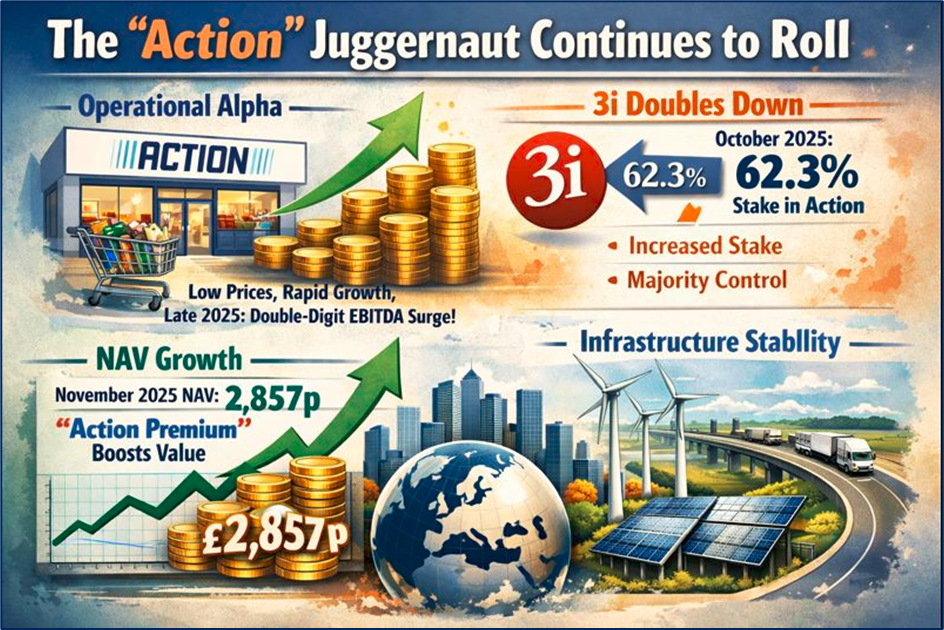
- The "Action" Juggernaut Continues to Roll
The primary driver remains Action, the Dutch non-food discounter. By late 2025, Action had cemented itself not just as a retailer, but as one of Europe's most valuable private companies.
- Operational Alpha: Action’s formula—low prices, dynamic inventory, and rapid store rollouts—proved recession-proof. Late 2025 updates confirmed continued double-digit EBITDA growth.
- Stake Increase: In October 2025, 3i aggressively increased its stake in Action to 62.3% (up from ~57% earlier in the year), using proceeds from a capital restructuring to buy out minority holders. The market views this as a "double down" on their best winner.
- NAV Growth & Valuation Clarity
The November 2025 half-year results revealed a Net Asset Value (NAV) per share of 2,857p, a significant jump. Investors buying on Dec 31 were effectively buying into a portfolio trading near its visible asset value, with the "Action premium" justifying the share price hovering above the NAV.
- Infrastructure Stability
While private equity grabs headlines, 3i’s Infrastructure division (3iN) provided a reliable floor. The share price of 3i Infrastructure plc rebounded in late 2025, boosting the valuation of 3i Group's ~29% stake. This defensive ballast attracted risk-averse capital ahead of the 2026 uncertainty.
SWOT Analysis
Source: Kalkine Group
Strengths (Internal)
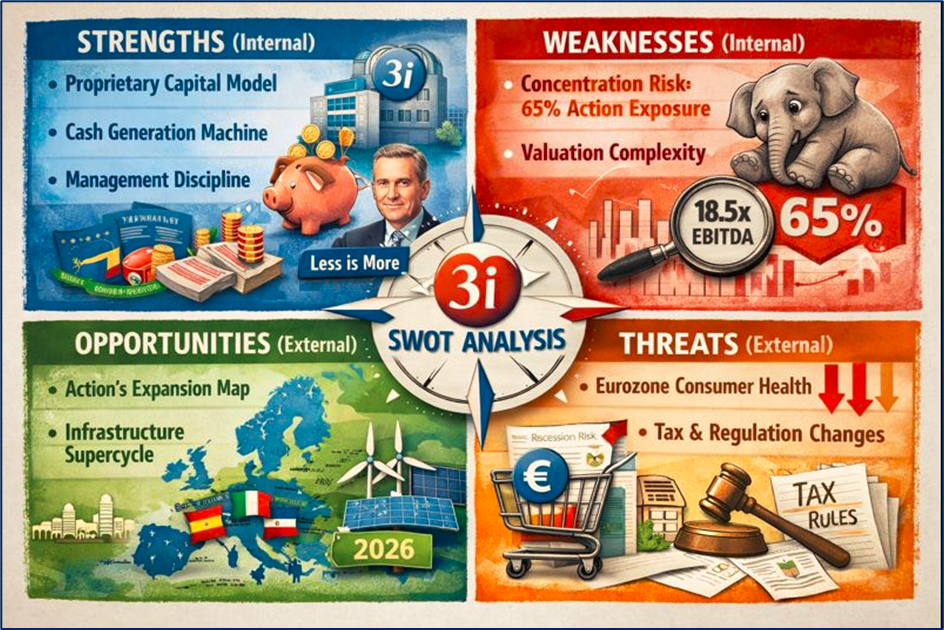
- Proprietary Capital Model: Unlike traditional PE firms that must sell assets to return cash to limited partners, 3i invests its own balance sheet. This allows them to hold winners like Action indefinitely (compounding tax-efficiently).
- Cash Generation: The portfolio is a cash machine. Action’s dividends alone cover 3i’s operating costs and shareholder payouts, creating a self-sustaining ecosystem.
- Management Discipline: CEO Simon Borrows’ "less is more" strategy—fewer assets, higher conviction—has delivered unmatched Total Shareholder Returns (TSR) in the FTSE 100 over the last decade.
Weaknesses (Internal)
- Concentration Risk: This is the elephant in the room. Action now accounts for >65% of 3i’s gross asset value. 3i has effectively become a proxy tracker for a single Dutch retailer. If Action sneezes, 3i catches a cold.
- Valuation Complexity: Valuing private assets is subjective. While Action’s multiples are defensible (18.5x EBITDA), they are high compared to listed retail peers, creating potential volatility if market multiples contract.
Opportunities (External)
- Action’s Expansion Map: Action is still underpenetrated in huge markets like Italy, Spain, and Eastern Europe. The "store count runway" remains long.
- Infrastructure Supercycle: Global demand for energy transition and digital infrastructure aligns perfectly with 3iN’s portfolio, potentially offering higher exit multiples in 2026.
Threats (External)
- Eurozone Consumer Health: A severe recession in Northern Europe (Germany/France/Benelux) could finally dent Action’s like-for-like sales, though historical data suggests they benefit from consumers trading down.
- Tax & Regulation: Changes in Dutch or UK corporate tax laws regarding private equity holdings or carried interest could impact net returns.
Latest Business Model & Operational Updates
The "Compounding Machine" Model
By the end of 2025, 3i had fully transitioned from a generalist PE firm to a high-conviction holding company.
- Strategy: Sell mediocre assets ruthlessly; pour capital into the top 1% of performers (Action, Royal Sanders, Tato).
- The Flywheel: Action pays dividends $\rightarrow$ 3i uses cash to buy more Action shares or pay 3i shareholders $\rightarrow$ NAV per share rises.
Financial Snapshot (Based on Nov 2025 Interim Data):
- Total Return: 13% on opening shareholder funds for H1 FY26.
- Gross Debt: Managed conservatively at £1.2bn, with gearing low at ~3%.
- Liquidity: A massive £1.6bn war chest, allowing them to pounce on opportunities or weather storms without distressed selling.
Risks to Watch in 2026
- The "Key Man" Risk (Action CEO): Much of Action's success is attributed to its management team. Any departure here would spook the market instantly.
- FX Headwinds: 3i reports in GBP but holds assets in EUR and USD. A surging Pound Sterling (GBP) against the Euro would optically slash the reported value of the portfolio.
- Multiple Compression: If global equity markets de-rate (e.g., S&P 500 P/E drops), 3i’s valuation of its private assets must eventually follow suit, leading to NAV write-downs.
Conclusion
The ~1% rise on December 31, 2025, was a microcosm of 3i Group's broader narrative: Quality commands a premium. Investors used the year-end to park capital in a vehicle that offers the growth of private equity with the liquidity of a FTSE 100 stock.
While the concentration in Action is terrifying to purists, it has been the single greatest wealth-creation trade in the City of London for a decade. As we move into 2026, the question isn't "Is Action good?", but rather "How much bigger can it get?" The market, for now, is betting on "much bigger."


 Jun 03, 2026




 Please wait processing your request...