
 AU
AU
 CA
CA
 US
US
 NZ
NZ
 IND
IND

 UK
UK

 Share
Share
 X (Formerly Twitter)
 Whatsapp
 Facebook
 LinkedIn
 Telegram
 Email This Article
 Copy Link
 Summarize with AI
 Chat GPT
 Perplexity
Key Takeaways
- High dividend yields are not inherently attractive—they often signal underlying risks such as declining earnings or structural challenges.
- Sustainable dividend investing depends on cash flow strength, balance sheet quality, and disciplined capital allocation, not just headline yield.
- Several UK equities currently yield above 6%, significantly higher than the FTSE 100 average (~3.4%) and competitive with gilt yields (~4.7%).
- Dividend cover varies widely—some companies maintain strong buffers while others operate with stretched payout ratios.
- Sector dynamics are critical: insurers and asset managers remain strong, while cyclicals like recruitment and advertising face pressure.
- Valuation dispersion is significant—many high-yield stocks trade at discounted multiples, offering both opportunity and risk.
- A diversified portfolio blending stable income names and selective turnaround plays provides the best risk-adjusted returns.
- Macroeconomic conditions in 2026—moderate inflation, easing interest rates, and slow growth—favor income-oriented equity strategies.
Source: Kalkine Group
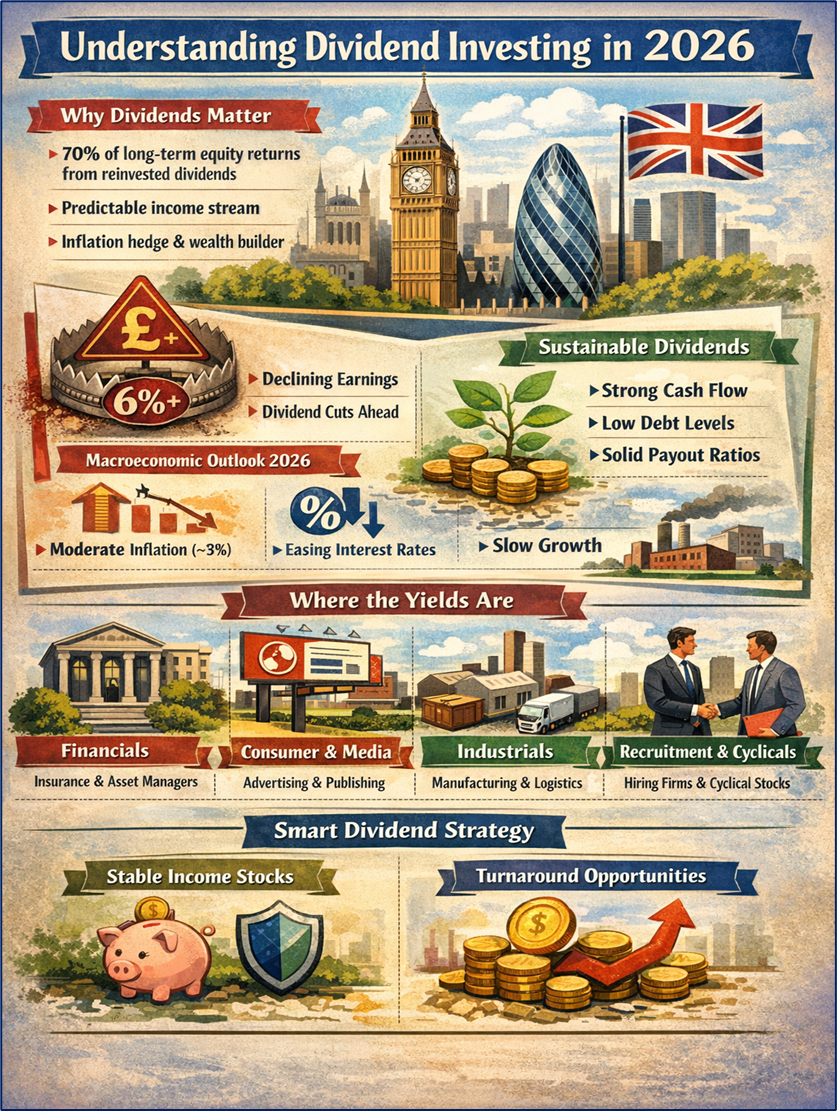
Understanding Dividend Investing in 2026
Why Dividends Remain Critical
Dividends represent the most tangible return mechanism in equity investing. Unlike capital gains, which depend on market sentiment, dividends provide predictable cash flow, making them essential for both retail and institutional investors.
Historically, reinvested dividends have contributed nearly 70% of long-term equity returns, highlighting their dominant role in wealth creation. In markets like the UK, where capital appreciation has been inconsistent, dividend income has been the primary driver of total returns.
Dividend Yield vs Sustainability: The Core Challenge
A high yield can arise from two scenarios:
- Positive: Increasing payouts due to strong earnings
- Negative: Falling share prices due to deteriorating fundamentals
The latter leads to yield traps, where investors are attracted by high yields only to face dividend cuts later.
Key Metrics to Evaluate Dividend Quality
- Payout ratio (earnings & cash-based)
- Dividend cover
- Free cash flow generation
- Balance sheet leverage
- Historical consistency
- Business model durability
Macroeconomic Environment: Why 2026 Favors Dividend Stocks
Interest Rates and Income Alternatives
With central bank rates declining from peak levels, traditional income sources like fixed deposits and bonds are becoming less attractive. This enhances the relative appeal of equity income.
Inflation Dynamics
Moderate inflation (~3%) creates a favorable environment where:
- Dividend yields provide real positive income
- Companies with pricing power outperform
- Cost pressures remain manageable but relevant
Growth Outlook
The UK economy is experiencing slow but positive growth, avoiding recession but limiting cyclical upside. This environment supports stable dividend payers while challenging highly cyclical businesses.
Sector Insights: Where High Yields Are Concentrated
Financials (Insurance & Asset Management)
Strong capital positions, regulatory buffers, and recurring income streams make this sector a cornerstone of dividend investing.
Consumer & Media
Companies like advertising firms and publishers offer high yields but face cyclical demand risks.
Industrials & Distribution
Often undervalued, but margins are thin and sensitive to input costs.
Recruitment & Cyclicals
High operational leverage creates both opportunity and risk depending on economic cycles.
Portfolio Strategy: Balancing Yield and Quality
An optimal dividend portfolio in 2026 should combine:
Core Stable Income Stocks
- Strong balance sheets
- Predictable cash flows
- Moderate but reliable growth
Selective High-Yield Opportunities
- Temporarily depressed valuations
- Cyclical recovery potential
- Higher risk but higher reward
Diversification Factors
- Sector allocation
- Market capitalization (large vs small cap)
- Geographic exposure
A balanced basket of high-yield UK equities can generate ~6.2% yield with ~1.7x dividend cover, indicating reasonable sustainability at the portfolio level .
Risks in High Dividend Investing
- Dividend cuts due to earnings decline
- Over-leveraged balance sheets
- Structural industry disruption
- Cyclical downturns
- Policy and tax changes
Conclusion: The Future of Dividend Investing in the UK
Dividend investing in 2026 stands at a fascinating intersection of opportunity and caution. The current macroeconomic environment—characterized by easing interest rates, moderate inflation, and subdued growth—creates a fertile ground for income-focused strategies. Yet, this same environment also exposes the underlying fragility of certain high-yield businesses.
The UK market, with its deep-rooted dividend culture, continues to offer one of the most attractive landscapes globally for income investors. Unlike markets dominated by growth and buybacks, UK equities maintain a strong commitment to cash distributions. This structural characteristic ensures that investors seeking income are not forced into excessive risk-taking to achieve meaningful yields.
However, the central lesson remains unchanged: yield alone is not a strategy. The most successful income investors will be those who treat dividends as an outcome of business quality rather than a screening metric. Companies with strong free cash flow, conservative leverage, and durable competitive advantages will continue to deliver sustainable income, even in uncertain economic conditions.
At the same time, selective exposure to higher-yield, turnaround opportunities can enhance returns—but only when approached with discipline and diversification. These positions should complement, not dominate, a portfolio.
Looking ahead, the role of dividends will likely expand further as global investors shift toward income-generating assets in a lower-growth world. The combination of steady income, potential capital appreciation, and inflation protection makes high-quality dividend equities one of the most compelling asset classes for long-term wealth creation.
Ultimately, the success of a dividend strategy will depend not on chasing the highest yield, but on building a resilient portfolio that can withstand cycles, adapt to structural changes, and compound income over time.


 Jun 08, 2026




 Please wait processing your request...