
 AU
AU
 CA
CA
 US
US
 NZ
NZ
 IND
IND

 UK
UK

 Share
Share
 X (Formerly Twitter)
 Whatsapp
 Facebook
 LinkedIn
 Telegram
 Email This Article
 Copy Link
 Summarize with AI
 Chat GPT
 Perplexity
Key Takeaways
·High dividend yield is not inherently attractive—it often signals underlying risk rather than opportunity.
· Sustainable dividend investing depends on cash flow strength, balance sheet health, and disciplined capital allocation, not just headline yield.
· UK and European equities currently offer yields above 6–7%, significantly higher than historical averages and competitive with fixed income.
· The macro shift from ultra-low rates to normalized interest rates has redefined income investing, making equity yields compete directly with bonds.
· Stocks fall into three categories:
o High-quality income compounders
o Cyclical recovery plays
o Dividend traps (high risk of cuts)
· A diversified portfolio targeting ~6.5–7% yield is achievable but requires risk-weighted allocation and sector diversification.
· Dividend sustainability—not yield—is the single most important factor for long-term success.
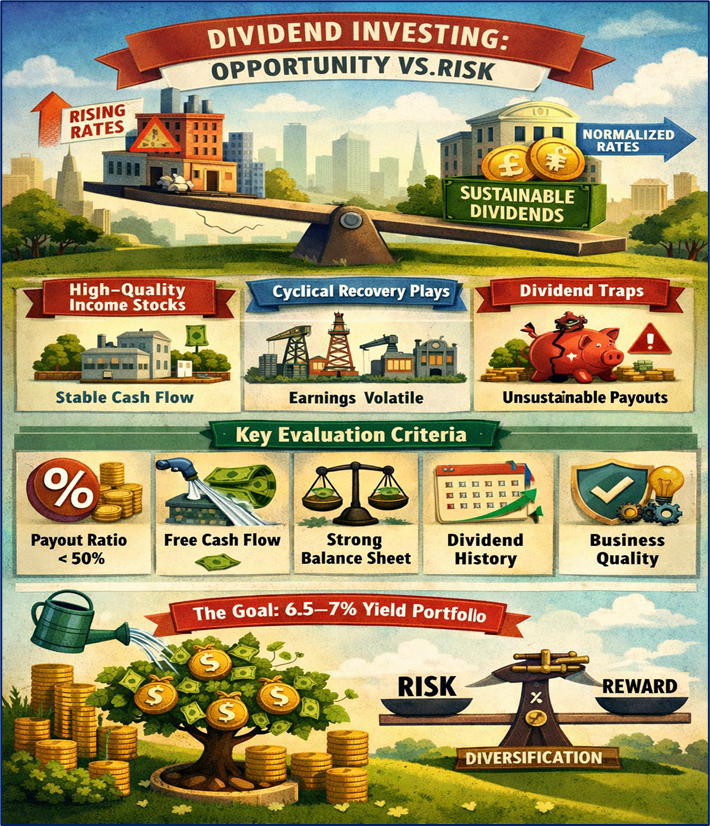
Source: Kalkine Group
Introduction to Dividend Investing
Dividend investing remains one of the most reliable long-term wealth creation strategies. While capital appreciation often dominates headlines, reinvested dividends historically account for 30–50% of total equity returns in developed markets.
The real power of dividends lies in compounding. When reinvested, they generate additional shares, which in turn generate more income—creating a powerful snowball effect over time.
Beyond returns, dividend-paying companies tend to exhibit:
· Stable cash flows
· Mature business models
· Disciplined capital allocation
· Lower volatility compared to growth stocks
However, not all dividends are equal. A high yield can either signal strength—or distress.
Macro Environment: Why 2026 Is a Turning Point for Income Investors
The global investment landscape has undergone a structural shift since the 2022–2023 rate hikes:
1. End of the Zero-Rate Era
· Interest rates moved from near 0% to 4–5% across major economies
· Bonds now offer meaningful yield, creating competition for equities
2. Repricing of Equity Income
· Dividend stocks must now justify their risk premium
· High yields often reflect valuation compression, not growth
3. Gradual Monetary Easing (2024–2026)
· Central banks have begun cutting rates
· However, rates remain structurally higher than the last decade
Implication for Investors
Dividend investing is no longer a “default choice”—it is now a selective strategy requiring deep analysis.
Understanding High Dividend Stocks: Opportunity vs Risk
A dividend yield increases due to:
· Higher payouts (positive signal)
· Falling stock prices (potential warning)
This leads to a critical concept:
Dividend Yield Trap
The highest-yielding stocks often underperform because:
· Earnings are declining
· Dividends are unsustainable
· Business models face structural challenges
Smart investors focus on sustainable yield, not maximum yield.
Three Categories of High Dividend Stocks
1. High-Quality Income Stocks
These are the core portfolio holdings:
· Strong free cash flow
· Low payout ratios
· Consistent dividend history
· Resilient business models
Example characteristics seen in companies like Barratt Redrow or OSB Group .
2. Cyclical or Transitional Stocks
These offer attractive yields but come with uncertainty:
· Earnings volatility
· Sector cyclicality
· Business model transitions
Example: PayPoint transitioning from legacy payments to digital services .
3. Dividend Traps
These are high-risk:
· Unsustainable payout ratios
· Weak balance sheets
· Structural decline
Often found in micro-cap or distressed companies like smaller consulting firms .
How to Evaluate Dividend Stocks (Professional Framework)
1. Payout Ratios
· Below 50% → Strong
· 50–75% → Healthy
· Above 100% → Risky
2. Free Cash Flow Coverage
Dividends must be supported by real cash, not accounting earnings.
3. Balance Sheet Strength
Key indicators:
· Low debt
· High liquidity
· Strong interest coverage
4. Dividend History
Consistency signals management discipline and reliability.
5. Business Quality
Look for:
· Competitive advantage
· Stable demand
· Pricing power
Sector Insights: Where the Yield Comes From
High dividend yields are concentrated in:
· Financials (banks, asset managers)
· Real estate & housing
· Energy & infrastructure
· Mature industrials
This creates sector concentration risk, requiring diversification.
Portfolio Construction Strategy (2026)
A well-structured income portfolio should include:
Core Holdings (50–60%)
· High-quality, stable dividend payers
· Lower risk, moderate yield
Secondary Holdings (25–35%)
· Growth + income combination
· Moderate risk
Satellite / Tactical (10–15%)
· High yield, higher risk
· Opportunistic exposure
Target Outcome
· Portfolio yield: ~6.5–7%
· Balanced risk exposure
· Sustainable long-term income
Risks in Dividend Investing
1. Interest Rate Risk
Higher bond yields reduce attractiveness of equities.
2. Earnings Volatility
Cyclical sectors can cut dividends during downturns.
3. Balance Sheet Stress
Highly leveraged companies are vulnerable.
4. Structural Industry Decline
Example: legacy payment systems, traditional retail.
5. Currency Risk
Important for international investors.
Company Analyses
The following thirteen company profiles are presented in descending order of indicated dividend yield. Each profile follows a consistent structure beginning with a company overview and progressing through business model, dividend history, payout analysis, financial performance, balance sheet, growth outlook, risks, valuation, market sentiment, and a concluding investment thesis. Headline data points are summarised in a table at the start of each profile to allow readers to scan key metrics at a glance before reading the narrative discussion.
1. Pollen Street Group Limited (POLN)
Company Overview
Pollen Street Group Limited is a London-listed alternative asset manager focused on private credit and private equity strategies in the financial and business services sectors. The group originated as the asset management arm of a specialist consumer finance business and has evolved into an independent platform with assets under management spread across closed-ended funds, separately managed accounts, and a small portfolio of co-investment positions. The company was created in its current form following the combination of Pollen Street Capital with Honeycomb Investment Trust in 2022, a transaction that consolidated the firm's investment management franchise with a permanent capital vehicle and produced the listed entity that trades today.
The business is positioned squarely within the broader trend toward private market allocation that has reshaped institutional asset management over the past decade. Pension funds, insurance companies, sovereign wealth investors, and family offices have steadily increased their allocations to private credit and private equity in pursuit of yield enhancement, return diversification, and exposure to assets that are not readily available through public markets. Pollen Street's offering targets this demand by providing capital to small and mid-sized financial services businesses that are typically too specialised, too operationally complex, or too small for the largest global private equity firms to address.
Dividend Yield and History
The current indicated dividend yield of 7.05 percent places Pollen Street at the top of the cohort under review and is among the more attractive distributions available from any UK-listed asset manager. The company has paid dividends consistently since its current corporate structure was established and has generally targeted a progressive distribution policy linked to underlying earnings and cash generation. Distributions have historically been paid on a quarterly basis, providing investors with a smooth income stream rather than relying on a single large annual payment. The combination of a high headline yield and a quarterly payment cadence is attractive to income-oriented investors who value both the absolute level and the regularity of cash distributions.
Looking at the multi-year dividend trajectory, the group has steadily increased its distribution at a rate that has broadly tracked the growth of its assets under management and the expansion of its earnings base. The progressive nature of the policy implies that management views the current distribution level as a floor rather than a ceiling, which is an important signal for income investors who are concerned about the possibility of a future cut. That said, asset management businesses are not immune to cyclical pressures, and a deterioration in private market conditions could in principle force a reassessment of the dividend trajectory.
Payout Ratio Analysis
Pollen Street's reported earnings per share of approximately 0.94 GBP support the current distribution comfortably on a backward-looking basis. With the price to earnings multiple at 8.93 times, the implied earnings yield of approximately 11.2 percent compares favourably with the dividend yield of 7.05 percent, suggesting an earnings payout ratio in the region of 60 to 65 percent. This is a reasonable level for an asset manager and leaves a meaningful buffer for the absorption of normal year-to-year volatility in earnings without forcing an immediate distribution cut. Combined with the firm's recurring management fee base, this coverage profile is among the more reassuring in the cohort.
Investors should nonetheless be aware of two caveats. First, asset managers typically report earnings that include both management fees and performance fees, and the volatility of the latter can produce headline earnings volatility that overstates the true cyclicality of the underlying business. The fee earning core is generally more stable than the reported numbers suggest. Second, balance sheet investment income is sensitive to market valuations, and a sustained decline in private credit or private equity asset values could compress reported earnings even if the underlying fee streams remain intact. A holistic assessment of dividend coverage should therefore distinguish between the recurring fee component and the more variable investment component.
Financial Performance
Pollen Street has reported strong recent earnings momentum, with the most recent twelve month diluted EPS growth figure registering an increase of approximately 19 percent year on year. This is one of the more favourable EPS growth figures in the cohort and reflects a combination of underlying assets under management growth, healthy fee earnings, and incremental contributions from the firm's investment portfolio. Revenue growth has been driven primarily by the steady accumulation of new mandates and the closing of successive vintages of the firm's flagship funds, while operating leverage has supported expanding operating margins as the platform has scaled.
Operating margins for Pollen Street are typical of the asset management industry in the sense that the bulk of the cost base is fixed personnel and infrastructure expense, leaving substantial operating leverage as revenue scales. As fee earning assets continue to grow, additional revenue should drop more than proportionally to the bottom line, although competitive pressures in private market fundraising could compress fee rates over time. Cash conversion has historically been strong, supported by the recurring nature of management fee income and modest working capital requirements.
Balance Sheet Strength
The group operates with a relatively conservative balance sheet by the standards of listed asset managers. Reported leverage is modest, the firm holds sufficient liquidity to meet its operating and distribution commitments, and the investment portfolio held on its own balance sheet is generally diversified across multiple positions rather than concentrated in a small number of large holdings. The principal balance sheet risk is the carrying value of co-investment positions, which depend on the performance of the underlying portfolio companies and credit instruments and which can be marked down in adverse market conditions.
From a regulatory and capital adequacy perspective, the firm is subject to the requirements that apply to UK-authorised investment firms and is required to maintain capital resources commensurate with the scale and risk of its activities. The group has consistently met these requirements and there is no indication of any near-term regulatory pressure that would force a change in its capital deployment plans, including its dividend policy.
Growth Outlook
The medium-term growth outlook for Pollen Street rests on the continued expansion of private market allocations by institutional investors, the firm's ability to raise successive larger vintages of its flagship strategies, and the success of its investment portfolio in generating attractive returns relative to public market benchmarks. Each of these drivers carries some uncertainty, but the structural tailwind from rising private market allocations remains intact and is likely to support the asset management industry as a whole for the foreseeable future.
Specific growth opportunities include the launch of new product strategies adjacent to the firm's core competencies, the expansion of the limited partner base into new geographies, and the potential for selective bolt-on acquisitions that add capabilities or assets under management at attractive prices. Management has signalled an interest in inorganic growth where opportunities arise but has emphasised that any acquisition would be subject to strict valuation discipline.
Risks and Challenges
The principal risks to the investment case are broadly grouped into industry, firm-specific, and macroeconomic categories. At the industry level, the private markets industry has become increasingly competitive as more players enter the space, which could compress fee rates over time. A sustained downturn in private market valuations could also reduce performance fee accruals and depress carrying values for the firm's balance sheet investments. At the firm level, the franchise depends heavily on the continued effectiveness of the investment team and on the firm's ability to deliver returns that justify the management fee. A run of poor investment performance could damage the brand and impair fundraising.
At the macroeconomic level, the firm is exposed to shifts in interest rates and credit conditions that affect the demand for private credit, the cost of capital for portfolio companies, and the valuation of the underlying investment portfolio. A sharp reversal of recent monetary easing, or a significant credit cycle downturn, could adversely affect both fee earning and balance sheet investment activities.
Valuation Overview
At a current price to earnings multiple of approximately 8.9 times, Pollen Street trades at a meaningful discount to both larger global asset managers and to many UK-listed financial services peers. The discount partly reflects the firm's relatively modest scale, its status as a hybrid investment company and asset manager, and the residual market discount applied to UK-listed alternative managers more broadly. For investors who are willing to look past the structural discount, the combination of a high yield, healthy earnings coverage, and visible operating leverage represents a compelling value proposition.
Market Sentiment
Sell-side coverage of Pollen Street is limited compared with larger UK financial stocks, but available commentary has generally been constructive, citing the quality of the management team, the durability of the recurring fee base, and the attractive distribution policy. Trading volume is moderate, and the share price has tended to track underlying fundamentals over multi-quarter periods rather than being driven by short-term momentum or technical factors.
Investment Thesis
Pollen Street offers a compelling combination of high yield, conservative earnings coverage, and exposure to a structurally growing industry. The principal risks are industry competition, balance sheet investment volatility, and the firm's dependence on the continued performance of its investment team. For income investors who are comfortable with these considerations, Pollen Street is an attractive component of a diversified income portfolio. We classify it as a second tier holding, suitable for an allocation that recognises both its yield appeal and the idiosyncratic risks inherent in a smaller-scale specialist asset manager. The thesis would be invalidated by a sustained deterioration in fundraising momentum, a material reduction in performance fee accruals over multiple consecutive periods, or evidence of distress in the firm's balance sheet investment portfolio.
2. Diales Group PLC (DIAL)
Company Overview
Diales Group PLC is a London-listed professional services firm specialising in expert advisory services for the construction, engineering, energy, and infrastructure sectors. The company provides consulting, dispute resolution, and expert witness services to clients involved in complex commercial disagreements and contractual disputes, primarily across infrastructure megaprojects and large industrial undertakings where expert assessment of delay, disruption, quantum, and quality issues is required. The firm operates across multiple international jurisdictions and serves a client base that includes contractors, owners, insurers, and law firms involved in high-value disputes and arbitrations.
The company is one of the smaller names in the cohort, with a market capitalisation in the region of 11 million pounds, which places it firmly in the micro-cap segment of the London market. As a small, specialised services firm, Diales is highly dependent on the reputation and expertise of its senior consultants, the flow of large dispute mandates, and the cyclical pattern of disputes activity in its core industries. The micro-cap profile means that the share price can be volatile, trading volumes can be thin, and market valuations may diverge meaningfully from intrinsic worth for extended periods.
Dividend Yield and History
Diales offers an indicated dividend yield of 7.04 percent, second highest in the cohort. The yield is supported by a relatively low share price following a period of subdued share price performance. Distributions are paid from the operating cash flows of the consulting business and depend on the firm's ability to convert revenue into cash and on the discretion of the board to declare dividends from available distributable reserves. The history of dividend payments at the current corporate structure is relatively short, and the absolute size of the distribution per share is small in absolute terms, reflecting the low share price.
Investors should be aware that for a small consulting firm of this scale, the dividend can be vulnerable to a small number of adverse events. The loss of a single large mandate, a key personnel departure, or a temporary slowdown in disputes flow could have a disproportionate effect on revenue and on the firm's ability to maintain its current distribution. The progressive distribution policies that are characteristic of larger established dividend payers are not necessarily applicable here, and the income flow should be viewed as more uncertain than the headline yield might suggest.
Payout Ratio Analysis
Reported diluted EPS of approximately 0.01 GBP suggests that the price to earnings multiple of 17.05 times implies a relatively thin earnings cushion above the current distribution level. A simple calculation indicates that the payout ratio on a backward-looking basis is high relative to current earnings, although the absolute small size of the per share figures means that minor changes in earnings can produce large percentage swings in the calculated payout ratio. Investors should focus on the cash position of the business, the visibility of forward mandates, and the stability of the senior consulting team rather than relying narrowly on a single year payout calculation.
Financial Performance
Diales has reported a relatively modest earnings profile in recent periods, reflecting the small absolute scale of the business and the variability inherent in project-based consulting revenues. The company does not currently disclose a meaningful EPS growth figure in the most recent screen, indicating either insufficient comparable data or muted earnings momentum. Revenue trends are characteristic of small consulting firms, with quarter-to-quarter variability driven by the timing of project completions, expert witness reports, and arbitration hearings.
Operating margins are sensitive to consultant utilisation, which can swing materially between busy and quiet periods. Cost discipline and the ability to flex headcount and discretionary expenses are important determinants of through-cycle profitability. The firm has historically focused on managing its overhead carefully and has avoided overextension during periods of strong demand.
Balance Sheet Strength
As a small professional services firm, Diales operates with a balance sheet that is largely cash and working capital based, with minimal physical assets and limited financial leverage. The principal balance sheet considerations are the level of trade receivables, which can be substantial relative to the size of the firm and which carry some collection risk in disputed engagements, and the cash position, which provides the buffer needed to fund ongoing operations and distributions during periods of revenue volatility. The absence of significant debt is a positive feature and reduces the risk of financial distress in adverse scenarios.
Growth Outlook
The medium-term growth outlook depends primarily on the firm's ability to win new mandates, retain its senior consulting talent, and expand into adjacent service lines. The construction and infrastructure disputes market is large in absolute terms and is likely to remain active given the volume of major projects underway globally, particularly in the energy transition, transportation infrastructure, and digital infrastructure sectors. Diales is well positioned to capture a share of this activity if it can maintain the reputation of its expert services and develop its commercial relationships with the law firms and clients that drive case flow.
Risks and Challenges
The principal risks include key personnel risk, which is acute for any small professional services firm whose value resides in the expertise of a relatively small group of individuals; client concentration risk, where the loss of a single large mandate can materially affect revenue; and the challenge of scaling a partnership-style business while maintaining its professional culture. The micro-cap profile also exposes shareholders to liquidity risk in the secondary market, where it can be difficult to enter or exit a position without affecting the share price.
Valuation Overview
On a price to earnings multiple of 17 times, Diales does not screen as conventionally cheap, although the headline multiple is distorted by the small absolute level of earnings. A more relevant valuation lens is the enterprise value relative to revenue or relative to historical free cash flow, which would suggest a more nuanced picture. Investors with high conviction in the management team and the long-term opportunity may find the current valuation acceptable, but those seeking a margin of safety should be cautious about extrapolating recent performance forward.
Market Sentiment
Diales receives little sell-side coverage and trades on modest volumes, which means that market sentiment is principally driven by retail investor interest and by occasional company announcements regarding mandate wins, results releases, and corporate developments. The narrow trading universe makes it more difficult for the share price to incorporate new information rapidly, which can create both opportunity and risk for active investors.
Investment Thesis
Diales offers an attractive headline yield but carries significant company-specific risks that constrain the case for a meaningful position in a diversified income portfolio. We classify it as a higher-risk holding suitable only for investors with a tolerance for micro-cap volatility, an understanding of the specialised consulting business model, and a willingness to accept the possibility that the dividend may be vulnerable to operational pressures. For most income investors, the appropriate position size in Diales is modest if not nil. The thesis would be invalidated by the loss of key personnel, a material decline in mandate flow, or evidence of working capital pressures that affect cash distributions.
- PayPoint plc (PAY)
Company Overview
PayPoint plc is a London-listed financial technology and services company that provides payment processing, retail technology, and consumer services across the United Kingdom. The group operates a network of payment and service locations through partnerships with thousands of independent retailers, and provides electronic payment and money transfer services that are used by households and businesses across the country. The business has evolved over more than two decades from a payments terminal provider into a more diversified group with operations spanning bill payments, card processing, parcel collection and delivery, and ecommerce enablement services.
The company occupies a distinctive position in the UK payments landscape because of the scale of its retailer network and its embedded relationships with both consumers and energy and water utilities that rely on PayPoint to facilitate prepayment top-ups and bill payments. This network is a meaningful competitive moat in the prepayment energy market segment, where PayPoint has historically been the dominant operator. At the same time, the broader payments market has been disrupted by the migration from cash to digital payments, by the expansion of fintech entrants offering frictionless payment experiences, and by the consolidation of bill payment volumes into direct debit and other automated mechanisms.
Dividend Yield and History
PayPoint is a long-standing dividend payer with a history of returning substantial cash to shareholders through both ordinary dividends and supplementary capital returns. The current indicated yield of 6.98 percent reflects a combination of a stable absolute distribution and a share price that has been pressured by concerns about the long-term trajectory of the legacy bill payment business. The company has historically operated a progressive ordinary dividend policy supplemented by special dividends when surplus cash was available, although the current focus has been on maintaining the ordinary dividend through the period of business model transition.
Payout Ratio Analysis
Diluted EPS of approximately 0.25 GBP combined with a reported price to earnings multiple of 23.6 times suggests that the dividend payout ratio on a backward-looking earnings basis is elevated, partly reflecting the recent decline in reported earnings. The 12-month EPS growth figure of negative 57 percent indicates a meaningful one-year deterioration in headline earnings, although this figure should be interpreted in the context of one-off items and accounting adjustments rather than as a clean indicator of underlying performance. Cash flow coverage of the dividend has historically been more comfortable than the reported earnings figure suggests, because the business produces strong free cash flow relative to reported profits.
Financial Performance
PayPoint has been navigating a challenging period in which the legacy parts of the business have shrunk and the newer growth segments have been working to fill the gap. Headline reported earnings have been volatile as a result, although the underlying business is genuinely cash generative and continues to fund investment in the higher growth segments while supporting the distribution. Revenue mix shift toward parcels, digital, and merchant services is the principal driver of the longer-term recovery in profitability, although the transition is not yet complete and the financial results in any single period can be distorted by the relative pace of decline in the legacy segments.
Balance Sheet Strength
The balance sheet is reasonably conservative for a payments business of PayPoint's scale. The group operates with modest debt and maintains adequate liquidity to fund operations and the distribution. Working capital movements can be substantial in any individual reporting period because of the timing of payment processing settlements and merchant float positions, and investors should focus on the cash position over multiple periods rather than relying on snapshot figures. The absence of significant near-term refinancing risk is a positive feature.
Growth Outlook
The growth outlook depends on the success of the strategic shift away from the legacy bill payment activity toward the parcels, digital, and merchant services segments. Each of these target segments has favourable structural drivers, but each also faces meaningful competition. Parcels in particular is a market with several large incumbents and a growing number of fintech entrants. The company has the advantage of an embedded retail network and existing relationships, which give it a head start in the race to capture share, but the execution risk remains material.
Risks and Challenges
The principal risks are the continued decline of the legacy bill payment activity at a faster pace than the growth of the new segments, regulatory pressures on payment services and consumer credit activities, and competitive pressure from larger payments and fintech companies. There is also a degree of execution risk associated with the strategic shift, since the new growth segments require investment in technology, sales, and marketing that may not generate immediate returns.
Valuation Overview
The reported price to earnings multiple of 23 times overstates the underlying multiple because of recent earnings depression, and the more relevant valuation metric is probably enterprise value relative to free cash flow, which suggests a more attractive starting point. The high dividend yield is the principal feature attracting income investors and reflects the market's discount for the structural headwinds in the legacy business.
Market Sentiment
Sell-side coverage of PayPoint is moderate and views are mixed. The bears focus on the secular decline of the legacy business and the execution risk of the transition. The bulls focus on the strong free cash flow generation, the attractive yield, and the optionality embedded in the new growth segments. The share price has been range-bound for an extended period, reflecting the unresolved tension between these views.
Investment Thesis
PayPoint is a transitional dividend story whose attractive headline yield is supported by genuinely strong free cash flow generation but is shadowed by the structural decline in the legacy bill payment business. We classify it as a second tier holding for income investors who are willing to wait for the transition to play out and who can tolerate some uncertainty about the medium-term earnings trajectory. The position should be sized to reflect the moderate risk profile, and investors should monitor the relative pace of decline in the legacy business against the growth of the new segments. The thesis would be invalidated by a sharper-than-expected decline in legacy revenues without a corresponding pickup in the growth segments, or by evidence of distress in the cash position.
4. Foresight Group Holdings Limited (FSG)
Company Overview
Foresight Group Holdings Limited is a UK-listed alternative asset manager focused on infrastructure, private equity, and tax-advantaged retail investment products. The firm has been a long-standing presence in the UK alternative investment landscape, with particular expertise in renewable energy infrastructure, regional venture capital, and specialist retail products such as venture capital trusts and enterprise investment scheme funds. The combination of institutional infrastructure mandates and retail-oriented tax-efficient products gives Foresight a relatively diversified asset management franchise compared with single-strategy peers.
The firm has expanded steadily over the past decade, both organically and through acquisitions that have added scale, geographic reach, and capabilities. The infrastructure business has benefited from the structural shift toward renewable energy investment, which has created multiple opportunities for capital deployment in solar, wind, battery storage, and grid infrastructure assets. The retail tax-advantaged product business has continued to attract subscriptions from UK individual investors who value the tax reliefs available on venture capital trust and enterprise investment scheme investments, particularly in a high marginal income tax environment.
Dividend Yield and History
The current indicated yield of 6.89 percent positions Foresight near the top of the cohort for income appeal, supported by an established progressive dividend policy that has been a key feature of the company's communication to shareholders since its IPO. Distributions are paid semi-annually and have grown steadily as the underlying assets under management have expanded. The progressive policy reflects management's confidence in the recurring nature of the management fee base and its expectation that fee earning assets will continue to grow over the medium term.
Payout Ratio Analysis
Earnings figures for Foresight in the most recent screen are not available in the simple form required for a precise payout ratio calculation, but an analysis of historic accounts suggests that the dividend has typically been comfortably covered by adjusted earnings, with cash flow coverage stronger still because of the relatively modest capital requirements of the asset management business. Investors should monitor the trajectory of fee earning assets, the realisation of performance fees, and the progression of operating margins as the firm grows.
Financial Performance
Foresight has been growing assets under management steadily, supported by net inflows into both its institutional and retail strategies. Operating leverage has been modest because the firm has continued to invest in headcount, infrastructure, and product development to support its expansion plans. As the platform matures and the marginal cost of new assets under management declines, operating leverage should become more visible and translate into faster earnings growth.
Balance Sheet Strength
The firm operates with a conservative balance sheet, modest leverage, and adequate liquidity to fund both ongoing operations and distributions. Regulatory capital requirements are met with comfortable headroom, and the firm does not have significant near-term refinancing needs. The principal balance sheet exposure is to co-investment positions held alongside managed funds, which can be marked up or down with market conditions but which are not large in the context of the overall balance sheet.
Growth Outlook
The medium-term growth outlook is supported by several structural drivers. Renewable energy infrastructure investment is expected to remain elevated for many years as countries pursue net zero commitments, providing a steady flow of opportunities for the infrastructure strategies. Retail demand for tax-advantaged investment products is likely to remain robust given the high marginal tax environment for individual investors. International expansion, particularly in continental Europe and Australia, offers additional growth pathways. Successful execution on each of these fronts should support continued asset gathering and earnings growth.
Risks and Challenges
Risks include competition for new mandates from larger global asset managers, regulatory changes affecting tax-advantaged retail products, and exposure to interest rate movements that affect the valuation of infrastructure assets and the relative attractiveness of long-duration investments. The firm is also exposed to the broader sentiment toward alternative investments and to the willingness of institutional investors to commit capital to private market strategies.
Valuation Overview
Foresight's valuation is best assessed on a price to assets under management or price to fee earning AUM basis, in addition to the price to earnings ratio. On these measures the company appears reasonably valued relative to UK-listed alternative asset managers, with the high dividend yield representing an additional support for the share price. The current entry point offers a balance of yield and growth that is attractive for income investors with a medium-term horizon.
Market Sentiment
The market view on Foresight has been generally positive, with sell-side coverage emphasising the quality of the management team, the diversification of the asset base, and the structural tailwinds supporting the infrastructure business. The share price has performed reasonably over recent periods, helped by the combination of dividend growth and modest multiple expansion.
Investment Thesis
Foresight Group Holdings is one of the more attractive income holdings in the cohort, combining a high dividend yield with exposure to a structurally growing alternative asset management franchise and a track record of progressive distributions. We classify it as a second tier holding suitable for a meaningful allocation in a diversified income portfolio, with the position size reflecting the firm's mid-cap status and its dependence on continued asset gathering. The thesis would be invalidated by a material slowdown in fundraising momentum or by a regulatory change that materially impaired the retail tax-advantaged business.
5. Barratt Redrow plc (BTRW)
Company Overview
Barratt Redrow plc is the largest housebuilder in the United Kingdom by volume and the result of the merger of Barratt Developments and Redrow that completed in 2024. The combined business operates a portfolio of regional housebuilding divisions that develop residential land and deliver new homes to private customers, social housing providers, and build-to-rent partners across England, Wales, and Scotland. The merger was the most significant industry consolidation in a generation and created an entity with the scale, geographic breadth, and brand portfolio to be the leading volume housebuilder in the country.
The combined group benefits from the operational expertise and brand identity of both predecessor companies. Barratt brought a track record of cost discipline and a national footprint, while Redrow added a focus on premium housing and a strong reputation for design quality. The integration of the two organisations has been well managed and has produced cost synergies through the rationalisation of regional operations, central functions, and procurement. The strategic rationale for the merger included not only synergies but also enhanced bargaining power with land owners, suppliers, and government counterparties.
Dividend Yield and History
Barratt Redrow offers a current indicated yield of 6.81 percent, supported by both a regular ordinary dividend and a history of supplementary returns of capital. UK volume housebuilders are among the most consistently high-yielding equities in the UK market because of their cash generative business models and the limited reinvestment requirements once a stable land bank has been established. The dividend has historically been linked to a target dividend cover ratio relative to underlying earnings, with surplus cash returned through additional special dividends or share buybacks when conditions have permitted.
The combined entity has signalled its intention to maintain an attractive distribution policy following the merger, supported by the cost synergies and the enhanced cash generation that the larger scale enables. The merger integration has not disrupted the distribution trajectory, and the current yield reflects both the strong fundamental cash flow profile and a measure of market caution about the housebuilding cycle.
Payout Ratio Analysis
With reported diluted EPS of approximately 0.15 GBP and a price to earnings multiple of 18.6 times, the implied earnings yield is approximately 5.4 percent. The dividend yield of 6.81 percent therefore exceeds the earnings yield, indicating that the headline payout ratio on a one-year basis is well in excess of 100 percent. This is partly an artefact of depressed reported earnings during a period of cyclical weakness, with management running the dividend at a more sustainable through-cycle level rather than allowing it to fall in line with cyclically low earnings. The cash flow coverage of the dividend is materially better than the earnings calculation suggests, because the company has been generating strong cash flows from working capital releases and reduced land acquisitions during the soft phase of the housing cycle.
Investors should view the payout ratio over a multi-year period rather than a single point in time. Over a normal cycle, Barratt Redrow's dividend should be comfortably covered by both earnings and cash flow, although there is some risk that a more prolonged or severe downturn could force a reassessment of the through-cycle distribution level.
Financial Performance
The company has reported a 12-month EPS growth figure of approximately positive 43 percent, the strongest growth figure in the cohort. This reflects the early stages of recovery from the 2023 to 2024 housing market slowdown, with completed home volumes and average selling prices both responding to lower mortgage rates and improving consumer confidence. The merger synergies have also begun to be realised, providing an additional tailwind to reported profits. Operating margins remain below the cycle peak levels achieved in 2021 and 2022 but are recovering steadily as volumes scale and cost pressures moderate.
Balance Sheet Strength
Volume housebuilders typically maintain conservative balance sheets with substantial cash reserves to provide flexibility through the cycle. Barratt Redrow follows this convention, with the combined group reporting net cash or near-net-cash positions in recent years. The principal balance sheet asset is the development land bank, which provides multiple years of forward production visibility and which is held at the lower of cost or net realisable value. Provisions for legacy building safety and remediation costs have been a feature of the sector since the post-Grenfell regulatory environment was introduced and represent a residual liability that the company has been working to discharge.
The balance sheet position is strong enough to support continued investment in the land bank, ongoing construction operations, and the distribution policy through a range of operating environments. The company has generally avoided the use of significant gearing and has the capacity to absorb a moderate downturn in housing market conditions without threatening the dividend.
Growth Outlook
The medium-term outlook for UK volume housebuilders is influenced by the interplay of mortgage availability, planning reform, and the structural shortfall of UK housing supply relative to long-run demand. The current government has signalled an intention to support increased housing delivery through planning reform and infrastructure investment, which would be supportive of the volume housebuilder business model if implemented effectively. Mortgage rates have moderated from their 2023 highs and consumer confidence has begun to recover, supporting transaction volumes and providing a tailwind to revenue growth.
Barratt Redrow is well positioned to capture a share of the structural growth opportunity through its scale, geographic reach, brand portfolio, and operational efficiency. The merger integration has provided a platform for organic growth and for selective expansion into adjacent products such as build-to-rent and modular housing. Cost synergies from the merger remain to be fully realised and should support margin expansion over the next several years.
Risks and Challenges
The principal risks are cyclical exposure to the UK housing market, regulatory exposure to building safety and energy efficiency requirements, sensitivity to mortgage availability and interest rates, and the operational complexity of the merger integration. A renewed downturn in housing transactions or a significant tightening of mortgage conditions could materially affect volumes and margins. Building safety remediation costs have been a recurring source of provisions and could surprise to the downside if further regulatory action is taken.
Valuation Overview
On a price to book basis, Barratt Redrow trades at a discount to its tangible book value, reflecting market caution about the housing cycle and uncertainty about the through-cycle return on equity. On a forward price to earnings basis, the company is reasonably valued relative to its history, and the high dividend yield provides an additional support for the share price. Investors looking for cyclical recovery exposure combined with a high yield are likely to find Barratt Redrow attractive at current levels.
Market Sentiment
Sell-side coverage of UK volume housebuilders is extensive and generally constructive on Barratt Redrow as the largest player in the sector. Recent commentary has emphasised the merger benefits, the recovery in housing transactions, and the strong balance sheet. The share price has reacted positively to incremental positive news flow, with the strong day change of plus 8.7 percent observed in the screen reflecting recent positive momentum.
Investment Thesis
Barratt Redrow is a high-conviction core holding for income investors seeking exposure to the UK housebuilding sector. The combination of a high dividend yield, strong balance sheet, market-leading scale, and cyclical recovery exposure makes it one of the most attractive names in the cohort. We classify it as a tier one holding suitable for a substantial allocation in a diversified income portfolio. The thesis would be invalidated by a renewed downturn in UK housing transactions, a material increase in building safety provisions, or evidence that the merger integration has failed to deliver the expected synergies.
6. Next 15 Group plc (NFG)
Company Overview
Next 15 Group plc is a London-listed marketing communications and customer experience company that operates a portfolio of specialist agency businesses. The group has assembled, through a combination of organic growth and acquisitions, a diverse set of operations spanning brand strategy, content marketing, public relations, customer insight, technology consulting, data analytics, and creative production. The agencies operate semi-autonomously under their own brands, sharing back-office functions and management oversight while preserving the creative cultures and client relationships that define agency businesses.
The company has historically been one of the more entrepreneurially managed listed marketing services groups, with a willingness to acquire interesting businesses, integrate them lightly, and let them grow under capable founder management. This approach has supported strong growth phases historically but has also produced periods of more mixed results when individual agencies have struggled or when the broader client environment has been weak. The company's exposure to technology and digital marketing clients has been a particular feature in recent years and has shaped the trajectory of both revenue and profit.
Dividend Yield and History
The current indicated dividend yield of 6.81 percent is among the highest in the cohort and partly reflects a depressed share price following a difficult period for the marketing services sector. Next 15 has a history of paying dividends but has been more variable in its distribution policy than the larger marketing services groups, partly because of its acquisitive strategy and the resulting capital requirements. The current yield should be viewed against the recent reset in earnings rather than as an indicator of long-run stability.
Payout Ratio Analysis
Diluted EPS of 0.15 GBP and the price to earnings multiple of 15.8 suggest that the dividend payout ratio against trailing earnings is high but manageable on a backward-looking basis. The 12-month EPS growth figure of negative 73 percent reflects a sharp deterioration in profitability, which has been partly driven by client losses, by softer demand for marketing services in certain segments, and by the unwinding of pandemic-era marketing budgets that had inflated revenues for the sector. Whether the dividend can be maintained at the current level depends on the pace and depth of any recovery in client demand.
Financial Performance
Recent financial performance has been challenging. After a period of strong growth that saw the group benefit from booming digital marketing demand and rapidly expanding technology client budgets, the cyclical reset has been sharp. Revenue has come under pressure as clients have reduced discretionary marketing spend, and operating margins have compressed as the firm has had to manage a relatively fixed cost base against a falling revenue line. Management has been working to right-size the cost base and refocus the agency portfolio on its highest-performing segments, but the transition is incomplete.
Balance Sheet Strength
The balance sheet carries some debt relating to past acquisition activity, although the overall leverage profile remains manageable. Working capital movements can be substantial because of the timing of project billings and receivables collections, and investors should focus on net debt and cash conversion over multiple periods rather than at a single reporting date. The company has not signalled imminent financial distress but has limited room for further sustained earnings deterioration without affecting balance sheet flexibility.
Growth Outlook
The medium-term outlook depends heavily on the trajectory of marketing budgets among the firm's core client groups and on the firm's ability to win new business and to reposition its agency portfolio for the next phase of growth. The marketing services industry overall is undergoing significant change, with traditional agency models facing pressure from in-house client capabilities, from automation and AI-driven creative tools, and from new entrants that combine creative work with software and data offerings. Next 15 has the opportunity to navigate this change successfully if it can move its capabilities up the value chain, but there is no guarantee of success and the path is competitive.
Risks and Challenges
Risks include a continued downturn in marketing budgets, the loss of key client accounts, the departure of senior creative talent, the disruption of agency models by technology, and the integration risks associated with the firm's previous acquisitions. The current dividend is more vulnerable than at some other names in the cohort and could come under pressure if the operating environment does not improve in the next several reporting periods.
Valuation Overview
The valuation of Next 15 is best assessed on a normalised earnings basis rather than the depressed trailing figure. On a normalised basis, the share price implies an attractive multiple if the firm can recover toward its through-cycle earnings power. The high dividend yield reflects both the depression of the share price and the market's caution about the recovery trajectory.
Market Sentiment
Sell-side coverage of Next 15 is limited, and the share price has been volatile, reflecting changing views on the recovery outlook. Strong day-on-day movements such as the plus 8.0 percent observed in the screen are not unusual and reflect both low absolute trading volumes and the periodic emergence of new information that prompts material reassessments.
Investment Thesis
Next 15 is one of the higher-risk holdings in the cohort, with a high yield supported by depressed earnings and elevated execution risk. We classify it as a tier three holding suitable for a small position in a diversified income portfolio for investors who are willing to take a constructive view on the recovery of marketing budgets and on the firm's ability to reposition its agency portfolio. Investors should size the position carefully and monitor the trajectory of revenues, margins, and the cash position. The thesis would be invalidated by further deterioration in client demand, by an inability to right-size the cost base, or by a dividend cut.
7. ZIGUP PLC (ZIG)
Company Overview
ZIGUP PLC, formerly known as Redde Northgate plc, is a UK-listed integrated mobility and vehicle services group. The company provides a portfolio of services including light commercial vehicle rental, accident management, claims handling, vehicle preparation and remarketing, and fleet management for corporate, public sector, and consumer customers across the United Kingdom, Ireland, and Spain. The business was formed through the combination of Northgate Vehicle Hire, a long-established commercial vehicle rental business, with Redde, a market leader in accident management and credit hire services.
The combined group operates one of the largest commercial vehicle rental fleets in the UK and has developed a vertically integrated business model that captures value across the lifecycle of a vehicle, from initial purchase through deployment, accident management, refurbishment, and ultimate resale. This integration provides scale advantages, captive flow between business segments, and the ability to optimise working capital and asset utilisation across the cycle. The rebranding to ZIGUP in 2024 was intended to signal the group's identity as a unified mobility services provider rather than two separate legacy businesses.
Dividend Yield and History
The current indicated yield of 6.80 percent reflects ZIGUP's status as a long-standing dividend payer and the recent compression of the share price following a period of softer used vehicle markets and other headwinds. The combined group has continued to pay a dividend that is broadly progressive, with management committed to a sustainable through-cycle distribution policy. The board has historically prioritised the maintenance of the ordinary dividend through periods of cyclical pressure, viewing it as an important component of the total shareholder return proposition.
Payout Ratio Analysis
With diluted EPS of 0.37 GBP and a price to earnings multiple of approximately 11 times, the implied earnings yield is roughly 9 percent, comfortably above the dividend yield of 6.8 percent. This suggests an earnings payout ratio in the region of 75 percent, which is not abnormally high for a mature business with stable cash flows but does leave less room for error than a more conservative payout. The 12-month EPS growth figure of negative 10.6 percent reflects recent earnings pressure but is not severe enough to threaten the distribution at current levels.
Financial Performance
ZIGUP has navigated a difficult period for the used vehicle market, with residual values softening from their post-pandemic peaks and putting pressure on remarketing margins and on the carrying values of rental fleet assets. The accident management business has been more resilient, with stable repair volumes and steady credit hire activity providing a counterweight to the rental fleet pressures. Management has been working to optimise the rental fleet mix, manage the depreciation profile carefully, and capture cost efficiencies across the integrated platform.
Operating margins have compressed somewhat from peak levels but remain at acceptable levels for the business model. Cash generation has continued to support investment in the rental fleet and the dividend distribution. The integration of the legacy Redde and Northgate businesses has continued to deliver synergies, though at a slower pace than during the initial post-merger phase.
Balance Sheet Strength
ZIGUP maintains a balance sheet that is moderately leveraged in the context of its asset-intensive business model. Net debt is principally the financing for the rental fleet, which is itself an income-producing asset that can be sold into the used vehicle market if necessary. Liquidity is adequate, the firm has access to committed credit facilities, and there are no immediate refinancing concerns. The principal balance sheet exposure is to used vehicle prices, which affect both the carrying value of the rental fleet and the realised proceeds from disposals.
Growth Outlook
The medium-term outlook is supported by structural demand for fleet vehicles among UK businesses, by the continued importance of accident management and credit hire services for the insurance industry, and by opportunities to expand the integrated business model into adjacent segments. The transition of the broader vehicle market toward electric powertrains presents both opportunity and risk, with ZIGUP needing to manage the transition of its fleet, the residual value risks of legacy combustion vehicles, and the operational requirements of supporting electric fleet operators.
Risks and Challenges
Principal risks include volatility in used vehicle prices, regulatory changes affecting the credit hire and insurance markets, operational risks associated with the rental fleet, and the broader transition of the vehicle market to electric powertrains. Macro-economic exposure to UK business confidence and to consumer demand also affects the demand for fleet vehicles and accident management services.
Valuation Overview
ZIGUP trades at a price to earnings multiple in the low double digits, which is reasonable for a mature, cash generative business in a moderately cyclical industry. The high dividend yield supports the valuation case and provides a meaningful component of expected total return. The integrated business model and the established market positions in both rental and accident management offer some defensive characteristics that justify a multiple in line with or modestly above the cyclical small and mid cap average.
Market Sentiment
Sell-side coverage of ZIGUP is moderate, with most coverage focusing on the used vehicle price environment, the integration of the merged group, and the sustainability of the dividend. Recent sentiment has been mixed, with the headline yield supporting interest from income investors but with some caution about the cyclical exposure to used vehicle prices.
Investment Thesis
ZIGUP offers an attractive yield supported by a mature, cash generative business with multiple revenue streams and an established market position. We classify it as a tier two holding suitable for a meaningful allocation in a diversified income portfolio. The principal risk is the cyclical exposure to used vehicle prices, which investors should monitor through the relevant industry indicators. The thesis would be invalidated by a sustained collapse in used vehicle prices, by a material disruption to the credit hire and accident management markets, or by evidence of integration challenges that affect cash generation.
8. OSB Group PLC (OSB)
Company Overview
OSB Group PLC, formerly OneSavings Bank, is a London-listed specialist UK lender focused on professional and complex residential mortgage segments. The bank serves customers who fall outside the appetite of mainstream lenders, including buy-to-let landlords, professional property investors, residential mortgage borrowers with non-standard income profiles, and commercial property investors. The group operates through two principal trading brands, Kent Reliance and Precise Mortgages, and has built a reputation as one of the leading specialist lenders in its core segments.
OSB occupies a defensible position in the UK mortgage market by serving customer groups that the larger high street banks find uneconomic to underwrite. The complexity of the credit assessment, the need for individualised underwriting, and the relatively small absolute volumes in each segment create natural barriers to entry that protect specialist lenders from competition by mainstream banks. At the same time, the segments are large enough collectively to support a viable specialist lender at OSB's scale. The group has grown its loan book steadily over more than a decade and has consistently delivered attractive returns on equity through the cycle.
Dividend Yield and History
OSB offers a current yield of 6.79 percent, supported by a long-standing progressive dividend policy and a track record of capital returns. The bank has historically paid an attractive ordinary dividend funded from retained earnings and has supplemented this with share buybacks when surplus capital has been available. The dividend has been resilient through cyclical pressures, including the post-pandemic environment when many banks reduced or suspended distributions, and the current yield reflects both the strong absolute distribution and a measure of market caution about the UK specialist mortgage cycle.
Payout Ratio Analysis
With diluted EPS of 0.74 GBP and a price to earnings multiple of just 7.4 times, OSB offers one of the lowest valuation multiples in the cohort and an implied earnings yield of approximately 13.5 percent. The dividend yield of 6.79 percent therefore implies an earnings payout ratio of approximately 50 percent, leaving substantial cushion for absorbing earnings volatility and supporting both continued investment in the loan book and ongoing share buybacks. This payout coverage is among the most comfortable in the cohort and is a significant positive feature of the investment case.
Financial Performance
OSB has reported a relatively stable earnings profile with the most recent 12 month diluted EPS growth figure of negative 2.7 percent, indicating only modest pressure on reported profits despite a challenging environment for UK specialist mortgage lending. Loan book growth has been measured, with management prioritising margin discipline over volume growth in periods of competitive pricing pressure. Net interest margin has fluctuated with the interest rate cycle but has remained at acceptable levels.
Credit quality has continued to be a strength of the franchise. Non-performing loan ratios have remained low by industry standards, supported by conservative underwriting, the secured nature of the portfolio, and active management of any emerging credit issues. Loan loss provisions have been at moderate levels and have not produced the kind of credit shocks that have affected some other UK lenders in recent years.
Balance Sheet Strength
OSB maintains a robust capital position, with regulatory capital ratios comfortably above the requirements set by the UK Prudential Regulation Authority. The funding base is diversified across retail deposits and wholesale sources, providing flexibility to manage the cost of funding through different interest rate environments. The asset side of the balance sheet is principally secured against UK residential and commercial property, providing a degree of protection against credit losses in adverse scenarios.
The bank has been an active manager of its capital, returning surplus capital to shareholders through both ordinary dividends and share buyback programmes when permitted by regulatory and business conditions. This active capital management is a positive feature of the franchise and supports the case for the high yield being sustainable over time.
Growth Outlook
The medium-term growth outlook for OSB is shaped by the structural demand for specialist mortgage finance, which has remained robust despite cyclical pressures, and by the bank's ability to continue capturing share in its target segments. The buy-to-let market in particular has been subject to regulatory and tax changes that have reduced the appeal of property investment for some smaller landlords, but the larger and more professional landlord segment, which is OSB's core focus, has remained more resilient. Continued growth in professional landlord lending, supported by selective expansion into adjacent specialist segments, should support steady loan book growth over the medium term.
Risks and Challenges
Principal risks include credit cycle exposure to UK property values, regulatory changes affecting specialist mortgage lending, competition from other specialist lenders, and the broader UK economic environment. The buy-to-let market has been subject to multiple rounds of tax and regulatory tightening over the past decade, and further changes could affect lending volumes and credit quality. Interest rate movements affect both the bank's net interest margin and the affordability of mortgage payments for borrowers.
Valuation Overview
OSB's valuation is among the most attractive in the cohort, with a price to earnings multiple in the mid single digits and a price to tangible book value at a meaningful discount to peers. This depressed valuation reflects market caution about the UK specialist mortgage cycle and is consistent with the broader de-rating of UK banks over the past several years. For investors with confidence in the resilience of the loan book and the franchise, the current valuation offers a substantial margin of safety alongside the high dividend yield.
Market Sentiment
Sell-side coverage of OSB is extensive given its position as a leading UK specialist lender. Views have been generally constructive, with the principal debate centring on the trajectory of the UK property market and on the regulatory environment for buy-to-let lending. Recent share price action has been positive, with the day change of plus 4.6 percent observed in the screen consistent with a period of improving market sentiment toward UK domestic financials.
Investment Thesis
OSB Group is one of our highest conviction holdings in the cohort, combining a high dividend yield with low valuation, conservative capital ratios, and strong credit quality. We classify it as a tier one core holding suitable for a substantial allocation in a diversified income portfolio. The compelling combination of yield, value, and balance sheet strength offsets the cyclical risks inherent in UK specialist mortgage lending. The thesis would be invalidated by a material increase in non-performing loans, a sharp adverse change in the regulatory environment for buy-to-let lending, or evidence of significant deterioration in UK property markets.
9. Hilton Food Group plc (HFG)
Company Overview
Hilton Food Group plc is an international food packing and processing business that supplies leading retailers across multiple geographies with packed meat, fish, and other protein products. The company operates a network of large processing facilities in the UK, continental Europe, Australia, New Zealand, and Asia, and works in long-term partnership with major supermarket customers under contractual arrangements that typically share the operational risks and rewards. The business has grown from its origins as a UK red meat processor into a diversified international food group with capabilities across multiple protein categories and value-added products.
The Hilton model is distinctive in the food processing industry because of the long-term, integrated nature of its customer relationships. Rather than competing for short-term supply contracts, Hilton typically operates dedicated facilities for individual retail customers under arrangements that share volume risk, input cost inflation, and operating margin in a structured way. This model creates a high degree of revenue visibility, operational alignment with customers, and barriers to entry from competitors who would struggle to replicate the established relationships and the scale of investment required to bid for new opportunities.
Dividend Yield and History
Hilton Food has been a consistent dividend payer with a long history of progressive distributions. The current indicated yield of 6.78 percent represents an attractive entry point and reflects a recent share price weakness rather than any reduction in the absolute distribution. Management has continued to grow the dividend in line with the growth of underlying earnings and cash generation, supported by the visibility provided by long-term customer contracts and the disciplined nature of the business model.
Payout Ratio Analysis
With diluted EPS of 0.53 GBP and a price to earnings multiple of approximately 10 times, the implied earnings yield is around 10 percent, comfortably above the dividend yield of 6.78 percent. The earnings payout ratio is therefore in the region of 65 to 70 percent, which is appropriate for a mature business with stable cash flows. The 12 month EPS growth figure of plus 22.7 percent indicates strong recent earnings momentum and supports the case for continued dividend growth over the medium term.
Financial Performance
Hilton Food has reported strong recent earnings progress, with the EPS growth figure of plus 22.7 percent reflecting both organic growth in the existing business and contributions from recent investments and acquisitions. Revenue growth has been supported by volume increases across multiple geographies and product categories, while margins have benefited from operational efficiencies, the rollout of new processing capacity, and effective management of input cost inflation.
Balance Sheet Strength
The balance sheet is in reasonable condition for an asset-intensive food processing business. Leverage is moderate, supported by the visibility of contracted revenues and the high cash conversion of the business model. The company has been investing in additional processing capacity and capability across multiple geographies, and these investments have been funded through a combination of internal cash generation and modest external financing. There are no significant near-term refinancing concerns, and the company maintains adequate liquidity to support its operations and distribution policy.
Growth Outlook
The medium-term growth outlook is supported by several factors. The structural shift in food retailing toward value-added prepared products, the continued internationalisation of grocery retail chains, and the steady demand for high-quality protein products all favour the Hilton model. Specific growth opportunities include the expansion of existing customer relationships into new product categories, the addition of new customer relationships in geographies where Hilton has established operations, and the development of capabilities in adjacent segments such as plant-based products and prepared meals.
Risks and Challenges
Principal risks include customer concentration risk, since several major retailers account for a meaningful share of revenue, the operational complexity of running large processing facilities across multiple geographies, food safety and quality risks inherent in the protein processing industry, and exposure to input cost inflation that may not be fully recovered through pricing arrangements. Currency volatility affecting the translation of overseas earnings is also a consideration.
Valuation Overview
Hilton Food trades at a price to earnings multiple in the low double digits, which is reasonable for a defensive food processing business with strong customer relationships and a track record of consistent execution. The high dividend yield combined with the moderate valuation makes Hilton Food attractive for income investors seeking a defensive holding with some growth optionality.
Market Sentiment
Sell-side coverage of Hilton Food is constructive, with most analysts highlighting the visibility of the contracted revenue base, the quality of customer relationships, and the international expansion opportunity. Recent share price performance has been steady, with the company benefiting from its defensive characteristics in a volatile market environment.
Investment Thesis
Hilton Food Group is a high conviction tier one core holding for income investors. The combination of a high yield, comfortable earnings coverage, defensive business model, international diversification, and proven execution makes it one of the most attractive names in the cohort. We see Hilton Food as a foundational allocation for any diversified income portfolio. The thesis would be invalidated by a material loss of customer relationships, a sustained margin compression that the contractual pass-through arrangements fail to mitigate, or operational issues at major facilities that affect customer service levels.
10. Halfords Group Plc (HFD)
Company Overview
Halfords Group Plc is a UK-listed specialty retailer and automotive services provider operating through a national network of retail stores and service centres. The group is the leading UK retailer of bicycles, cycling equipment, and car parts, and through its Halfords Autocentres business is one of the largest providers of independent vehicle servicing, MOT testing, and tyre replacement in the country. The combined business operates more than 600 locations across the UK and serves both retail consumers and business customers.
The strategic positioning of Halfords combines a traditional specialty retail business with a growing services component that is intended to provide more recurring, less cyclical revenue. The shift toward services has been a multi-year strategic priority for management as they have sought to reduce the dependence on cyclical retail of bicycles and cycling accessories and to capture more of the value created in the lifetime ownership of a vehicle. The strategy has produced mixed financial results to date, with the services business growing but the retail business facing structural and cyclical headwinds.
Dividend Yield and History
Halfords offers an indicated yield of 6.76 percent, reflecting the recent depression of the share price following a difficult trading period. The dividend has been cut and partly restored at various points in the company's history, and the current distribution should not be viewed as a guarantee. Management has signalled a commitment to maintaining a dividend that is consistent with the cash generation of the business, which implies that the distribution is more vulnerable to operating performance than at some of the more defensive names in the cohort.
Payout Ratio Analysis
Reported diluted EPS of negative 0.16 GBP indicates that Halfords has been loss making on a trailing twelve month basis. The negative EPS makes a conventional payout ratio calculation impossible, and the dividend is being funded from cash generation rather than from current period earnings. Investors should focus on the cash flow profile of the business, the trajectory of underlying profitability excluding one-off charges, and the balance sheet capacity to fund continued distributions during the period of recovery.
Financial Performance
Recent financial performance has been challenging. The retail business has faced multiple headwinds including weaker discretionary spending, the unwinding of pandemic-era cycling demand, and competitive pressures in the automotive products segment. The Autocentres business has been more resilient but has not yet grown to a sufficient scale to fully offset the pressures in the retail segment. Reported earnings have been further depressed by one-off charges relating to restructuring activities and write-downs.
The 12 month EPS growth figure of negative 351 percent in the screen reflects the swing from a small positive to a small negative reported EPS, and is more an artefact of the calculation than a meaningful indicator of business deterioration. Underlying earnings before exceptional items have held up better than the reported figures suggest, but the trajectory of the business remains uncertain.
Balance Sheet Strength
The balance sheet carries a moderate level of debt that reflects historic acquisition activity and the working capital requirements of the retail business. Liquidity is adequate but limited, and there is less room for absorption of further sustained earnings deterioration than at some other names in the cohort. Management has been focused on managing working capital tightly and on selective cost discipline to preserve balance sheet flexibility through the period of weak retail trading.
Growth Outlook
The medium-term growth outlook depends on the continued expansion of the Autocentres services business, the recovery of the retail business as consumer discretionary spending improves, and management's ability to execute on the strategic shift toward services. Each of these elements carries execution risk, and the timing of recovery is uncertain. There is some structural support from the long-term need for vehicle maintenance, particularly as the UK car parc ages and as electric vehicle servicing creates new demand streams, but the path to sustained earnings recovery is not assured.
Risks and Challenges
Principal risks include continued weakness in consumer discretionary spending, competitive pressures from online retailers and from large multi-product retailers, execution risks in the strategic shift toward services, and the possibility that the dividend cannot be sustained at the current level if cash generation deteriorates further. The transition to electric vehicles also creates both opportunities and risks for the Autocentres business, since electric vehicles require less routine servicing than combustion vehicles.
Valuation Overview
The valuation of Halfords on a price to earnings basis is meaningless given the negative trailing earnings, and investors should focus on enterprise value relative to sales, on price to tangible book value, and on the implied normalised earnings multiple. On these measures, the company appears cheap relative to historic levels, although the discount is not without justification given the operational challenges. The high dividend yield is the principal feature attracting attention, but it should be approached with caution given the underlying earnings position.
Market Sentiment
Sell-side coverage of Halfords is moderate and views are mixed. Bears focus on the structural and cyclical pressures in the retail business and on the risks to the dividend. Bulls focus on the recovery potential, the value embedded in the Autocentres business, and the optionality from a successful strategic transition. Recent share price action has been volatile, reflecting the unresolved tension between these views and the periodic emergence of new information.
Investment Thesis
Halfords is one of the higher risk holdings in the cohort. The high yield is supported by reported earnings that are currently negative, and the dividend is more vulnerable to operating performance than at the more defensive names in the cohort. We classify it as a tier three holding suitable only for a small position in a diversified income portfolio for investors who are willing to take a constructive view on the recovery of the retail business and on the execution of the strategic shift toward services. The thesis would be invalidated by a continued deterioration in cash generation or by an explicit reduction in the dividend.
11. Billington Holdings Plc (BILN)
Company Overview
Billington Holdings Plc is a UK-listed structural steel and construction services group that designs, manufactures, and erects steel structures for commercial, industrial, and infrastructure projects across the United Kingdom. The company operates through several specialist subsidiaries that collectively cover the full range of structural steel applications, from small commercial buildings to large industrial facilities, distribution centres, and infrastructure megaprojects. Billington has been a long-established presence in the UK structural steel sector and has built a reputation for technical capability and project delivery on complex undertakings.
The company is one of the smaller names in the cohort by market capitalisation, with a market value in the region of 47 million pounds. The structural steel sector in the United Kingdom is highly cyclical and depends on the level of construction activity in commercial property, industrial development, and infrastructure spending. Billington's project mix and operational footprint give it some diversification across these end markets, but the overall business remains exposed to the construction cycle and to the timing of large project awards.
Dividend Yield and History
Billington offers a current indicated yield of 6.76 percent, supported by a strong recent operating performance and management's commitment to returning surplus cash to shareholders. The company has a history of paying both ordinary dividends and supplementary distributions when conditions have permitted. The relatively small absolute size of the business and the cyclical nature of the underlying market mean that the distribution should be viewed as more variable than at larger and more diversified peers, but the company has demonstrated discipline in managing its capital returns.
Payout Ratio Analysis
The screen does not provide complete current period earnings or payout ratio data for Billington at this granular level. Investors should consult the most recent annual and interim accounts for a full picture of dividend coverage. Historical payout ratios at Billington have generally been managed at sustainable levels relative to underlying earnings, with the company avoiding the over-distribution that can characterise smaller industrial businesses.
Financial Performance
Recent financial performance has been supported by a strong order book, good operational execution, and a generally favourable mix of project work. UK construction activity has been mixed, with some segments such as warehousing and logistics remaining robust while others such as office construction have been more subdued. Billington's project mix has been weighted toward more resilient segments, supporting steady revenue and profit generation.
Balance Sheet Strength
The balance sheet is relatively conservative for a small structural steel company, with limited debt and adequate cash reserves to support operations through the cycle. Working capital movements can be substantial because of the project-based nature of the business, with receivables and contract balances varying significantly between reporting periods. Investors should focus on net debt and cash conversion over multiple periods rather than at single reporting dates. The absence of significant balance sheet stress is a positive feature.
Growth Outlook
The medium-term outlook depends on the level of UK construction activity, the mix of project types, and the firm's ability to win new orders in competitive tender processes. Structural drivers such as infrastructure spending, the energy transition, the build-out of data centre capacity, and the continued expansion of warehousing and logistics facilities all support continued demand for structural steel services. Billington is well positioned to capture a share of this activity through its established reputation and operational capabilities.
Risks and Challenges
Principal risks include cyclical exposure to UK construction activity, input cost volatility for steel, project execution risks on complex undertakings, competition from other structural steel contractors, and the small absolute scale of the business which makes the company more vulnerable to single project setbacks. The micro-cap status also exposes shareholders to limited trading liquidity in the secondary market.
Valuation Overview
Billington's valuation is best assessed on a price to book and enterprise value to EBITDA basis given the variability of reported earnings between periods. The high dividend yield is the principal attraction for income investors, and the underlying business has demonstrated reasonable through cycle profitability. The micro cap profile means that valuation discounts can be wide relative to larger peers.
Market Sentiment
Sell-side coverage of Billington is minimal, and the share price is principally driven by company announcements of contract wins, results releases, and broader sector sentiment. Trading volumes are modest, and price action can be volatile.
Investment Thesis
Billington Holdings is a higher risk income holding suitable for a small position in a diversified portfolio for investors who are comfortable with micro cap exposure and with the cyclical nature of the structural steel industry. The yield is attractive but the small scale and cyclical exposure constrain the appropriate position size. We classify it as a tier three holding. The thesis would be invalidated by a sustained downturn in UK construction activity, by a material project execution failure, or by signs of cash flow pressure that affect the distribution capacity.
12. BRCK Group PLC (BRCK)
Company Overview
BRCK Group PLC is a UK-listed building materials and construction services group focused on the manufacture and supply of products used in the construction of residential, commercial, and infrastructure projects. The company operates through several subsidiaries that collectively offer a range of building products including bricks, blocks, structural components, and related services. The group has been a long-established presence in the UK construction materials sector and has built relationships with major contractors, housebuilders, and merchant distributors across the country.
The building materials sector is exposed to the broader UK construction cycle and is influenced by trends in residential construction, commercial development, and infrastructure investment. BRCK has positioned its product range to address multiple end markets and has invested in production capacity, distribution infrastructure, and customer relationships to support continued growth as the construction cycle improves. The relatively small absolute scale of the business compared with the largest building materials groups means that BRCK is more reliant on a defined set of customer relationships and end markets, although the company has worked to broaden its exposure where possible.
Dividend Yield and History
BRCK offers a current indicated yield of 6.75 percent, supported by recent earnings progress and management commitment to returning cash to shareholders. The company has paid dividends consistently and has indicated an intention to maintain a progressive distribution policy linked to underlying performance. The high yield reflects both the attractive distribution and a measure of caution about the cyclical exposure of the building materials sector.
Payout Ratio Analysis
Diluted EPS of 0.03 GBP combined with a price to earnings multiple of 16.6 times suggests an earnings yield of approximately 6 percent, which is broadly in line with the dividend yield. This implies that the dividend is being paid at close to 100 percent of trailing earnings, which is high but is consistent with a recovery in earnings expected in subsequent periods. The 12 month EPS growth figure of plus 27.7 percent indicates strong recent momentum, and if continued, would substantially improve the payout coverage.
Financial Performance
Recent financial performance has been supported by improving demand in the company's key end markets, by operational efficiency initiatives, and by some recovery in pricing power following a difficult period for the sector. Revenue has grown steadily and operating margins have begun to expand from cyclical lows. The earnings growth figure indicates that the company is in the early stages of a recovery cycle, with the potential for continued progress as construction activity strengthens and as cost pressures moderate.
Balance Sheet Strength
The balance sheet carries some debt that reflects historic capital investment in production facilities and working capital. Leverage is moderate, supported by improving operating cash generation. Liquidity is adequate, and the company has not signalled any near-term refinancing concerns. Continued improvement in operating performance should support balance sheet strengthening over time and provide additional capacity for distribution growth.
Growth Outlook
The medium term outlook is supported by the structural shortfall in UK housing supply, by infrastructure investment programmes, by the energy transition and the associated demand for new building types, and by the cyclical recovery in construction activity. BRCK is positioned to benefit from these drivers through its established customer relationships and production capacity, although competitive pressures and execution risk remain important considerations.
Risks and Challenges
Principal risks include cyclical exposure to UK construction activity, energy cost volatility, competition from larger building materials groups, environmental and regulatory pressures on emissions intensive manufacturing processes, and the operational risks associated with running production facilities. Smaller scale relative to industry peers also means that the company may have less ability to absorb shocks than larger competitors.
Valuation Overview
BRCK's valuation on a forward earnings basis is reasonable in the context of expected earnings progression, although the current trailing multiple is elevated by recent earnings depression. The high dividend yield is a meaningful component of the expected total return and is supported by the recovery trajectory in the underlying business.
Market Sentiment
Sell-side coverage of BRCK is moderate and views have been improving as the recovery in operating performance has become more visible. Recent share price action has been positive, reflecting both improving fundamentals and broader sector sentiment toward UK construction-exposed names.
Investment Thesis
BRCK Group offers a high yield combined with cyclical recovery exposure and an established position in the UK building materials sector. We classify it as a tier two holding suitable for a moderate allocation in a diversified income portfolio. The position should be sized to reflect the cyclical exposure and the smaller scale of the business relative to industry leaders. The thesis would be invalidated by a renewed downturn in UK construction activity, by a sustained increase in energy costs that compresses margins, or by an inability to translate volume recovery into earnings growth.
13. RHI Magnesita NV (RHIM)
Company Overview
RHI Magnesita NV is a Dutch-incorporated, London-listed industrial materials group and the global leader in refractory products. Refractories are heat-resistant materials used to line furnaces, kilns, reactors, and other high temperature industrial equipment in industries such as steel production, cement manufacturing, glass making, non-ferrous metals processing, and energy generation. RHI Magnesita supplies refractory products and integrated solutions to customers in more than 125 countries through a network of more than thirty production sites and an extensive sales and technical service organisation. The company was formed through the 2017 merger of RHI and Magnesita and has since become the clear global leader in its sector by revenue and capability.
The business serves an essential industrial purpose: refractories are required wherever materials are heated to extreme temperatures, and the global production of steel, cement, glass, and other heavy industrial products depends on the availability of high-quality refractory linings. Despite the essential nature of the products, the refractories industry is cyclical and is influenced by trends in industrial production, particularly steelmaking activity, which represents the largest single end market for the industry. RHI Magnesita has worked to diversify its revenue base across multiple industries and geographies and has invested in capabilities such as automation, digitalisation, and full-service contracts that go beyond pure product supply.
Dividend Yield and History
RHI Magnesita offers an indicated yield of 6.59 percent, the lowest in the cohort but still attractive by absolute standards. The company has paid dividends consistently since the formation of the merged entity and has historically targeted a payout ratio in the range of 30 to 40 percent of underlying earnings. The dividend is paid in euros at the company level and is converted to sterling for UK shareholders, introducing a small element of currency translation that affects the realised yield in pound terms over time.
Payout Ratio Analysis
Diluted EPS of 1.54 GBP combined with a price to earnings multiple of 16.9 times suggests that the dividend is well covered by reported earnings. The implied earnings yield of approximately 5.9 percent compares with the dividend yield of 6.59 percent, indicating that the payout ratio on a backward-looking basis is broadly equivalent to earnings, although the management's stated policy of 30 to 40 percent payout would imply that earnings have declined relative to the period when the policy was set. The 12 month EPS growth figure of negative 38 percent confirms that earnings have been under recent pressure, principally reflecting the cyclical downturn in steelmaking and other heavy industrial activity.
Financial Performance
Recent financial performance has been challenging, with the EPS decline reflecting the downturn in major customer industries and the resulting pressure on volumes and pricing. Steel production in Europe has been particularly weak, with capacity utilisation below long-run averages and several major producers operating at reduced output. The cement industry has been more stable but is also navigating cyclical and structural pressures. Cost pressures from energy and raw material inputs have been moderating but remain elevated relative to historical norms.
Management has been working to manage the cost base, optimise production capacity, and capture market share in segments where competitive dynamics are favourable. The company has continued to invest in research and development, automation, and digitalisation, positioning itself for the longer term recovery of the industrial cycle and for the structural changes affecting its key customer industries.
Balance Sheet Strength
The balance sheet carries moderate leverage that reflects both historic acquisition activity and ongoing investment in production capacity. Net debt to EBITDA is at acceptable levels but has trended higher in recent periods as earnings have come under pressure. The company has access to diversified funding sources and has managed its maturity profile carefully. Liquidity is adequate to support operations and the distribution policy through the current cyclical trough, although a prolonged downturn would put more pressure on balance sheet flexibility.
Growth Outlook
The medium term outlook is shaped by the trajectory of industrial production globally, particularly in the steel, cement, and non-ferrous metal sectors. The energy transition is creating both opportunities and risks for the refractories industry. On the opportunity side, new technologies for green steel production, hydrogen-based processes, and battery materials manufacturing all require advanced refractory solutions and create new markets for the industry. On the risk side, the long-term decline of certain traditional industries, the carbon footprint of steel and cement production, and the regulatory pressures on emissions intensive activities could all affect customer industries in ways that reduce overall demand for refractory products.
RHI Magnesita is positioned to benefit from the technological shifts in customer industries through its leading R&D capabilities, its full-service contract approach that locks in long-term customer relationships, and its scale advantages in production and distribution. The company has signalled an intention to invest in technologies and partnerships that align with the energy transition and that position it as a strategic partner for customers undertaking process upgrades.
Risks and Challenges
Principal risks include cyclical exposure to industrial production globally, particularly steel; competitive pressures from regional refractory producers; raw material and energy cost volatility; the long-term effects of the energy transition on customer industries; geopolitical risks affecting global trade and industrial activity; and currency translation effects on the reported earnings of the global operations. The company is also exposed to operational risks at its mining and production facilities, including environmental and health and safety considerations.
Valuation Overview
RHI Magnesita's valuation on a price to earnings basis is moderate and reflects the cyclical compression of recent earnings. On a price to sales basis and enterprise value to EBITDA basis, the company appears attractively valued relative to its position as the global leader in its industry and its long-term earnings power. The high dividend yield combined with the depressed earnings provides an attractive entry point for investors with a multi-year horizon and confidence in the eventual recovery of industrial activity.
Market Sentiment
Sell-side coverage of RHI Magnesita is reasonable given its market leading position. Views have been mixed, with the bulls focused on the long-term franchise value and the eventual cyclical recovery, and the bears focused on the depth of the current downturn and the ongoing pressures from customer industries. The share price has been range-bound for an extended period, reflecting these competing views.
Investment Thesis
RHI Magnesita offers an attractive yield combined with exposure to the global leader in an essential industrial sector. The principal risks are cyclical and the timing of recovery is uncertain, but the long-term franchise value, the technology positioning, and the dividend support combine to make the stock interesting for income investors with a medium to long-term horizon. We classify it as a tier two holding suitable for a moderate allocation in a diversified income portfolio. The thesis would be invalidated by a sustained collapse in global steel production, by a structural deterioration in the competitive position of the company, or by a forced reduction in the dividend driven by balance sheet pressures.
Portfolio Construction and Allocation
Principles of Income Portfolio Construction
Building a portfolio from a cohort of high-yielding equities involves balancing several competing considerations. The first is the absolute level of income generated by the portfolio, which is the principal reason for adopting an income-focused strategy. The second is the sustainability of that income, which depends on the underlying earnings power and balance sheet strength of the constituent companies. The third is the diversification of risk, which involves spreading exposure across multiple sectors, geographies, and business models so that no single failure can materially impair the income stream. The fourth is the total return potential, which combines the income yield with the prospect of capital appreciation as underlying businesses grow or as valuations expand.
The trade-offs between these considerations are not always obvious. A portfolio that maximises absolute yield will tend to be concentrated in higher risk names and may sacrifice both diversification and total return potential. A portfolio that maximises diversification across the cohort may dilute the income contribution from the strongest names and produce a lower headline yield. A portfolio that emphasises total return may underweight stable income holdings in favour of recovery and growth names whose dividends are less secure. There is no single optimal answer, and the appropriate balance depends on the investor's specific objectives, time horizon, and risk tolerance.
Risk Diversification Strategy
The base case portfolio provides reasonable diversification across business models but is concentrated in UK and European exposure and tilts toward cyclical sectors. Investors seeking broader diversification should consider supplementing the cohort with exposure to other geographies, defensive sectors, and asset classes. A diversified income portfolio might allocate the cohort exposure to perhaps 40 to 60 percent of total income-oriented capital, with the balance invested in international dividend equities, investment grade corporate bonds, government bonds, real estate investment trusts, and other income-producing assets. This broader diversification reduces single-country, single-currency, and single-sector risk while preserving the higher yield contribution from the UK specialist cohort.
Within the cohort itself, diversification is best achieved by maintaining position sizes that reflect both yield contribution and risk. Concentration in any single name above 15 to 20 percent of cohort capital exposes the portfolio to material idiosyncratic risk from that name. The base case allocation respects this principle by capping individual positions at 15 percent for the highest conviction holdings and at progressively lower weights for the more uncertain names.
Sector concentration is another consideration. Three of the thirteen names are exposed to UK construction activity through different but correlated channels, and these positions will tend to move together with the underlying construction cycle. Three are exposed to financial services in different ways and will be affected by movements in interest rates, credit conditions, and the broader UK economic environment. Investors should be aware of these correlated exposures and may wish to dilute the construction or financial services concentration if they have other significant exposures to these sectors elsewhere in their portfolios.
Income Projections
For an investor allocating 100,000 pounds to the base case portfolio described above, the implied annual income at the current blended yield of 6.82 percent is approximately 6,820 pounds in the first year before any reinvestment. Assuming the dividends are reinvested into the same allocation, and assuming no change in the underlying yield, the income would grow at the rate of capital growth in the portfolio. If the underlying companies grow their distributions at a modest 3 to 5 percent annual rate, which is consistent with the historical growth of UK dividend payers, the income would compound accordingly.
Over a five year horizon, an initial 100,000 pound investment with reinvested distributions and 3 percent annual dividend growth would generate cumulative income of approximately 36,000 to 38,000 pounds, with the underlying capital value depending on the trajectory of the share prices. Over a ten year horizon, the cumulative income would compound to approximately 80,000 to 95,000 pounds depending on the assumed reinvestment rate and dividend growth rate. These figures illustrate the power of compounding for long-term income investors and underscore the importance of selecting holdings whose distributions can be sustained and grown over multi-year horizons.
Investors should bear in mind that these projections assume continuity of the current dividend policies, which is not guaranteed. A material reduction in distributions at one or more of the cohort companies would reduce both the headline income and the compounding effect, potentially significantly. The risk of distribution cuts is the principal reason for our emphasis on quality differentiation across the cohort and for the tiered allocation framework that overweights the highest conviction names.
Reinvestment Strategy
Income investors face a choice between consuming the dividend income generated by their portfolio and reinvesting it to compound the portfolio over time. For investors in the accumulation phase of their financial life, reinvestment is typically the optimal choice because it allows the portfolio to compound at the gross dividend yield rather than at the net consumption yield. For investors in the distribution phase, the dividend income may be needed to fund living expenses, in which case reinvestment is not a practical option.
Where reinvestment is being practised, the question arises of whether to reinvest each distribution back into the same holding from which it was generated or to reinvest into the most attractive opportunity at the time of receipt. Mechanical reinvestment into the same holding is operationally simple and avoids the complexity of timing decisions, but it tends to concentrate the portfolio over time as the higher yielding names accumulate disproportionate weight. A more active approach reinvests into the most attractive holding at the time of each distribution, maintaining the desired allocation across the cohort. Both approaches have merits and the choice depends on the investor's preferences and the practical constraints of their brokerage arrangements.
Conclusion and Outlook
Key Takeaways
This report has analysed thirteen high yielding equities listed on the London Stock Exchange, with indicated dividend yields ranging from 6.59 percent at RHI Magnesita to 7.05 percent at Pollen Street Group. The cohort spans a diverse range of sectors and business models, from specialist mortgage lending to refractories manufacturing, from international food processing to UK volume housebuilding, from alternative asset management to mobility services. The breadth of the cohort illustrates both the opportunities and the challenges of pursuing income in the current market environment.
Several themes emerge from the analysis. The first is that not all high yielding stocks are created equal. Within the relatively narrow yield range of the cohort, there are significant differences in the quality of the underlying earnings, the coverage of the dividend by free cash flow, the strength of the balance sheet, and the trajectory of the business. Investors who screen exclusively on yield risk concentrating their portfolios in names whose elevated payouts are a warning rather than a reward, while those who incorporate quality considerations alongside the yield can achieve more durable income with less downside risk.
The second theme is that the current environment is unusually rich in income opportunities for sterling-based investors. The combination of a sustained valuation discount on UK equities, a return to more normal interest rates, and a market that has been somewhat indifferent to the structural attractiveness of certain UK businesses has produced a starting yield environment that is among the most favourable in any major developed equity market. Investors who are willing to accept the company-specific and macro risks have an opportunity to construct portfolios that generate income at levels that have not been available for over a decade.
The third theme is that diversification matters more than ever. Even within a high quality cohort, individual stocks can disappoint, and concentration risk is the principal cause of permanent capital impairment in income portfolios. The tiered allocation framework proposed in this report is designed to balance income contribution with risk control by overweighting the highest conviction names while still capturing the income contribution from a diversified set of holdings.
Long Term Outlook
The long term outlook for income investing is shaped by several broad themes. The interest rate environment is likely to remain meaningfully positive, providing competition for dividend yields from cash and investment grade credit. The structural characteristics of the UK equity market, including its sectoral composition and the persistent valuation discount, are likely to continue to support an above average dividend yield environment for the foreseeable future. The transition of the global economy toward lower carbon production processes, the continued aging of developed market populations, the ongoing shift toward private market allocations, and the various other long-term forces shaping investment markets will all create both opportunities and risks for the cohort and for the broader income equity universe.
Investors who construct income portfolios with discipline, who emphasise quality over headline yield, who diversify across multiple business models and sectors, and who are willing to hold through cyclical periods of underperformance can reasonably expect to generate attractive total returns over multi-year horizons. The thirteen names analysed in this report offer a range of starting points for such a portfolio, and the framework presented here provides a structured way to think about how they might be combined.
We close with a reiteration of the central caveat that opens the report. High dividend yields are not inherently virtuous and they are certainly not risk free. Each of the names in the cohort carries risks that could materially affect the realised return, and the investment cases presented here are subject to the assumptions, judgements, and limitations described throughout. Readers should treat the analysis as a starting point for their own due diligence rather than as a substitute for it. Income investing rewards patience, discipline, and analytical care, and the rewards accrue most reliably to those who approach the task with realistic expectations and a long-term horizon.
Common Pitfalls in High Yield Investing
Many investors who pursue high yield strategies fall into a number of recurring traps that diminish their realised returns. Recognising these traps in advance is the most reliable way to avoid them. The first trap is anchoring on the headline yield as the primary investment criterion without examining the sustainability of the underlying distribution. As discussed throughout this report, a high yield can reflect either an attractive distribution from a healthy business or a depressed share price from a stressed business. The two cases look identical on a yield screen but produce dramatically different long-run outcomes for investors.
The second trap is concentration. The temptation to load up on the highest yielding name in a screen, or to limit a portfolio to a small number of high yielders, exposes the investor to material idiosyncratic risk that can produce substantial losses if even one position experiences a distribution cut or share price decline. The discipline of diversification across multiple holdings is one of the few free lunches in finance, and income investors should embrace it even when the headline yield is somewhat lower than the maximum theoretical possibility.
The third trap is failing to monitor positions adequately. Income strategies are often described as buy and hold approaches, which is broadly accurate but should not be interpreted as buy and forget. The fundamentals of underlying companies change over time, and what was an attractive holding at the time of purchase may become unattractive years later. Periodic reviews of each holding, with attention to the trajectory of earnings, dividend coverage, balance sheet strength, and competitive position, are an essential part of disciplined income investing.
The fourth trap is reaching for yield by accepting deteriorating quality. As interest rates and dividend yields move through cycles, investors are sometimes tempted to swap higher quality holdings for lower quality ones in pursuit of marginally higher headline yields. This habit produces a steady erosion of portfolio quality over time and can leave the investor heavily exposed to dividend cuts during the next downturn. The discipline of accepting a lower yield in exchange for higher quality is one of the most important habits for long-term income investors.
The fifth trap is failing to consider the cycle. High yielding equities often appear cheapest at points in the cycle when sentiment toward the underlying sector is most negative, which is often when the underlying business is most challenged. The timing of entry into a cyclical income holding affects the realised return materially, and investors who buy at the top of the cycle may find that subsequent earnings declines and dividend cuts produce a permanent impairment of capital. Awareness of the cycle, combined with patience and discipline, is essential for making good entry decisions.
The Behavioural Dimension of Income Investing
Behavioural factors play an outsized role in the success or failure of income strategies. The discipline required to hold dividend paying equities through periods of price weakness, to reinvest distributions even when sentiment is poor, and to resist the temptation to chase the latest market fashion is greater than many investors anticipate. The income strategy that looks straightforward on paper becomes psychologically demanding when the share prices of cohort holdings are falling, when the financial press is full of stories about distressed sectors, and when peers are reporting strong returns from growth oriented strategies. The investors who succeed are those who internalise the long-term nature of the strategy and who develop habits that protect them from acting on short-term emotions.
One useful behavioural anchor is the dividend itself. Receiving a regular cash distribution provides a tangible reminder that the underlying company continues to function and to share its earnings with shareholders, even when the market quote is volatile. This psychological reinforcement helps many investors stay the course during difficult periods and is one of the underappreciated advantages of dividend strategies relative to pure growth strategies. Investors who actively use the dividend as a behavioural anchor, perhaps by tracking total income received over time and watching it grow alongside their portfolio, often find the strategy easier to maintain than those who focus narrowly on capital values.
Another useful habit is to maintain a written investment thesis for each holding. Articulating in writing the reasons for owning a stock and the conditions under which the thesis would be invalidated provides an objective benchmark against which subsequent developments can be assessed. When the share price falls, the investor can return to the written thesis and ask whether the relevant conditions have been met or whether the price decline is unrelated to the underlying investment case. This discipline helps separate signal from noise and prevents emotional reactions to market volatility from driving poor decisions.
Building Conviction in High Yield Holdings
Conviction in any income holding is built through a process of investigation, reflection, and continued monitoring. The investigation phase involves understanding the business model, the competitive position, the financial condition, and the dividend policy of the company. The reflection phase involves forming a view about the range of plausible outcomes and assessing whether the current valuation offers an adequate margin of safety. The monitoring phase involves tracking the relevant metrics over time and being willing to update the view as new information arrives. Each of these phases is essential, and the absence of any of them weakens the foundation of the investment case.
Conviction should be calibrated to the available evidence. Holdings where the evidence supports a high degree of confidence in the dividend sustainability and the underlying business should be sized more aggressively, while holdings where the evidence is more mixed should be sized more conservatively. The tiered allocation framework proposed in this report reflects this principle, with the highest weights going to the names where conviction is strongest. Investors who follow this discipline are likely to find that their portfolios perform better over time than those who allocate equal weight to all holdings regardless of conviction.
Implementation Considerations
Several practical considerations affect the implementation of an income strategy based on this cohort. The first is liquidity. Several of the smaller names, including Diales Group, Billington Holdings, and BRCK Group, trade on relatively modest daily volumes, and entering or exiting positions of meaningful size may be difficult without affecting the share price. Investors with substantial portfolios should consider this constraint when sizing positions and may wish to limit exposure to the least liquid names.
The second consideration is timing. Dividend payment dates differ across the cohort, with some names paying quarterly, some semi-annually, and others annually. The timing of dividend receipts affects the cash flow profile of the portfolio and may be relevant for investors seeking a regular income stream. Aggregating the cohort to produce a smoother income profile across the calendar year may be desirable, although it should not be the primary determinant of allocation decisions.
The third consideration is taxation. UK dividend income is subject to dividend tax above the dividend allowance, with rates varying by income tax band. Investors holding the cohort within an Individual Savings Account or Self Invested Personal Pension wrapper can shelter the income from tax, while those holding in general investment accounts face the dividend tax. The after tax yield can therefore differ significantly from the gross yield depending on the wrapper used and the investor's marginal tax rate. Tax considerations should be incorporated into the investment decision process but should not override the underlying analytical considerations.
The fourth consideration is rebalancing. As the relative performance of the cohort holdings diverges over time, the actual allocation will drift from the target allocation. Periodic rebalancing brings the portfolio back into alignment with the target weights and ensures that the diversification properties of the strategy are maintained. The frequency of rebalancing should reflect the trading costs, the tax consequences, and the volatility of the underlying holdings. Annual rebalancing is a reasonable starting point for most investors and balances simplicity with effectiveness.
A Note on Time Horizon
The conclusions in this report are intended for investors with a multi-year investment horizon, ideally three to five years or longer. Income strategies are not designed to deliver short-term outperformance, and indeed they may underperform growth-oriented strategies during specific phases of the market cycle. The compounding effects that make income strategies attractive operate over years and decades rather than months, and investors who lack the patience to allow these effects to play out are unlikely to capture the full benefits of the approach. Readers with shorter horizons should consider whether income strategies are appropriate for their circumstances or whether other approaches might better serve their needs. The cohort analysed here is best viewed as a building block for a long-term portfolio, complementing other holdings and contributing to a diversified income stream that supports the investor's broader financial objectives over many years. Investors should also be prepared for the possibility that interim drawdowns of fifteen to twenty five percent in the value of the cohort holdings may occur during periods of market stress, and that these drawdowns can persist for several months or longer before recovery. Riding through such drawdowns without panic selling is one of the central skills of successful long term investing.
Disclaimer - This report is published for informational purposes only and does not constitute investment advice. The opinions expressed reflect the judgement of the analyst at the time of writing and are subject to change without notice. Past performance is not a reliable indicator of future results. Dividend yields are point-in-time figures and may change as a result of distribution decisions or share price movements. Readers should consult a licensed financial advisor before making any investment decisions and should consider their personal financial circumstances, tax position, and risk tolerance. Neither the analyst nor any associated party accepts liability for any losses arising from reliance on this report.


 Jun 08, 2026




 Please wait processing your request...