
 AU
AU
 CA
CA
 US
US
 NZ
NZ
 IND
IND

 UK
UK

 Share
Share
 X (Formerly Twitter)
 Whatsapp
 Facebook
 LinkedIn
 Telegram
 Email This Article
 Copy Link
 Summarize with AI
 Chat GPT
 Perplexity
Views Expressed Disclaimer:
You are reading a free article with opinions that may differ from the recommendation given by Kalkine in its paid research reports. Become a Kalkine member today to get access to our research reports, in-depth technical and fundamental research.
Aviva shares are attracting income investors. Discover dividend outlook, valuation, growth potential, and risks before investing.
Key Takeaways — February 2026
- Aviva stock rose approximately 2% on 20 February 2026 supported by positive insurance sector sentiment and dividend investor demand.
- Strong capital generation, shareholder return visibility, and defensive sector positioning continue to support investor confidence.
- UK macroeconomic stability expectations and interest rate dynamics remain favourable for insurers’ profitability outlook.
- Analysts broadly maintain constructive long-term views due to predictable earnings and cash flow strength.
- Dividend sustainability remains one of the biggest investment attractions for income-focused investors in 2026.
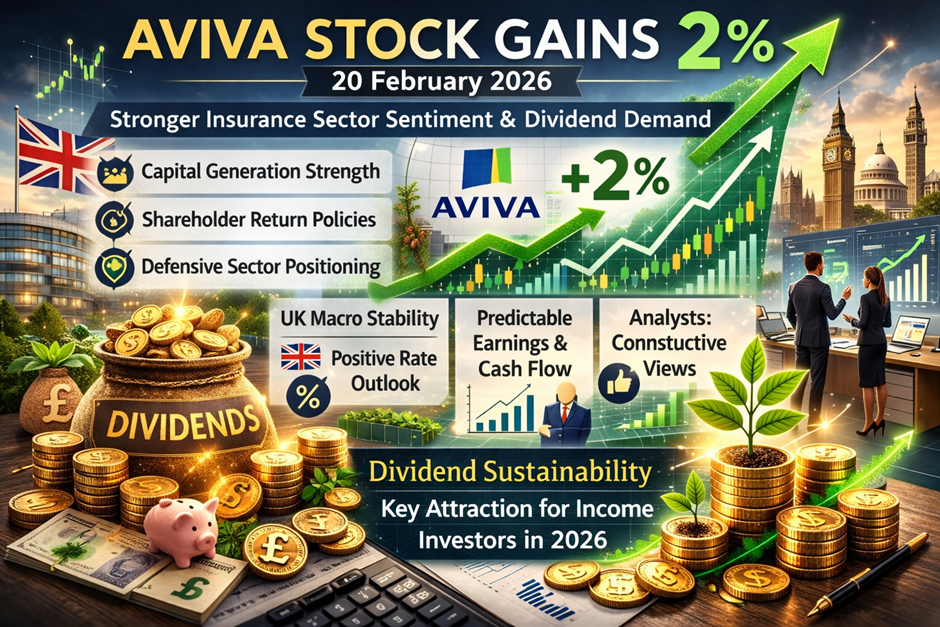
Source: Kalkine Group
Could Aviva Be One Of The Most Attractive FTSE 100 Dividend Stocks For Passive Income Investors In 2026?
Aviva stock, FTSE 100 dividend shares, UK insurance stocks, high dividend yield companies, passive income investing, best UK dividend stocks 2026, and long-term income investing strategies are dominating global investor searches in February 2026 as markets remain volatile and investors increasingly rotate toward defensive sectors with stable earnings. Aviva plc continues to attract strong attention following its recent share price movement, supported by its capital-return-focused strategy, progressive dividend policy, resilient operating model, and exposure to structural growth trends such as pensions demand, retirement planning, wealth management expansion, and demographic ageing.
Search interest around phrases like “Is Aviva a good investment in 2026?”, “Best FTSE 100 income stocks”, “UK insurance sector outlook”, “high dividend stocks UK”, and “passive income shares Europe” has increased significantly because investors are prioritising companies with reliable cash generation and shareholder returns. Insurance companies typically benefit from higher interest rates because they invest premiums into fixed-income assets, and the current global interest rate environment remains structurally more supportive compared with the ultra-low-rate period that lasted for more than a decade.
From both retail and institutional investor perspectives, Aviva offers a combination of dividend income potential, capital return visibility, defensive business characteristics, and valuation support relative to global peers. These factors are contributing to renewed buying interest and explain the upward share price momentum observed in February 2026.
What Are The Latest Catalysts Driving Aviva’s Share Price Momentum?
Several interconnected factors appear to be supporting the stock:
- Expectations of continued strong operating capital generation and earnings resilience (company disclosures).
- Shareholder-friendly capital allocation including dividends and share buybacks (company announcements).
- Positive sentiment toward financial sector equities amid interest rate stability expectations.
- Investor rotation into defensive dividend sectors during periods of geopolitical and macroeconomic uncertainty.
- Improving sentiment toward UK equities and the FTSE 100 relative to previous years.
Aviva has spent recent years simplifying its business, exiting non-core markets, improving efficiency, and strengthening its balance sheet. Investors are increasingly recognising the benefits of this strategic repositioning.
How Are Global Markets, The UK Economy, FTSE Indices, And GBP Influencing Aviva’s Outlook In 2026?
Global Market Dynamics
- Interest rates remain structurally higher compared with the 2010–2021 period, supporting insurers’ investment income.
- Geopolitical risks continue to drive demand for defensive sectors such as insurance and financials.
- Ageing populations globally support long-term demand for retirement and protection products.
UK Economic Environment
- Inflation is moderating but remains above historical norms.
- Interest rate expectations suggest gradual easing rather than aggressive monetary loosening.
- Household resilience is stabilising, supporting insurance premium growth.
- Financial system stability remains strong despite fiscal pressures.
GBP Currency Considerations
- Relative currency stability versus major global currencies supports investor confidence.
- Stable exchange rates reduce volatility in international earnings.
FTSE 100 And FTSE 250 Trends
- The FTSE 100 benefits from global revenue exposure and defensive sector composition including energy, banks, and insurers.
- The FTSE 250 remains more sensitive to domestic economic conditions.
- Global investors continue favouring large-cap dividend payers like Aviva for income portfolios.
What Is Aviva’s Current Business Model And Financial Strength?
Aviva operates through integrated segments including:
- Life insurance and retirement solutions
- General insurance across major markets including the UK, Ireland, and Canada
- Wealth management and asset management
Key competitive strengths include:
- Strong brand recognition and customer trust in core markets.
- Diversified revenue streams across multiple financial services segments.
- Capital-light growth initiatives improving return on equity.
- Digital transformation improving customer engagement and efficiency.
- Large customer base enabling cross-selling opportunities.
Recent company updates highlight:
- A robust solvency position comfortably above regulatory requirements (company filings).
- Continued strong operating capital generation momentum (company disclosures).
- Commitment to progressive dividends and shareholder returns (company statements).
- Ongoing cost discipline and operational efficiency initiatives.
How Sustainable Is Aviva’s Dividend And Shareholder Return Strategy Going Forward?
Dividend sustainability remains central to the investment thesis.
Supporting factors:
- Strong recurring cash flows from insurance operations.
- Improved balance sheet and reduced leverage compared with historical periods.
- Disciplined capital allocation framework.
- Predictable earnings profile relative to cyclical sectors.
- Management commitment to shareholder distributions.
Potential risks:
- Severe economic downturn affecting claims experience.
- Regulatory capital requirement changes.
- Financial market volatility impacting investment income.
Overall, Aviva is widely viewed as one of the more reliable dividend payers in the UK financial sector.
How Does Aviva Compare With Other Major Insurance Sector Peers?
Key peers include:
- Legal & General
- Prudential
- Phoenix Group
- Allianz
- AXA
Relative positioning:
- Competitive dividend yield compared with UK peers.
- Strong domestic market leadership.
- Lower emerging market exposure compared with some global insurers.
- Improved capital discipline supporting valuation attractiveness.
What Are Analysts And Brokers Forecasting For Aviva Shares In 2026?
Consensus sentiment among major financial institutions remains generally constructive.
Common analyst themes:
- Stable earnings supported by capital generation strength.
- Attractive dividend yield relative to bond yields.
- Moderate but consistent growth expectations.
- Limited downside risk due to defensive business characteristics.
Broker positioning examples based on latest available consensus:
- Barclays — Overweight
- JPMorgan — Overweight
- UBS — Buy
- Goldman Sachs — Neutral
Forecast expectations vary depending on interest rate assumptions, macroeconomic outlook, and capital return projections.
What Is The Insurance Sector Outlook Across Short, Medium, And Long-Term Horizons?
Short Term Outlook (3–6 Months)
- Interest rate expectations influencing sector valuations.
- Dividend announcements acting as catalysts.
- Market volatility driving defensive sector demand.
Medium Term Outlook (1–3 Years)
- Pension and retirement product demand growth.
- Digital transformation improving efficiency and margins.
- Regulatory developments influencing capital structures.
Long Term Outlook (3–10 Years)
- Ageing populations supporting structural insurance demand.
- Wealth management expansion opportunities.
- Climate risk creating both challenges and product innovation potential.
What Strategies Could Investors Consider Across Different Time Horizons?
Short Term Investors
- Monitor earnings announcements and dividend updates.
- Track interest rate policy signals from central banks.
- Observe insurance sector sentiment and FTSE trends.
Medium Term Investors
- Focus on capital return sustainability and earnings growth.
- Evaluate valuation relative to peers.
- Assess operational efficiency improvements.
Long Term Investors
- Consider dividend compounding potential.
- Evaluate structural industry growth drivers.
- Monitor management execution and strategy consistency.
Does Aviva Stock Look Bullish, Bearish, Or Neutral In 2026?
Short Term View: Neutral To Moderately Bullish
Supporting factors:
- Dividend attractiveness and yield support.
- Defensive sector rotation.
- Stable earnings expectations.
Risks:
- Market volatility.
- Interest rate surprises.
Long Term View: Moderately Bullish
Supporting factors:
- Predictable cash generation.
- Strong capital discipline.
- Structural demographic demand drivers.
What Could The Bull And Bear Investment Scenarios Look Like?
Bull case drivers include stable economic growth, supportive interest rates, sustained dividends and buybacks, operational efficiency improvements, and valuation re-rating toward global peers.
Bear case risks include recession pressures, claims inflation, regulatory capital constraints, investment market volatility, and persistent valuation discounts.
What Key Risks Should Investors Monitor Closely?
- Macroeconomic slowdown affecting insurance demand.
- Catastrophic loss events.
- Regulatory capital requirement changes.
- Investment market volatility.
- Competitive pricing pressures across insurance markets.
Could Aviva Continue To Be A Leading FTSE 100 Income Stock Over The Long Term?
Aviva’s long-term investment appeal is driven by:
- Reliable dividend income potential.
- Strong capital generation capacity.
- Defensive business characteristics.
- Improving operational efficiency.
- Shareholder-focused management strategy.
For income-focused portfolios, these attributes remain compelling provided execution remains consistent.
Final Investment Perspective: Is Aviva Worth Considering In 2026 And Beyond?
From an analytical retail investor perspective, Aviva appears positioned primarily as a stable income-oriented FTSE 100 stock rather than a high-growth opportunity. The combination of dividend visibility, capital discipline, macro tailwinds from interest rates, and defensive characteristics supports a constructive long-term outlook. However, short-term performance may remain sensitive to broader market sentiment and monetary policy expectations.
Investors seeking passive income, portfolio stability, and dividend compounding opportunities may continue to find Aviva attractive, while growth-focused investors may prefer sectors with higher earnings expansion potential.


 Jun 29, 2026




 Please wait processing your request...