
 AU
AU
 CA
CA
 US
US
 NZ
NZ
 IND
IND

 UK
UK

 Share
Share
 X (Formerly Twitter)
 Whatsapp
 Facebook
 LinkedIn
 Telegram
 Email This Article
 Copy Link
 Summarize with AI
 Chat GPT
 Perplexity
Babcock International (LSE: BAB) continues its impressive multi-year ascent, with shares trading up approximately 3% on January 7, 2026, reaching levels around 1,430p.
This move comes amid a broader rally in the UK defense sector and follows a historic milestone for the FTSE 100, which breached the 10,000-point mark earlier this month.
Key Drivers: Why the Stock is Rising Today
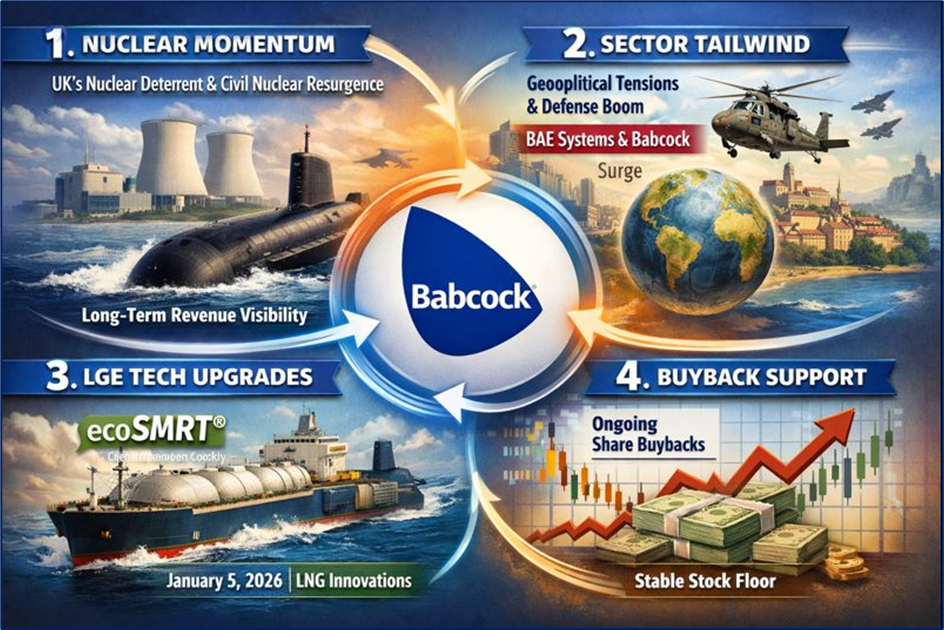
The ~3% jump on January 7 is attributed to a "perfect storm" of fundamental strength and sector rotation:
- Nuclear Momentum: Babcock’s role in the UK’s nuclear deterrent program and civil nuclear resurgence is providing long-term revenue visibility.
- Sector Tailwind: Geopolitical tensions (notably recent events in South America and Eastern Europe) have funneled capital back into "safe haven" defense stocks like BAE Systems and Babcock.
- LGE Tech Upgrades: On January 5, 2026, Babcock’s LGE business announced a 12% performance upgrade to its ecoSMRT® LNG technology, signaling higher margins in its civil marine division.
- Buyback Support: Recent RNS filings show continued execution of share buybacks, providing a steady floor for the stock price.
Source: Kalkine Group
Technical Analysis (Jan 2026)
Source: Trading View
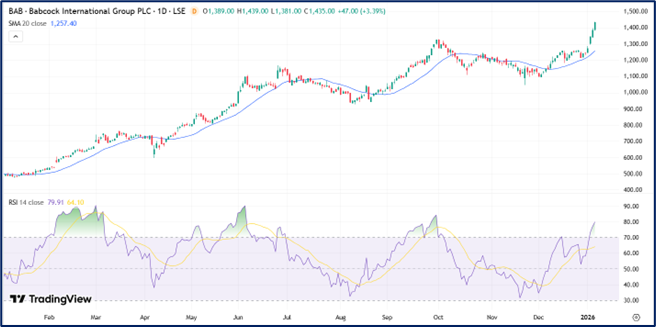
Babcock's price action on January 7 confirms a decisive bullish breakout above the critical psychological resistance of 1,350p, with the stock hitting an intra-day high of 1,439p. This move has effectively turned previous resistance into a primary support zone. The stock is currently trading with strong momentum, supported by a "Golden Cross" earlier in the year and remaining well above its 50-day SMA and 200-day SMA. While the RSI (Relative Strength Index) has climbed toward 80, it remains around "overbought" threshold which reflects a cooling-off period may happen.
Volume on this leg up has been approximately 315% higher than the 30-day average, signaling strong institutional conviction. Technical traders are now eyeing the next major Fibonacci extension target at 1,500p, while a failure to hold the 1,380p level on a closing basis could trigger a brief consolidation back toward the 1,340p support floor.
Latest Business Model
Babcock has transitioned from a troubled conglomerate into a streamlined, high-tech defense and engineering powerhouse.
- The "Nuclear-First" Strategy: Babcock is now a critical partner in the UK’s Submarine Dismantling Project and the AUKUS pact. A £114 million contract for submarine defueling (the first in 20 years) is a major operational anchor.
- Naval Leadership: The Type 31 Frigate program is meeting key milestones, with the first of five ships completing its float-off phase.
- High-Margin Services: The company is focusing on "Through-Life Support," which yields higher margins than initial construction.
- Global Expansion: Recent $250M contracts with the Australian Border Force and new defense agreements in France have diversified the revenue base away from purely UK-centric risk.
Risks to Consider
While the outlook is bullish, several headwinds remain:
- Government Dependency: Significant reliance on UK MoD budgets; any shift in government spending priorities could impact the order book.
- Execution Risk: Large-scale engineering projects (Type 31, Nuclear) are complex; delays can lead to cost overruns.
- High Leverage: While gearing is low, the total debt-to-equity ratio remains relatively high compared to some mid-cap peers.
- Inflation: Wage pressure in specialized nuclear and marine engineering sectors remains "sticky."
Conclusion
Babcock International’s performance on January 7, 2026, reflects a company that has successfully rehabilitated its balance sheet and is now reaping the rewards of a global re-armament cycle. With its nuclear division providing a "moat" and its naval segment delivering on long-term contracts, the stock remains a favorite among institutional investors looking for stability in the FTSE 100.


 Jun 03, 2026




 Please wait processing your request...