
 AU
AU
 CA
CA
 US
US
 NZ
NZ
 IND
IND

 UK
UK

 Share
Share
 X (Formerly Twitter)
 Whatsapp
 Facebook
 LinkedIn
 Telegram
 Email This Article
 Copy Link
 Summarize with AI
 Chat GPT
 Perplexity
The FTSE 250 is witnessing a distinct divergence today, as specialty engineering stalwart Goodwin PLC (GDWN) and food production giant Cranswick PLC (CWK) command significant investor attention. While the broader mid-cap index navigates macroeconomic shifts and interest rate speculation, these two firms have decoupled from the pack, driven by robust operational updates and a "flight to quality" within the UK industrials and consumer staples sectors.
Their upward trajectory on January 27, 2026, underscores a market preference for companies with high visibility in earnings and dominant niche market positions.
Cranswick PLC (CWK): The Premium Food Powerhouse
Source: Kalkine Group
Latest Drivers and Surge Reasons
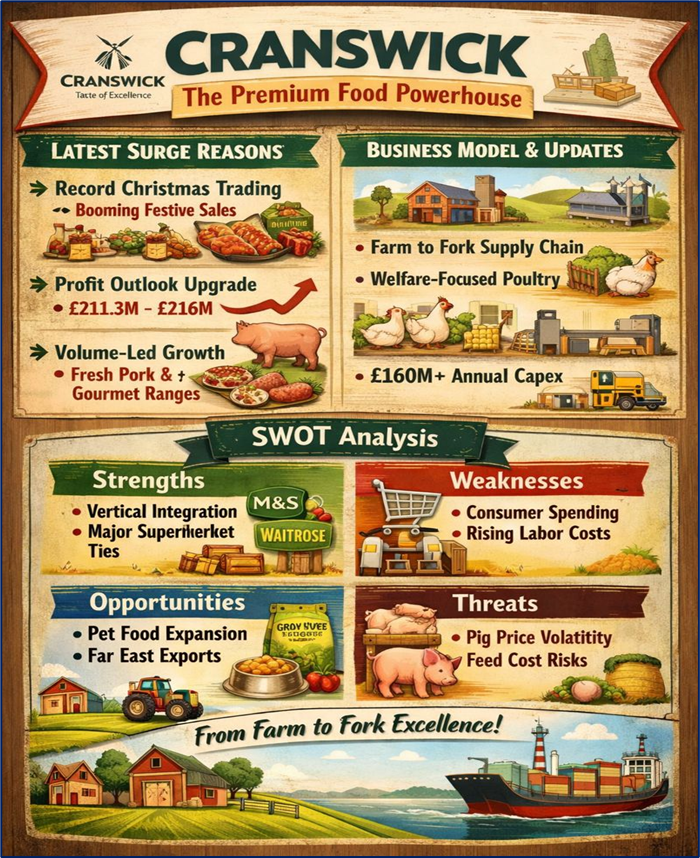
- Record Christmas Trading: Cranswick released a third-quarter trading statement this morning (Jan 27) reporting a "record" festive period, with sales across all categories exceeding the previous year (London Stock Exchange).
- Profit Outlook Upgrade: Due to positive momentum, management now expects full-year adjusted pre-tax profit to be at the upper end of the £211.3 million to £216.0 million market consensus (Alliance News).
- Volume-Led Growth: Revenue growth is being driven by volume rather than just price inflation, particularly in Fresh Pork and Gourmet festive ranges.
Business Model and Financial Updates
- Model: A vertically integrated food producer specializing in high-quality pork, poultry, and "convenience" foods. They own the supply chain from "farm to fork," including feed mills and pig breeding.
- Operational Highlights: The firm is moving toward lower poultry stocking densities (welfare-focused), which has allowed for premium pricing and onboarding of new retail contracts (London Stock Exchange).
- Dividend & Capex: Cranswick maintains a 35-year track record of dividend growth. Current Capex is projected at £160–170 million for the year, focusing on automation and capacity at their flagship Hull facility.
Latest SWOT Analysis
- Strengths: Unrivaled vertical integration; dominant relationship with major UK supermarkets (M&S, Waitrose); strong cash conversion.
- Weaknesses: High sensitivity to UK consumer spending power; rising labor costs in food processing.
- Opportunities: Expansion into the Pet Food market via the "Grove Pet Foods" acquisition; growth in Far East export licenses.
- Threats: Volatility in pig prices and feed costs; potential regulatory shifts in animal welfare standards.
Goodwin PLC (GDWN): The Engineering Excellence
Source: Kalkine Group
Latest Drivers and Surge Reasons
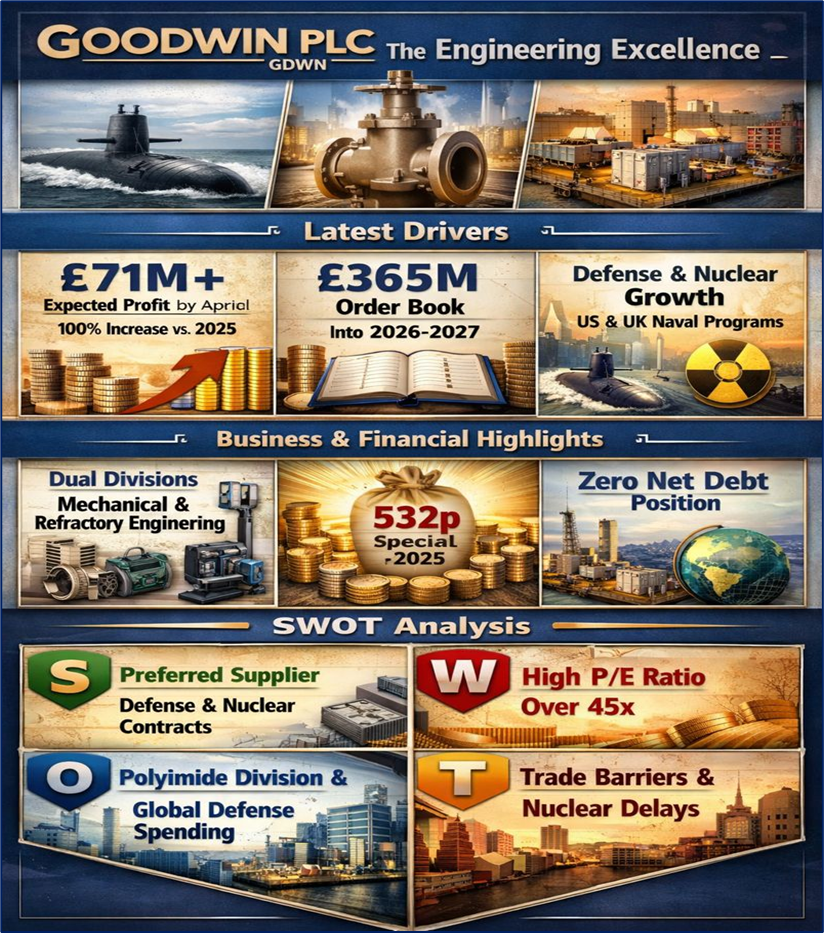
- Profitability Explosion: In a recent trading update, the board confirmed they expect pre-tax profit for the year ending April 2026 to exceed £71 million—a 100% increase over 2025 (Investegate).
- Massive Order Book: The current workload stands at a staggering £365 million, providing visibility into late 2026 and 2027.
- Defense & Nuclear Tailwinds: Growth is primarily driven by mission-critical components for US and UK naval programs, including the Virginia and Dreadnought submarine classes (London Stock Exchange).
Business Model and Financial Updates
- Model: A dual-division structure: Mechanical Engineering (specialized valves and castings for defense/nuclear) and Refractory Engineering (jewelry casting powders and technical ceramics).
- Dividend Update: To reward long-term holders, the company declared a massive one-off special interim dividend of 532 pence per share in late 2025, alongside its regular payouts (Investegate).
- Operational Growth: The firm is currently moving toward a zero net debt position despite heavy investment in its German pressing facilities and Indian manufacturing hubs.
Latest SWOT Analysis
- Strengths: "Preferred supplier" status for multi-decade nuclear and defense contracts; high barriers to entry due to technical complexity.
- Weaknesses: High P/E ratio (currently over 45x) makes the stock sensitive to any minor earnings miss.
- Opportunities: The "Polyimide Division" is expected to start contributing to revenue in the next fiscal year; rising global defense spending.
- Threats: Geopolitical trade barriers or tariffs on high-alloy steel; potential delays in large-scale nuclear infrastructure projects.
Outlook and Risk Profile
Market Outlook The outlook for both companies remains fundamentally tied to their ability to execute on high-demand backlogs. For Cranswick, the focus is on maintaining margins through automation as it scales its poultry and pet food divisions. For Goodwin, the transition from "investment phase" to "harvest phase" is now yielding record profits, with its participation in multi-decade submarine and frigate programs providing a unique "moat" in the industrial sector.
Key Risks
- Macroeconomic Pressure: While both are "defensive" in nature, a prolonged UK recession could eventually temper Cranswick’s premium product demand.
- Supply Chain & Commodities: Fluctuations in steel prices (Goodwin) and agricultural inputs (Cranswick) remain the primary variables for margin stability.
- Valuation Sensitivity: Following recent surges, both stocks are trading at premiums to historical averages, leaving little room for operational execution errors.
Compelling Conclusion
On January 27, 2026, Cranswick and Goodwin represent the "Goldilocks" zone of the FTSE 250—combining the reliability of defensive business models with the high-octane growth usually reserved for tech. Whether it is the record-breaking Christmas dinner plates provided by Cranswick or the mission-critical naval valves forged by Goodwin, both companies are demonstrating that specialized, well-invested British firms can still deliver exceptional momentum in a complex global economy.


 Jun 29, 2026




 Please wait processing your request...