
 CA
 NZ
 US
 AU
 IND

 UK

 Share
 X (Formerly Twitter)
 Whatsapp
 Facebook
 LinkedIn
 Telegram
 Email This Article
 Copy Link
 Summarize with AI
 Chat GPT
 Perplexity

Key Takeaways
- Bitcoin ETFs and ETNs have transformed crypto investing by making Bitcoin accessible through traditional financial markets
- The United States now offers spot Bitcoin ETFs, while Europe primarily uses physically backed ETNs due to regulatory constraints
- Bitcoin remains a highly volatile but high-growth asset, capable of delivering over 100% multi-year returns alongside severe drawdowns
- Fees significantly impact long-term returns, with expense ratios ranging from 0.05% to 2.00% across products
- Institutional adoption is accelerating, driving liquidity, legitimacy, and long-term market stability
- Bitcoin cycles are extreme, requiring long-term discipline rather than short-term speculation
- Portfolio allocation should be limited (typically 1–5%) due to risk concentration
- The future of Bitcoin ETFs and ETNs is strongly tied to regulation, institutional flows, and global macroeconomic trends
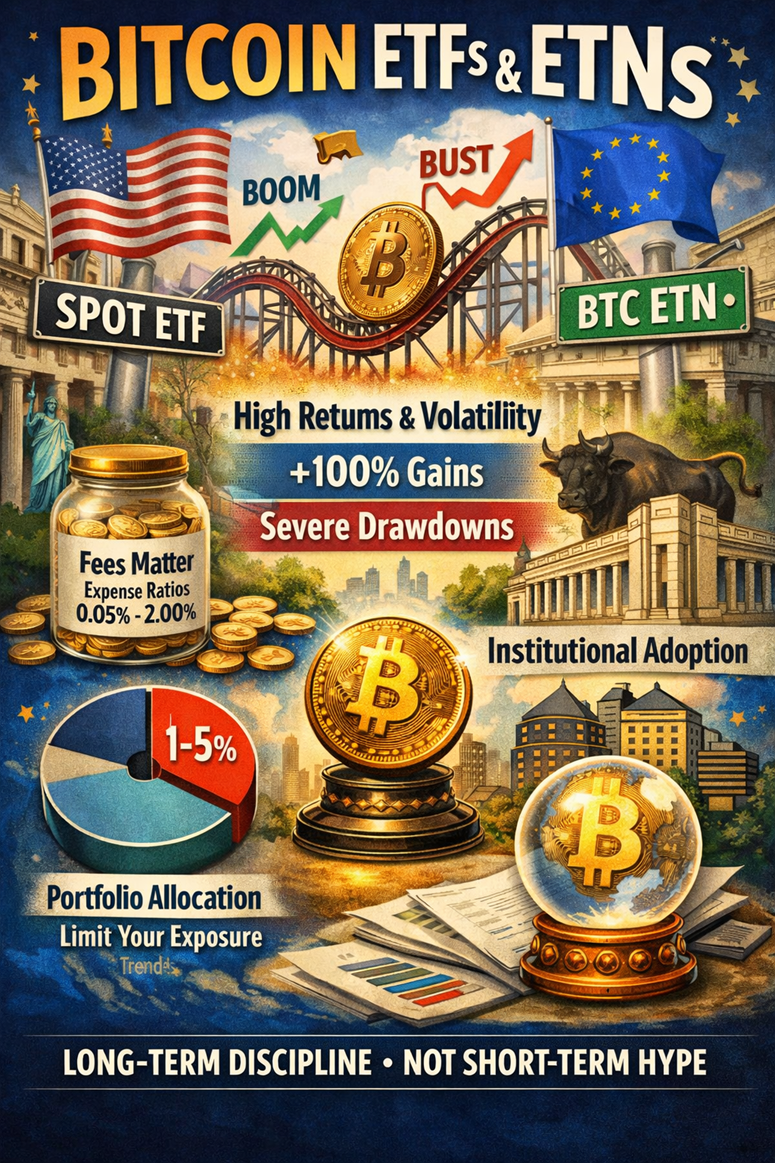
Source: Kalkine Group
Introduction: Bitcoin’s Journey Into Mainstream Finance
The financial world is undergoing a profound structural transformation, and at the center of this shift is Bitcoin. What began as a decentralized experiment in digital currency has evolved into a globally recognized asset class, now integrated into institutional portfolios, hedge fund strategies, and even retirement accounts.
Bitcoin’s rise has been fueled by a combination of technological innovation, distrust in traditional monetary systems, and a growing demand for alternative stores of value. However, despite its popularity, direct investment in Bitcoin has historically been complex and risky. Investors needed to navigate cryptocurrency exchanges, manage private keys, and safeguard digital wallets—tasks that introduced both technical and security challenges.
The emergence of Bitcoin ETFs and ETNs has fundamentally changed this equation. These instruments allow investors to gain exposure to Bitcoin through familiar, regulated financial structures. By eliminating the need for direct ownership, they have opened the door for widespread adoption across both retail and institutional segments.
This guide explores every dimension of Bitcoin ETFs and ETNs—from structure and performance to risks, costs, and future outlook—providing a complete roadmap for investors in 2026.
Understanding Bitcoin as a Financial Asset
Bitcoin is unlike any traditional asset. It does not produce income, pay dividends, or generate earnings. Instead, its value is driven by scarcity, demand, and its perceived role as a decentralized store of value.
With a fixed supply cap of 21 million coins, Bitcoin introduces a level of monetary discipline absent in fiat currencies. This scarcity has positioned it as a hedge against inflation and currency debasement, particularly in an era of expansive monetary policy.
At the same time, Bitcoin’s volatility remains one of its defining characteristics. Unlike stocks or bonds, which are influenced by earnings and interest rates, Bitcoin is heavily driven by sentiment, adoption trends, and macroeconomic narratives.
This dual nature—high risk and high reward—makes Bitcoin both attractive and challenging for investors.
Bitcoin ETFs and ETNs: Structural Foundations
Bitcoin ETFs and ETNs serve as bridges between traditional finance and the cryptocurrency ecosystem.
Bitcoin ETFs
Bitcoin ETFs are funds that track Bitcoin’s price by holding the asset directly or through derivatives. Investors buy shares of the ETF, which represent ownership in the fund.
The approval of spot Bitcoin ETFs in the United States in 2024 marked a historic turning point. These ETFs hold actual Bitcoin, ensuring accurate price tracking and eliminating many inefficiencies associated with futures-based products.
Bitcoin ETNs
Bitcoin ETNs, widely used in Europe, are debt instruments issued by financial institutions. They track Bitcoin’s price but do not represent ownership of the underlying asset.
However, most modern European ETNs are physically backed, meaning they hold Bitcoin as collateral, reducing counterparty risk.
Regulatory Divide: US vs Europe
The global Bitcoin investment landscape is shaped by regulatory frameworks.
United States
The US market now offers spot Bitcoin ETFs regulated under strict financial laws. These products have attracted massive inflows, driven by trust in established asset managers and regulatory oversight.
Europe
In Europe, UCITS regulations prohibit single-asset ETFs like Bitcoin ETFs. As a result, ETNs dominate the market.
Despite structural differences, European ETNs function similarly to ETFs in providing Bitcoin exposure.
Institutional Adoption and Market Transformation
The introduction of Bitcoin ETFs has catalyzed institutional participation. Large asset managers, pension funds, and hedge funds are now allocating capital to Bitcoin through regulated products.
This shift has several implications:
- Increased liquidity and market depth
- Reduced volatility over time (relative to early years)
- Enhanced legitimacy of Bitcoin as an asset class
Institutional demand has also contributed to upward price pressure, particularly during periods of constrained supply.
European Bitcoin ETN Market: Structure and Competition
The European market features a diverse range of Bitcoin ETNs with varying fee structures and operational models.
Key characteristics include:
- Physically backed exposure
- Accumulating structures (no dividend payouts)
- Competitive fee ranges
- Strong custodial infrastructure
Major players include CoinShares, WisdomTree, and iShares.
Competition has driven significant fee compression, benefiting investors.
Performance Analysis: Returns and Volatility
Bitcoin ETFs and ETNs closely mirror Bitcoin’s price movements.
Short-Term Dynamics
Short-term performance is highly volatile, influenced by:
- Macroeconomic events
- Regulatory announcements
- Market sentiment
Monthly returns can vary widely, making short-term prediction difficult.
Medium-Term Trends
Over 3–6 months, Bitcoin often reflects broader market cycles, including corrections and recoveries.
Long-Term Returns
Over multi-year periods, Bitcoin has delivered exceptional returns exceeding 100% in some cases.
However, these gains come with significant drawdowns.
Bitcoin Cycles: The Core of Investment Strategy
Bitcoin operates in pronounced cycles:
- Accumulation Phase – Low prices, limited interest
- Bull Market – Rapid price increases and strong inflows
- Peak Euphoria – Maximum optimism and valuation extremes
- Bear Market – Sharp corrections and reduced activity
Understanding these cycles is critical for successful investing.
Cost Structures: The Importance of Fees
Fees play a crucial role in long-term performance.
Expense Ratios
- Ultra-low cost: 0.05%–0.15%
- Standard range: 0.15%–0.25%
- Premium products: up to 2.00%
Long-Term Impact
Even small differences in fees can significantly reduce returns over time.
Hidden Costs
Investors should also consider:
- Trading spreads
- Currency conversion
- Tracking differences
Risk Analysis: What Investors Must Understand
Bitcoin ETFs and ETNs carry several risks:
Volatility Risk
Extreme price fluctuations are common.
Regulatory Risk
Government policies can impact Bitcoin markets.
Custody Risk
Though reduced, risks remain in underlying asset storage.
Credit Risk (ETNs)
ETNs depend on issuer solvency.
Liquidity Risk
Market stress can reduce liquidity.
Portfolio Strategy: Integrating Bitcoin
Bitcoin should be used strategically within portfolios.
Diversification
Low correlation with traditional assets enhances diversification.
Growth Potential
Bitcoin offers high upside potential.
Allocation Guidelines
Most investors allocate 1–5% of portfolios to Bitcoin.
Future Outlook: The Next Phase of Bitcoin Investing
The Bitcoin ETF and ETN market is expected to evolve rapidly.
Key trends include:
- Greater institutional participation
- Expansion of crypto investment products
- Improved regulatory clarity
- Integration into traditional financial systems
Bitcoin’s role in portfolios is likely to grow over time.
Conclusion: Bitcoin ETFs and ETNs in the Global Financial System
Bitcoin ETFs and ETNs represent far more than just new financial products—they are a structural evolution in how capital markets interact with digital assets. They signify the convergence of two worlds that were once considered incompatible: decentralized cryptocurrencies and traditional, regulated finance.
This transformation has profound implications. For the first time, investors can access Bitcoin exposure through vehicles that fit seamlessly into existing financial systems. This accessibility removes many of the barriers that previously limited participation, from technical complexity to custody concerns. As a result, Bitcoin is no longer confined to niche investor communities—it is becoming a mainstream asset class.
However, this accessibility does not eliminate the fundamental characteristics of Bitcoin. It remains a highly volatile, sentiment-driven asset with significant upside potential and equally significant downside risk. The presence of ETFs and ETNs does not change Bitcoin’s underlying nature; it simply changes how investors interact with it.
From a strategic perspective, Bitcoin should be viewed as a complementary asset rather than a core holding. Its role is to enhance portfolio diversification, provide asymmetric return potential, and offer exposure to a rapidly evolving technological and financial paradigm. Investors who treat Bitcoin as a speculative short-term trade are more likely to be affected by its volatility, while those who approach it with a long-term perspective may benefit from its growth trajectory.
The importance of cost efficiency, product selection, and regulatory understanding cannot be overstated. As the market matures, competition among issuers will continue to drive innovation and reduce fees, ultimately benefiting investors. At the same time, regulatory developments will play a critical role in shaping the availability and structure of these products across different regions.
Looking ahead, the trajectory of Bitcoin ETFs and ETNs will be closely tied to broader macroeconomic conditions, institutional adoption, and technological advancements within the cryptocurrency ecosystem. As financial markets continue to evolve, Bitcoin is likely to occupy an increasingly prominent position within global portfolios.
For investors, the key takeaway is clear: Bitcoin ETFs and ETNs offer a powerful, accessible way to participate in one of the most transformative financial innovations of our time. But like all powerful tools, they must be used with discipline, understanding, and a clear alignment with long-term investment goals.
FAQs
- What is the main difference between Bitcoin ETFs and ETNs?
ETFs hold Bitcoin directly, while ETNs are debt instruments tracking its price.
- Are Bitcoin ETFs better than buying Bitcoin directly?
They are more convenient and regulated but lack direct ownership benefits.
- Why are Bitcoin ETFs not available in Europe?
Due to UCITS regulations restricting single-asset funds.
- What is the safest way to invest in Bitcoin?
Through regulated ETFs or physically backed ETNs.
- How volatile are Bitcoin ETFs?
They mirror Bitcoin’s volatility, which is significantly higher than traditional assets.
- What fees should I expect?
Typically between 0.05% and 0.25% for competitive products.
- Can Bitcoin ETFs go to zero?
Only if Bitcoin itself loses all value, which is unlikely but possible.
- Is Bitcoin a good long-term investment?
It can be, but only as part of a diversified portfolio with controlled exposure.


 Nov 24, 2026





 Please wait processing your request...