
 AU
AU
 CA
CA
 US
US
 NZ
NZ
 IND
IND

 UK
UK

 Share
Share
 X (Formerly Twitter)
 Whatsapp
 Facebook
 LinkedIn
 Telegram
 Email This Article
 Copy Link
 Summarize with AI
 Chat GPT
 Perplexity
Key Takeaways
- The Friday Jump: Burberry stock defied a wider market slump on Friday, rising approximately 5% as investors rallied behind early signs of a successful turnaround.
- Primary Driver: Renewed optimism in China (a critical market returning to growth) and the execution of the new "Burberry Forward" strategy.
- Strategic Shift: The brand is pivoting back to its roots—"Timeless British Luxury" (trench coats and scarves)—abandoning recent attempts to push into ultra-high-end leather goods.
Friday’s Market Move: Why the Green Candle?
On a Friday when the FTSE 100 largely struggled due to weak economic data, Burberry emerged as a clear outlier, posting a gain of nearly 5%. This wasn't driven by a single explosive press release, but rather a "perfect storm" of converging positive sentiment:
- China "Green Shoots": Data has begun to surface indicating that Burberry’s sales in China are stabilizing and even returning to growth (+3% comparable store sales in recent updates). As the engine room of global luxury, any pulse of life from the Chinese consumer is an immediate buy signal for the sector.
- Defensive Value Play: With the broader market wobbling, investors rotated into Burberry as a "recovery stock." trading at historically low valuations (a P/E ratio far below peers like Hermès or LVMH), it is seen by value hunters as having limited downside and high upside.
- Strategy Validation: The market is beginning to price in confidence for CEO Joshua Schulman’s "Burberry Forward" plan. The pivot away from abstract high-fashion experiments back to core heritage products is resonating with investors who view it as a safer, more cash-generative path.
- Lingering M&A Speculation: While rumors of a Moncler takeover have cooled, the low share price keeps Burberry on the radar as a potential acquisition target for larger luxury conglomerates or private equity, adding a "takeover premium" to the stock.
The Business Model: "Timeless British Luxury"
Burberry is currently undergoing a radical simplification of its business model to correct the "identity crisis" of the last few years.
- Core Pillars: The business is built on Outerwear (the iconic trench coat) and Soft Accessories (cashmere scarves). These are high-margin, high-authority categories where Burberry faces little direct competition.
- Revenue Mix: The company operates a dual-channel model:
- Retail (approx. 80%): Direct-to-consumer sales through flagship stores and e-commerce. This allows for total brand control and higher margins.
- Wholesale/Licensing (approx. 20%): Selling to third-party retailers (e.g., department stores) and licensing the brand for fragrances and eyewear.
- The Shift: Previous leadership tried to elevate the brand to "ultra-luxury" to compete with Chanel, hiking prices on leather handbags. The current model reverses this, focusing on "Accessible Luxury" entry points (scarves) while maintaining prestige in coats.
Latest Business Updates & "Burberry Forward"
The latest strategic update, dubbed "Burberry Forward," is a "back-to-basics" manifesto:
- Operational Efficiency: A cost-savings program targeting £100 million in annualized savings, including streamlining corporate functions and reducing inventory overhang.
- Merchandising Overhaul: A reduction in SKU complexity. The brand is cutting back on seasonal, trend-heavy fashion items that end up on discount racks, focusing instead on "permanent" collections that hold value.
- Marketing Pivot: Campaigns are shifting away from obscure "high fashion" imagery to clearly recognizable British heritage cues—expect more rain, more check patterns, and more trench coats in ads.
- Scarf Bar Pilot: A new retail concept dedicated entirely to scarves is being rolled out to drive high-volume, high-margin sales and attract new, younger customers into the ecosystem.
Risks: The "Stiff Upper Lip" Test
Despite the Friday rally, the path remains treacherous.
- The China Gamble: Burberry is disproportionately exposed to the Chinese market. While recent numbers are good, the Chinese economy remains volatile. A sudden pullback in Chinese consumer confidence would hit Burberry harder than its more diversified peers.
- Brand Dilution: The "accessible" strategy is a double-edged sword. If Burberry pushes too hard on lower-priced items (scarves/accessories) to drive volume, it risks losing the "exclusivity" that justifies its pricing power in the long term.
- Execution Risk: Turnarounds in fashion are notoriously difficult. The brand has to clear out old, unsold inventory (often at a discount) without damaging the brand equity of the new collections.
- Macro Headwinds: Global inflation and tariff uncertainties (particularly potential US tariffs on European luxury goods) could squeeze margins.
Conclusion
Burberry’s 5% Friday surge is a vote of confidence in a logical, grounded turnaround plan. The company is trading the ego of "ultra-luxury" for the profits of "heritage luxury." For investors, the story has shifted from "catching a falling knife" to "backing a recovery play." While the sector remains volatile, the check-patterned titan is finally buttoning up its coat and weathering the storm.
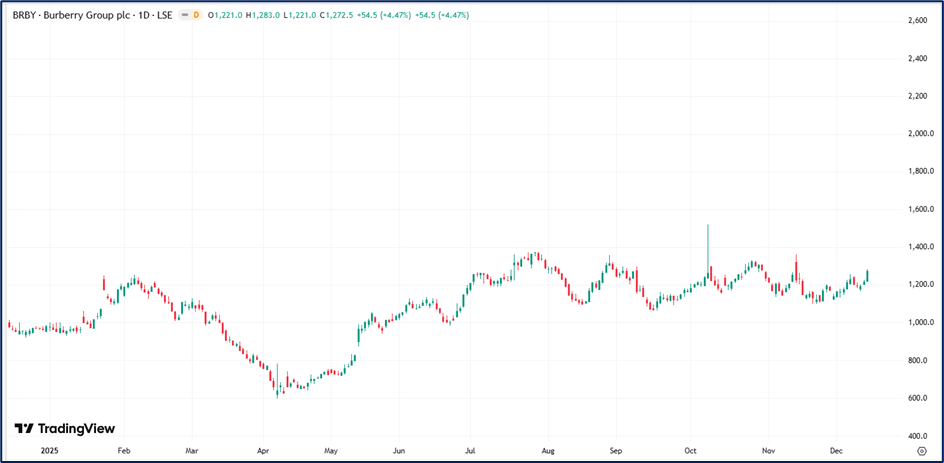
Source: Trading View, 12 December 2025


 Jun 03, 2026




 Please wait processing your request...