
 AU
AU
 CA
CA
 US
US
 NZ
NZ
 IND
IND

 UK
UK

 Share
Share
 X (Formerly Twitter)
 Whatsapp
 Facebook
 LinkedIn
 Telegram
 Email This Article
 Copy Link
 Summarize with AI
 Chat GPT
 Perplexity
Key Takeaways
- Friday's Lift (2.09%): The stock's rise on a down day for the broader FTSE 100 suggests a company-specific, "relief rally" dynamic, likely supported by recent positive analyst commentary and the reconfirmation of key financial targets.
- Driver: Reaffirmed guidance on future free cash flow (FCF) targets, specifically the ambitious £3 billion FCF target by FY30, provides a compelling long-term narrative for investors focusing on future dividends and balance sheet strength.
- Business Update Focus: The accelerated rollout of Full-Fibre to the Premises (FTTP) by its Openreach division remains the core engine of its long-term strategy, despite short-term customer losses.
- Key Risk: Intense competition in the broadband market and the substantial £20.9 billion net debt continue to be the primary structural challenges.
The Friday Bounce: More Than Just Market Noise
On a Friday when the FTSE 100 overall faced pressure due to weak UK economic growth data, BT Group's 2.09% gain (up GBX 3.70 to GBX 180.45) stands out. This suggests the rally was driven by individual stock performance rather than a rising tide lifting all boats.
The most recent catalysts trace back to earlier updates and subsequent market interpretation. Specifically, the reaction to the Half-Year Financial Report in November 2025, which, despite a revenue miss and higher-than-expected broadband customer losses, included some crucial silver linings:
- EBITDA In-Line: Adjusted earnings before interest, taxes, depreciation, and amortisation (EBITDA) was flat year-on-year at £4.1 billion, meeting consensus forecasts. This strong cost control provided reassurance.
- Reaffirmed Guidance: CEO Allison Kirkby reiterated the full-year targets for the current fiscal year and, more importantly, backed the long-term cash flow target of £3 billion in Free Cash Flow (FCF) by the end of the decade. This commitment is vital for dividend expectations.
- Dividend Uplift: The company increased its interim dividend by 2% to 2.45 pence per share, reinforcing its commitment to a progressive dividend policy once the intensive capex phase peaks.
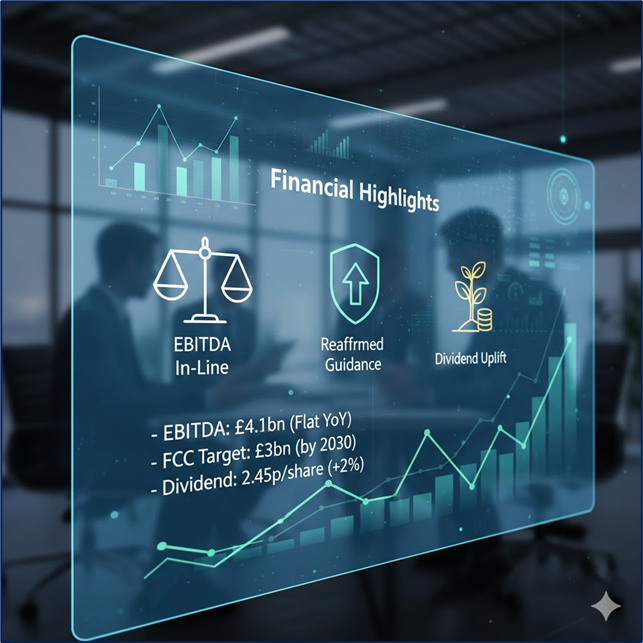
Source: Kalkine Group
The Friday move likely reflects investors continuing to process the encouraging long-term FCF guidance, seeing the high capital expenditure today as an investment that will soon mature into higher cash returns.
The Core BT Group Business Model: A Digital Juggernaut
BT Group's operations are typically divided into three main pillars:
- Openreach: This is the regulated wholesale network division, which owns and maintains the UK’s primary telecommunications infrastructure. Its current strategic focus is the colossal Full-Fibre (FTTP) rollout, aiming to reach 25 million premises by December 2026. This is the long-term value driver for the entire group.
- Consumer (BT, EE, Plusnet): This is the retail arm, offering mobile, fixed-line, broadband, and TV services directly to customers. The challenge here is balancing price increases (often CPI-linked) with intense competition from rivals like Virgin Media O2 and various AltNets (Alternative Network Providers).
- Business & International: This segment provides network and IT services to businesses, government, and wholesale customers both domestically and globally. The focus is on simplifying and rationalising its global footprint to improve profitability.
Drivers and Tailwinds for the Stock
- FTTP Rollout Momentum: Openreach continues its record pace of fibre build (over 2.2 million premises in H1 FY26), creating a superior, future-proof network that commands higher prices and lower operational costs over time.
- Cost Transformation Program: The ongoing £3 billion cost-saving plan is ahead of schedule, with £1.2 billion realised so far, helping to offset revenue declines and inflationary pressures.
- Potential for Dividend Growth: The confirmed path to higher FCF (£3bn by FY30) signals a strong possibility of a material increase in the dividend payout once the full-fibre build is complete (expected December 2026), making the stock more attractive to income investors.
- Regulatory Stability: Recent regulatory updates, such as the Telecoms Access Review, aim to provide long-term certainty for major infrastructure investors like BT.
Key Risks and Headwinds
- Heavy Net Debt: BT carries a significant net debt load (£20.9bn), which exposes it to higher interest costs, particularly in a high-rate environment, and limits financial flexibility.
- Competition and Customer Attrition: The competitive landscape is fierce. The reported loss of 242,000 broadband customers in Q2 FY26 was worse than analyst expectations, highlighting the risk of market share erosion.
- High Capital Expenditure (Capex): The massive investment in FTTP (£4.9bn in FY25) acts as a drag on current profitability and free cash flow until the rollout nears completion.
- Macroeconomic Environment: Weak UK economic growth and low consumer confidence can impact both broadband and mobile Average Revenue Per User (ARPU) as customers trade down to cheaper options.
Conclusion: The Long-Term Cash Flow Bridge
BT Group's 2.09% stock rally on Friday, despite a weaker overall market, underscores a growing divide between its short-term operating challenges and its long-term infrastructure narrative.
The gain was primarily a "confidence vote" in the future, driven by the management's decisive reaffirmation of its ambitious mid-to-late decade targets: specifically, achieving £3 billion in Free Cash Flow (FCF) by FY30 and completing the massive Full-Fibre rollout by December 2026. This target acts as a financial bridge, assuring the market that the current high capital expenditure phase is temporary and will soon transition into a period of significantly higher cash generation and, crucially for income investors, potential for a more robust dividend.
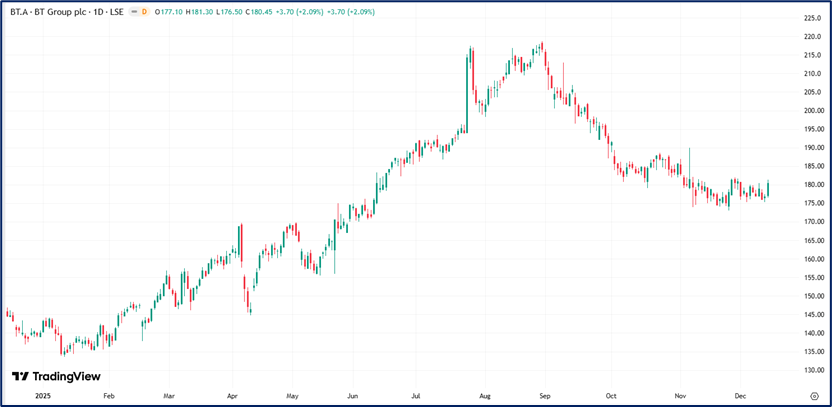
Source: Trading View, 12 December 2025


 Jun 03, 2026




 Please wait processing your request...