
 AU
AU
 CA
CA
 US
US
 NZ
NZ
 IND
IND

 UK
UK

 Share
Share
 X (Formerly Twitter)
 Whatsapp
 Facebook
 LinkedIn
 Telegram
 Email This Article
 Copy Link
 Summarize with AI
 Chat GPT
 Perplexity
While shoppers freeze their cards, Britain’s watchdog ignites a post-Brexit fire sale on regulations. Here’s how smart money is playing the divergence. The United Kingdom is currently living a tale of two economies. On the high street, wallets are snapping shut at the fastest rate since the pandemic. In the City, however, regulators are tearing up the rulebook in a desperate bid to turn a nation of savers into a powerhouse of investors.
For the retail investor, this disconnect presents a rare, high-stakes window of opportunity. As card spending plummets due to budget anxiety, the Financial Conduct Authority (FCA) is rolling out the red carpet for risk-takers.
The Current Landscape: A "Wallet Freeze" Meets Regulatory Thaw
1. The Spending Deep Freeze
The latest data is grim. UK consumer card spending cratered by 1.1% in November 2025—the sharpest decline since the dark days of February 2021. This drop is confirmed by the latest Barclays Consumer Spend report.
- The Culprit: "Budget Anxiety." Rachel Reeves' fiscal tightening, outlined in the November 2025 Autumn Budget, has spooked households.
- The Trend: Essential spend dropped 2.9%, marking seven consecutive months of decline, while non-essential spending fell 0.3%. The Black Friday boost was highly concentrated and failed to lift overall monthly spend.
- The Risk: A consumer recession that drags into mid-2026, which puts immense pressure on the Bank of England to cut the 4.00% base rate sooner than anticipated.
2. The Post-Brexit Investment Pivot
While consumers retreat, the FCA is advancing. This week, the watchdog delivered a landmark Policy Statement (PS25/20), finalizing a massive package of reforms designed to scrap EU-era red tape (specifically the hated PRIIPs rules).
- The Shift: Replacing complex "Key Information Documents (KIDs)" with a streamlined and flexible Product Summary under the new Consumer Composite Investment (CCI) regime.
- The Goal: To unlock the billions sitting in low-interest cash ISAs and funnel it into the stock market.
- Implementation: Firms now have until June 2027 to implement the changes, giving them ample time to design more consumer-friendly disclosures. The rules also introduce a new 1-10 risk score for funds (expanded from 1-7).
Smart Money Strategy: What the Fund Managers Are Doing
Institutional investors ("Smart Money") are looking past the current gloom. They see the spending drop not as a disaster, but as a signal that inflation will cool (currently 3.80%), forcing interest rates down—a classic trigger for equity rallies.
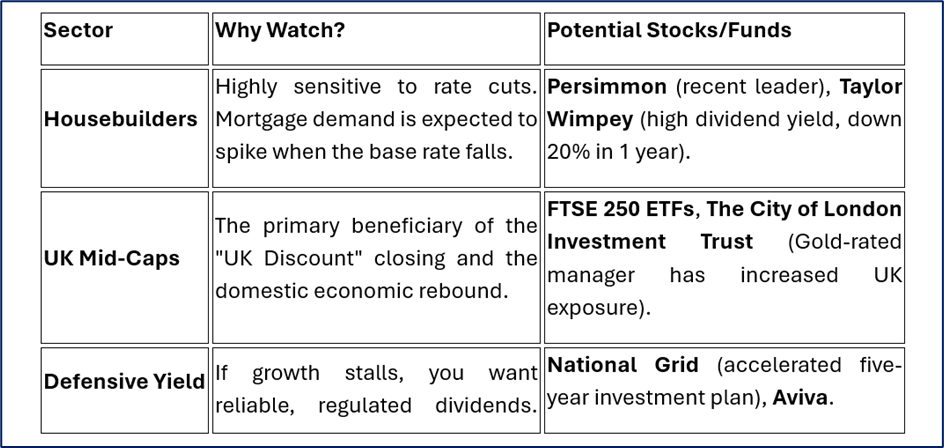
- The "Mid-Cap" Rotation: Managers are aggressively positioning into the FTSE 250. Why? Mid-caps are more domestic-focused and highly sensitive to interest rate cuts. When rates fall, these stocks typically outperform the heavyweights in the FTSE 100.
- Housebuilders Rally: With expectations for lower mortgage rates in 2026, Housebuilders have seen a recent surge. Persimmon was the pick of the sector in November 2025, boosted by the outlook for rate cuts.
- Gold as a Hedge: Amid geopolitical instability and currency uncertainty, Gold miners like Endeavour Mining continue to perform strongly, with the sector up significantly year-to-date.

Source: Kalkine Group
Sectors & Stocks to Watch
Based on the divergence between weak consumer spending and lower future rates, here are the areas to watch:
Source: Kalkine Group
Conclusion
The headlines scream "recession" and "spending cuts," but the subtext screams "opportunity." The UK government is effectively engineering a reset: dampening consumption today to rebuild the investment architecture for tomorrow. For the retail investor, the danger lies in following the herd into cash just as the regulatory gates to wealth creation are being thrown open.


 Jun 24, 2026




 Please wait processing your request...