
 AU
AU
 CA
CA
 US
US
 NZ
NZ
 IND
IND

 UK
UK

 Share
Share
 X (Formerly Twitter)
 Whatsapp
 Facebook
 LinkedIn
 Telegram
 Email This Article
 Copy Link
 Summarize with AI
 Chat GPT
 Perplexity
Artificial intelligence is rapidly reshaping global credit scoring, fraud detection, and risk analytics — and Experian PLC sits directly at the centre of this data-driven transformation. As financial institutions race to deploy AI-powered decision tools, investors are asking a critical question: can Experian leverage AI innovation to accelerate growth, defend margins, and outperform the broader FTSE 100 in 2026 and beyond?
Key Takeaways – Experian Stock Outlook (February 2026)
- Experian PLC (LSE: EXPN) shares remain volatile in early February 2026, reflecting broader sell-offs across data, analytics, and technology-linked stocks.
- The UK economy is expanding modestly, with inflation still above target and monetary policy remaining cautious.
- The FTSE 100 is trading near record highs, supported by global earnings resilience despite ongoing sector rotation.
- AI disruption narratives are creating short-term uncertainty for data and analytics firms, including Experian, despite strong long-term fundamentals.
Is Experian’s Share Price Action Signalling a Bullish Trend Amid FTSE 100 Strength?
In the current February 2026 market environment, global equities are being shaped by inflation data, currency movements, and evolving central bank expectations. Within this backdrop, Experian’s share price has experienced sharp daily fluctuations, as investors balance macro uncertainty against the company’s strategic importance in credit analytics, fraud prevention, and identity management.
While trading volumes have spiked on certain sessions, Experian has occasionally underperformed the FTSE 100, largely due to sector-wide caution around AI-driven competition rather than company-specific deterioration. Importantly, demand for resilient, recurring-revenue data platforms remains a priority theme for long-term investors.
Is Experian Really Up 4% on 5 February 2026 — Or Is Volatility Distorting the Picture?
Market data from 5 February 2026 presents mixed signals. Some live feeds indicate intraday gains, while others reflect modest pullbacks, highlighting the highly volatile trading conditions currently affecting data and analytics stocks.
At the same time, the FTSE 100 continues to hover near historic highs, suggesting overall market confidence. However, selective profit-taking in technology and data providers — driven by fears of AI commoditisation — has temporarily weighed on names like Experian.
Does the UK Macro Environment Support Experian’s Investment Case in 2026?
The UK economic landscape in early 2026 offers both support and friction for equity markets:
- Inflation & Rates: Inflation remains above target, keeping the Bank of England in a cautious stance, with interest rates expected to hold around 3.75%.
- Economic Growth: GDP growth is positive but subdued, with steady expansion projected through 2026.
- Currency Dynamics: Sterling has shown relative strength, reflecting confidence but remaining sensitive to global policy shifts.
- Market Structure: The FTSE 100 benefits from global revenue exposure, while more domestically focused indices show greater divergence.
For Experian, global diversification helps cushion domestic economic softness.
Is Experian’s Business Model Built for Sustainable Growth in an AI-Driven World?
Experian’s operating model spans credit data, advanced analytics, fraud detection, identity verification, and digital consumer services — all areas seeing sustained global demand.
Key strategic strengths include:
- A $1 billion share buyback programme, reinforcing shareholder returns and balance-sheet confidence.
- Expanding AI-enabled analytics and fraud prevention tools aligned with digital financial ecosystems.
- A geographically diversified revenue base across North America, Latin America, EMEA, and Asia-Pacific.
These attributes position Experian as a structural beneficiary of digital finance, rather than a casualty of AI disruption.
Is Experian Stock Bullish, Bearish, or Neutral? (Investor Timeframe Analysis)
Short Term (3–6 months)
- Neutral to mildly bearish bias due to sector rotation, AI-related valuation pressure, and macro uncertainty.
- Short-term price swings likely remain elevated.
Medium Term (6–12 months)
- Constructively bullish if inflation eases and lending activity improves.
- Any pivot toward monetary easing could catalyse valuation re-rating.
Long Term (12+ months)
- Bullish on fundamentals, supported by high barriers to entry, data scale advantages, and persistent demand for credit intelligence.
How Does Experian Compare With Sector Peers?
Relative to competitors such as Equifax, Experian benefits from broader geographic diversification and a strong consumer-facing digital footprint. While AI disruption risks affect the entire sector, Experian’s data depth and regulatory positioning remain key competitive moats.
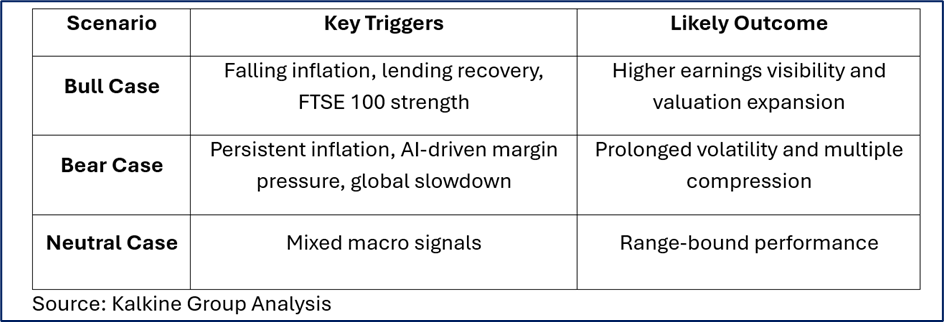
Bull, Bear, and Neutral Scenarios for Experian Stock
Key Risks Investors Should Watch in 2026
- AI-led disruption concerns across the data and analytics sector
- Prolonged inflation and delayed interest-rate cuts
- Global economic and geopolitical uncertainty
Experian Stock FAQs (SEO-Optimised)
Q: Is Experian stock up 4% on 5 February 2026?
A: Intraday data varies by source; volatility and sector rotation are driving mixed readings.
Q: What does Experian do?
A: Experian provides credit data, analytics, fraud prevention, and digital identity solutions globally.
Q: How does the UK economy impact Experian?
A: Inflation, interest rates, and lending trends influence credit activity and investor sentiment.
Final Retail Investor Verdict
Experian’s share price action in early February 2026 reflects market volatility rather than fundamental weakness. While AI-related fears and macro uncertainty may cap short-term upside, the company’s global data franchise, recurring revenue streams, and strategic positioning in credit and risk analytics support a compelling long-term investment thesis.
For long-term investors, Experian remains a high-quality compounder aligned with digital finance growth. Short-term traders, however, should remain disciplined given heightened sensitivity to macro headlines and sector rotations.


 Jun 29, 2026




 Please wait processing your request...