
 AU
AU
 CA
CA
 US
US
 NZ
NZ
 IND
IND

 UK
UK

 Share
Share
 X (Formerly Twitter)
 Whatsapp
 Facebook
 LinkedIn
 Telegram
 Email This Article
 Copy Link
 Summarize with AI
 Chat GPT
 Perplexity
UK banking stocks are flashing mixed signals as 2026 unfolds. Against this backdrop, Barclays is emerging as a focal point for investors asking a simple but critical question: can it successfully balance growth, dividends, and risk management in a shifting macro environment?
Key Takeaways (Latest Update: February 2026)
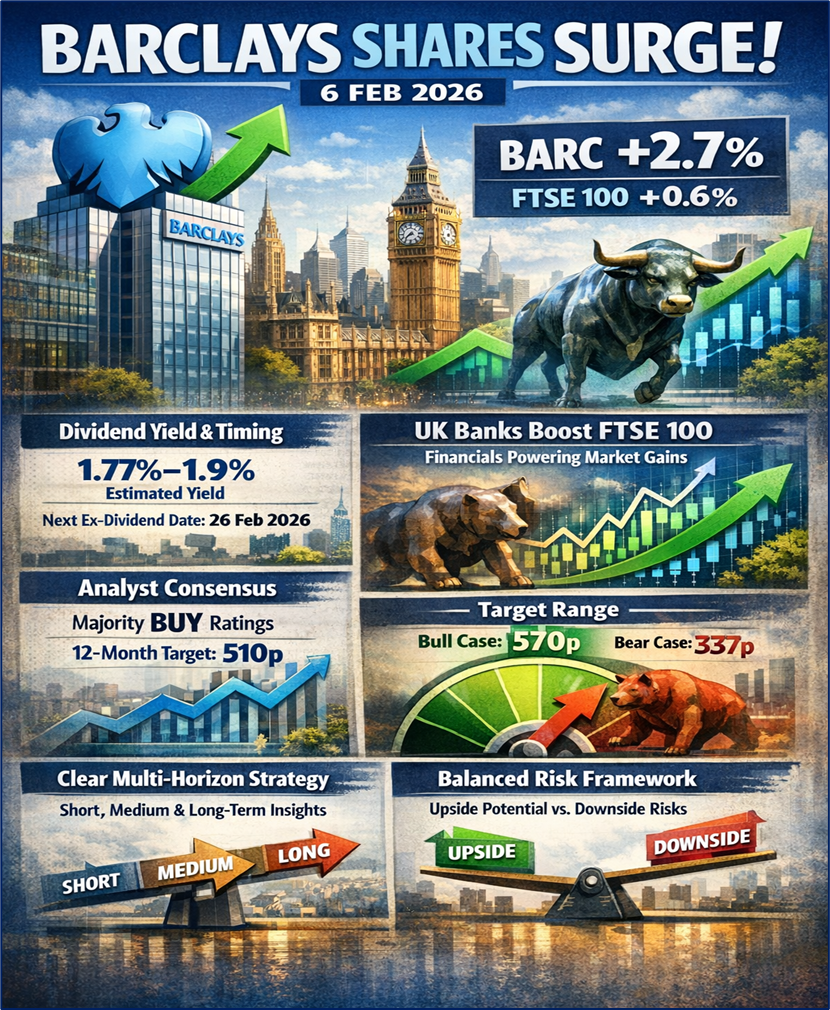
- Barclays Shares Surge on 6 Feb 2026: The stock jumped roughly +2.7%, significantly outperforming the FTSE 100, which gained about +0.6%, driven by renewed optimism toward UK banks.
- Dividend Yield & Timing: Barclays offers an estimated 1.77%–1.9% yield, with the next final dividend ex-date expected around 26 Feb 2026.
- Financials Power UK Markets: Strength in banking stocks continues to underpin FTSE 100 resilience amid easing inflation expectations.
- Analyst Consensus Remains Constructive: Majority Buy ratings, with an average 12-month target near 510p (bull case ~570p, bear case ~337p).
- Clear Multi-Horizon Strategy: Actionable insights across short-, medium-, and long-term investment timeframes.
- Balanced Risk Framework: Transparent bull and bear scenarios highlight both upside drivers and downside threats.
Source: Kalkine Group
Is Barclays Stock Rising on 6 Feb 2026 — and Why Does It Matter?
Barclays shares captured investor attention in early February 2026, climbing approximately +2.7% on 6 Feb, decisively outperforming the broader UK market. This move reflects a sector-wide re-rating of UK banks, supported by:
- Stabilising inflation data
- Improved confidence in the UK economic outlook
- Expectations of a more predictable interest-rate path from the Bank of England
The FTSE 100’s advance was led by heavyweight lenders such as Barclays, Lloyds, and NatWest, reinforcing the banking sector’s renewed leadership role. Momentum suggests strong participation from both institutional and retail investors, drawn by valuation appeal and improving sentiment.
What Do Barclays’ Financials and Dividend Signals Show in 2026?
Barclays’ diversified operating model remains a defining strength, spanning:
- UK consumer and business banking
- Corporate and investment banking
- Wealth management and global markets
This mix provides a balance between recurring income streams and cyclical growth opportunities.
Dividend Snapshot (Feb 2026)
- Final Dividend Ex-Date: Expected around 26 Feb 2026
- Forward Yield: Approximately 1.77%–1.9%
While the yield is modest relative to some income-heavy peers, it is underpinned by solid capital buffers and improving payout consistency, enhancing total return potential rather than pure yield appeal.
How Do Global and UK Economic Trends Affect Barclays?
Global Markets & Sector Rotation
Volatility across global equities—particularly in high-growth and AI-linked technology stocks—has encouraged capital rotation into traditional sectors, including financials. Banks benefit from:
- Stabilising bond yields
- Reduced inflation uncertainty
- Improved earnings visibility
UK Economy & Index Dynamics
The FTSE 100 has shown notable resilience, reaching record or near-record levels in early February 2026, driven largely by internationally exposed financial and cyclical stocks. In contrast, the FTSE 250’s underperformance highlights softer domestic growth—making globally diversified banks like Barclays relatively attractive.
Currency & Rates
A steadier British pound supports capital ratios and FX-linked revenues. The future interest-rate trajectory remains a critical earnings lever for net interest margins.
How Does Barclays Compare With Other UK Banks?
Relative to peers:
- Valuation: Mid-range P/E compared with Lloyds and NatWest
- Price-to-Book: Slight discount versus sector averages
- Business Mix Advantage: Greater earnings diversification than retail-only lenders
This diversified structure offers earnings resilience across economic cycles, positioning Barclays as a flexible operator within the UK banking landscape.
Is Barclays Stock Bullish or Bearish Right Now?
Short Term (0–3 Months): Neutral to Bullish
- Positive technical momentum
- Supported by strong sector sentiment
- Macro headlines remain a volatility risk
Medium Term (3–12 Months): Neutral
- Analyst forecasts imply ~7%–12% upside
- Rate uncertainty and economic moderation could cap gains
Long Term (1–3 Years): Bullish Bias
- Potential valuation re-rating if earnings and dividends remain consistent
- Strong capital adequacy supports buybacks and growth initiatives
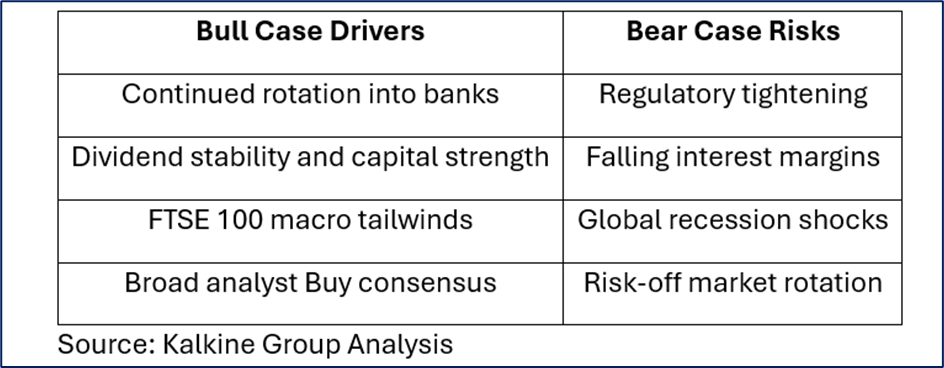
Bull vs. Bear Scenario Matrix
Analyst Ratings and Price Targets Explained
Current analyst positioning reflects measured optimism:
- Average Target: ~510p
- Upside Case: ~570p
- Downside Case: ~337p
This spread underscores confidence in Barclays’ fundamentals while acknowledging macro and policy risks.
Forward-Looking Investor Strategies
Short Term (3–6 Months)
- Track Bank of England guidance
- Use disciplined risk controls around key technical levels
Medium Term (6–12 Months)
- Accumulate selectively on pullbacks
- Reinvest dividends to enhance compounding
Long Term (12+ Months)
- Hold as a core FTSE 100 financial exposure
- Balance with global diversification to manage UK-specific risk
Frequently Asked Questions
Why did Barclays shares rise about 2.7% on 6 Feb 2026?
The move was driven by strong banking-sector momentum and renewed confidence in UK financials.
Is Barclays expected to pay dividends in 2026?
Yes. The next final dividend is expected to go ex-dividend around 26 Feb 2026.
Is Barclays stock considered a buy right now?
Most analysts rate the stock Buy, citing moderate upside and solid fundamentals.
Final Investment Perspective (Informational Only)
Barclays’ strong performance in early February 2026 highlights its role as a resilient, globally diversified UK bank. While sensitive to interest-rate policy and macro shifts, it offers a compelling blend of capital strength, dividend continuity, and long-term growth optionality.
For investors, the key is balance: managing short-term volatility while positioning for longer-term value creation within the FTSE 100 banking space.


 Jun 29, 2026




 Please wait processing your request...