
 AU
AU
 CA
CA
 US
US
 NZ
NZ
 IND
IND

 UK
UK

 Share
Share
 X (Formerly Twitter)
 Whatsapp
 Facebook
 LinkedIn
 Telegram
 Email This Article
 Copy Link
 Summarize with AI
 Chat GPT
 Perplexity
Luxury stocks have endured a choppy cycle, and Burberry Group PLC has been no exception. Slowing global demand, cautious consumers, and operational resets have weighed on sentiment. But February 2026 has injected fresh energy into the story—raising the big question: is this the early phase of a genuine turnaround, or just another short-lived bounce?
Key Takeaways (February 2026 Market & Burberry Stock Snapshot)
- Burberry shares jumped ~5.17% on 6 February 2026, decisively outperforming the FTSE 100, which gained ~0.59%.
- The stock remains well below its 52-week high, highlighting ongoing volatility and an uneven recovery path.
- Analyst consensus tilts toward “Buy,” with average 12-month price targets implying ~18%–30% upside.
- Dividend visibility is low, with no confirmed FY 2025/26 payout announced to date.
- A potential China and Asia-Pacific luxury rebound could act as a medium- to long-term growth catalyst.
- Key risks include UK macro pressure, earnings variability, and intense competition from global luxury peers.
- Strategy matters: traders may target momentum, while long-term investors focus on brand revival and valuation re-rating.

Source: Kalkine Group
Is the Burberry Stock Surge on 6 February 2026 Built to Last?
On Friday, 6 February 2026, Burberry shares surged by approximately +5.17%, making it one of the standout performers among major UK equities. By comparison, the FTSE 100 posted only a modest gain of around +0.59%.
This sharp move placed Burberry firmly back on investor radars, driven by a mix of:
- Renewed interest in oversold luxury names
- Early optimism around turnaround execution
- Broader risk-on rotation into consumer discretionary stocks
Still, the move came amid elevated volatility—suggesting enthusiasm is returning, but conviction is not yet universal.
How Does Burberry Compare With the FTSE 100 and FTSE 250 in Early 2026?
Global equity markets in early 2026 are navigating a cautious upswing. Defensive sectors remain popular, while selective risk appetite is re-emerging in luxury and discretionary stocks.
In the UK:
- The FTSE 100 has shown resilience, supported by defensives and global earners.
- The FTSE 250 continues to feel pressure from domestic economic uncertainty, including wage growth and employment concerns.
Burberry’s February rally reflects:
- Sector rotation into value-tilted fashion and luxury stocks
- Asia-driven optimism, particularly tied to China demand stabilization
- Market response to cost-control measures and brand refocusing
Yet, the stock’s distance from its prior highs underscores lingering skepticism.
What Is the Current Dividend Outlook for Burberry?
Dividend investors should tread carefully.
- Burberry has not confirmed a dividend for FY 2025/26.
- Historically, the stock delivered attractive yields of ~4%–6% before 2025.
- The absence of recent guidance suggests that capital preservation and turnaround funding remain management priorities.
Bottom line: income-focused investors may need patience until profitability and cash flow consistency improve.
What Are Analysts Predicting for Burberry’s Share Price?
Sell-side sentiment has improved, though it remains balanced rather than euphoric.
Analyst consensus highlights:
- A majority “Buy” bias, with fewer Hold and Sell ratings
- 12-month price targets averaging 18%–30% above current levels
- Clear warnings that missed execution or weaker luxury demand could cap upside
Overall view: constructive optimism, paired with realistic risk awareness.
Is Burberry Bullish, Bearish, or Neutral Across Time Horizons?
Short Term (0–3 months)
- Momentum from recent gains and sector rotation
- Ongoing macro and inflation uncertainty
Outlook: Neutral-to-Bullish, with high volatility
Medium Term (3–12 months)
- Dependent on turnaround milestones, regional sales traction, and margin recovery
Outlook: Neutral, execution-driven
Long Term (1–3 years)
- Potential for valuation re-rating if brand equity strengthens and global demand normalizes
Outlook: Neutral-to-Bullish for patient investors
Core Business and Financial Drivers Shaping Burberry’s Outlook
Company-Specific Factors
- Brand revitalisation initiatives and tighter product focus
- Cost-cutting and operational streamlining
- Past drag from weak retail demand, now showing tentative stabilization
Macro & Industry Forces
- UK inflation trends and central-bank policy
- Global luxury demand cycles
- Recovery momentum in China and Asia-Pacific
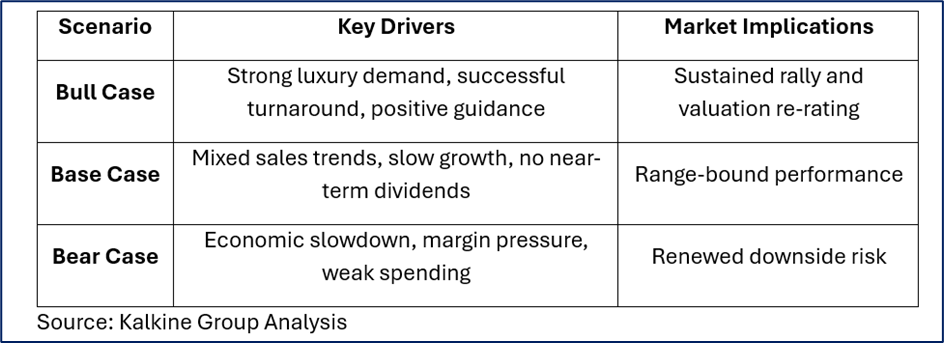
Bull, Base, and Bear Case Scenarios for Burberry (BRBY)
Investment Strategies by Time Horizon
- Short Term (3–6 months): Momentum and event-driven trading around earnings and macro data
- Medium Term (6–12 months): Monitor execution milestones, Asia sales trends, and dividend signals
- Long Term (1–3 years): Focus on brand recovery, global luxury exposure, and re-rating potential
Key Risks Investors Should Watch Closely
- UK economic softness and consumer spending pressure
- Ongoing dividend uncertainty
- Fierce competition from global luxury leaders
- Currency, geopolitical, and macro-driven demand shocks
Investor FAQs
Is Burberry a Buy or Sell in February 2026?
Consensus leans Buy, but risk tolerance and time horizon are critical.
Does Burberry currently pay a dividend?
No dividend has been confirmed for FY 2025/26.
Why did Burberry shares jump on 6 February 2026?
The stock rose ~5.17%, outperforming the FTSE 100 amid renewed luxury optimism.
What factors most influence Burberry’s outlook?
Luxury demand trends, brand strategy execution, and macroeconomic conditions.
Final Verdict: Should Investors Pay Attention Now?
Burberry’s early-February surge signals renewed market interest, but the path ahead remains uneven. For traders, volatility offers opportunity. For long-term investors, the real payoff depends on whether management can restore brand momentum, stabilize earnings, and unlock a valuation re-rating as global luxury demand recovers.
In short: high risk, high potential—best approached with strategy, patience, and clear expectations.


 Jun 29, 2026




 Please wait processing your request...