
 AU
AU
 CA
CA
 US
US
 NZ
NZ
 IND
IND

 UK
UK

 Share
Share
 X (Formerly Twitter)
 Whatsapp
 Facebook
 LinkedIn
 Telegram
 Email This Article
 Copy Link
 Summarize with AI
 Chat GPT
 Perplexity
NatWest shares could offer strong dividends and valuation upside. Here’s what investors should know before buying.
Key Takeaways — February 2026
- NatWest share price climbed about 4.7% on 16 February 2026 as investor sentiment toward UK banks strengthened
• Robust capital levels support dividends, share buybacks, and long-term shareholder returns (Company disclosures 2025–2026)
• Expectations of stabilizing UK interest rates improving sector outlook
• Valuation remains attractive relative to global banking peers
• Medium- and long-term growth supported by efficiency initiatives and digital banking strategy

Source: Kalkine Group
Why Is NatWest (FTSE 100: NWG) Stock Rising Sharply in February 2026?
NatWest share price, FTSE 100 banking stocks, UK dividend shares, high-yield bank stocks, UK interest rate outlook, Bank of England policy expectations, GBP currency trends, and undervalued financial stocks are among the most searched global investment keywords in February 2026 — and NatWest has emerged as a key stock attracting attention from income investors, value investors, and institutional funds seeking exposure to UK financial recovery opportunities.
The recent NatWest rally reflects improving macroeconomic confidence, renewed interest in cyclical financial stocks, and optimism that the UK interest-rate cycle may be approaching a more stable phase. Banking stocks typically benefit when rate expectations stabilize because earnings visibility improves, loan demand becomes more predictable, and credit risk fears decline.
Another major factor supporting investor enthusiasm is NatWest’s relatively low valuation compared with international banking peers despite strong profitability metrics. This combination of attractive dividend yield, capital return potential, and valuation discount positions NatWest as a compelling candidate for investors seeking passive income and long-term total return opportunities.
What Are the Key Catalysts Driving NatWest Shares Higher Right Now?
- Expectations that UK interest rates may stabilize or gradually decline
• Strong capital ratios enabling dividends and share buybacks (Company updates)
• Improving UK macroeconomic resilience versus earlier recession concerns
• Rotation by investors into financial stocks from defensive sectors
• Attractive price-to-earnings and price-to-book valuation metrics
How Are Global Markets and the UK Economy Supporting NatWest’s Momentum?
Global financial markets in early 2026 are influenced by moderating inflation trends, evolving central-bank policies, and shifting investor risk appetite. Financial institutions generally perform well when macroeconomic uncertainty declines and economic growth stabilizes.
The UK economy currently shows signs of gradual stabilization:
- Inflation pressures easing compared with previous peaks
• Consumer spending stabilizing
• Housing market activity showing early recovery indicators
• Employment remaining relatively resilient
Because NatWest has strong domestic exposure, improvements in the UK economic outlook directly support investor confidence in its earnings trajectory.
What Do FTSE 100, FTSE 250, and GBP Currency Trends Indicate?
FTSE 100 financial stocks are benefiting from:
- Capital rotation into cyclical sectors
• Competitive dividend yields compared with global equity markets
• International investor flows returning to UK equities
FTSE 250 performance also matters because it reflects domestic economic strength, which influences lending demand and credit conditions for NatWest.
GBP stability provides additional support through:
- Improved investor confidence
• Lower funding volatility
• Greater foreign investment attractiveness
How Resilient Is NatWest’s Business Model in 2026?
NatWest operates through diversified segments including retail banking, commercial banking, corporate services, and wealth management. Its strategy focuses on efficiency, digital innovation, and disciplined risk management.
Core strengths include:
- Strong net interest income generation
• Cost optimization initiatives
• Digital transformation investments
• Conservative lending practices
• Shareholder capital returns
Financial performance remains supported by stable lending demand and improving operational efficiency (Company financial releases).
How Does NatWest Compare With Other UK Banking Giants?
Peer comparisons suggest:
- Greater domestic focus than HSBC
• Comparable retail exposure to Lloyds
• Competitive capital returns versus Barclays
• Improving efficiency metrics relative to sector averages
Despite these strengths, NatWest often trades at a valuation discount, creating potential upside if investor sentiment toward UK banks improves.
What Is the Outlook for the Banking Sector and NatWest Across Time Horizons?
Short-term outlook:
Market movements likely influenced by macroeconomic data, interest-rate expectations, and investor sentiment shifts.
Medium-term outlook:
Improving loan demand, margin normalization, and continued shareholder distributions could support returns.
Long-term outlook:
Digital banking transformation, structural efficiency gains, and sustainable capital generation may drive shareholder value.
What Strategies Could Investors Consider Going Forward?
Short-term approach:
- Monitor macroeconomic indicators and central-bank signals
• Track earnings announcements and sector catalysts
• Use volatility for tactical entry opportunities
Medium-term approach:
- Focus on dividend sustainability and payout growth
• Evaluate capital return programs
• Monitor credit-quality metrics
Long-term approach:
- Accumulate during market weakness
• Reinvest dividends for compounding returns
• Assess valuation relative to long-term earnings growth
Is NatWest Stock Bullish or Bearish Right Now?
Short-term view:
Neutral to moderately bullish due to macro-driven volatility but improving sector sentiment.
Long-term view:
Constructively bullish based on strong capital generation, shareholder returns, and valuation discount potential.
This analysis is informational and not a price forecast.
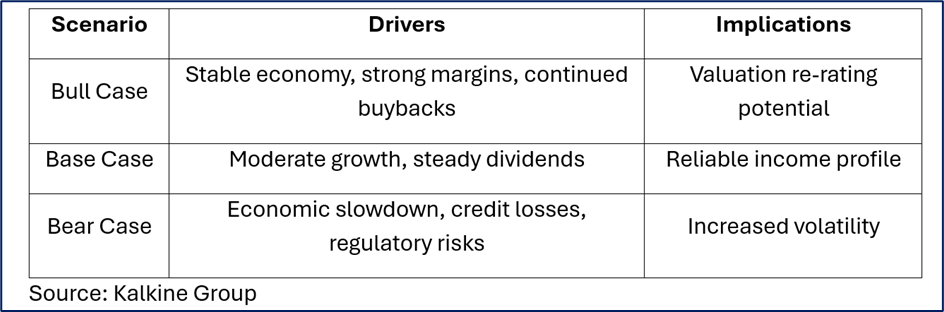
What Are the Bull and Bear Case Scenarios for NatWest?
What Do Analysts and Brokers Expect for NatWest?
Major financial institutions maintain broadly constructive views:
- Goldman Sachs — Positive stance citing capital strength (2026 research)
• JPMorgan — Overweight rating based on valuation opportunity (2026 research)
• UBS — Balanced but improving profitability outlook (2026 research)
• Barclays — Supportive view on UK banking recovery (2026 research)
Consensus forecasts generally indicate potential upside depending on macroeconomic conditions.
What Risks Should Investors Monitor Closely?
- UK recession or economic slowdown
• Interest-rate volatility affecting margins
• Credit losses in mortgages or commercial lending
• Regulatory or political intervention
• Global financial instability
Frequently Asked Investor Questions About NatWest
What is driving NatWest stock higher in 2026?
Improving banking sentiment, strong capital returns, and stabilizing macro conditions.
Is NatWest a good dividend investment?
It offers attractive yield potential supported by strong capital ratios.
How sensitive is NatWest to UK interest rates?
Highly sensitive because of its domestic lending exposure.
Is NatWest undervalued compared with peers?
Many analysts consider valuation attractive relative to fundamentals.
Final Investment Perspective — Could NatWest Be a Compelling Opportunity?
NatWest represents a combination of income potential, value characteristics, and cyclical recovery exposure within the FTSE 100 banking sector. The investment thesis is driven primarily by capital strength, shareholder distributions, and improving macroeconomic conditions rather than aggressive growth expectations.
For investors seeking dividend income and exposure to a potential UK financial sector recovery, NatWest may offer a strategically interesting opportunity, particularly during periods of market volatility.


 Jun 29, 2026




 Please wait processing your request...