
 AU
AU
 CA
CA
 US
US
 NZ
NZ
 IND
IND

 UK
UK

 Share
Share
 X (Formerly Twitter)
 Whatsapp
 Facebook
 LinkedIn
 Telegram
 Email This Article
 Copy Link
 Summarize with AI
 Chat GPT
 Perplexity
Key Takeaways – Why Is Rolls-Royce (FTSE 100: RR.) Up 3% on 13 February 2026?
- Rolls-Royce shares climbed approximately 3% on 13 February 2026, outperforming the broader FTSE 100 index.
- Civil Aerospace large engine flying hours continue trending above pre-2019 benchmarks, supporting aftermarket revenue momentum.
- Margin expansion, free cash flow upgrades, and balance sheet deleveraging remain central catalysts.
- Defence order visibility strengthened amid sustained geopolitical spending growth.
- Dividend reinstatement expectations are building as capital allocation targets move closer.
- Broker consensus remains broadly constructive, highlighting structural turnaround progress.

Source: Kalkine Group
Is Rolls-Royce the Most Powerful FTSE 100 Momentum Stock in February 2026?
Is Rolls-Royce once again among the most searched UK blue-chip stocks? Are investors right to chase the Rolls-Royce share price rally? Could this aerospace and defence heavyweight continue to outperform the FTSE 100 in 2026?
With global aviation demand strengthening, defence budgets expanding, and free cash flow accelerating, Rolls-Royce has re-emerged as a high-conviction UK recovery stock with structural growth exposure.
Why Is Rolls-Royce Stock Up 3% Today?
The latest rally reflects a blend of company-specific improvements, sector rotation, and supportive macro dynamics.
Company-Level Catalysts Driving the Share Price
- Civil Aerospace flying hours materially above 2019 levels on key long-haul corridors
- Continued structural margin expansion under the transformation strategy
- Strong free cash flow momentum and balance sheet repair
- Expanding defence backlog amid elevated global military budgets
- Progress in Small Modular Reactor (SMR) development
Business Model Strength
Rolls-Royce operates across three high-value segments:
- Civil Aerospace – long-term service agreements (LTSA) delivering recurring aftermarket revenue
- Defence – engines and power systems for air and naval platforms
- Power Systems – distributed and backup energy solutions
The LTSA model remains the earnings engine. As flight hours rise, high-margin servicing revenue scales, improving cash conversion and operating leverage.
Is the UK Macro Backdrop Supporting FTSE 100 Outperformance?
Early 2026 macro signals suggest gradual stabilisation:
- Inflation moderating versus peak cycles
- Increasing speculation around Bank of England rate cuts
- Sterling stabilising versus USD and EUR
- Manufacturing data showing resilience
The FTSE 100, with its global revenue exposure, benefits more from international demand than domestic consumption. Rolls-Royce in particular earns substantial USD-linked revenue, making currency movements a key earnings sensitivity.
A stable or softer GBP can enhance reported earnings translation.
How Do Global Aviation and Defence Trends Impact Rolls-Royce?
Rolls-Royce sits at the intersection of two structural growth engines:
- Civil Aviation Recovery
- Sustained long-haul demand
- Airline fleet expansion
- Installed engine base growth
- Defence Spending Expansion
- Heightened geopolitical tensions
- Increased European and global military budgets
- Long-cycle contract visibility
Capital flows into aerospace and defence equities have strengthened as investors seek geopolitical hedges and durable earnings growth.
Is Rolls-Royce Financially Stronger Than Pre-2020?
Recent operational updates highlight:
- Improved operating margins
- Strong and improving free cash flow
- Accelerating net debt reduction
- Cost efficiencies delivered ahead of schedule
The transformation programme has reshaped operational discipline, improving execution credibility. Investors increasingly view the business as structurally leaner and financially resilient compared with its pre-pandemic profile.
Dividend Reinstatement – Is 2026 the Turning Point?
Dividend restoration remains one of the most searched investor questions. While not yet fully reinstated, balance sheet progress and cash generation improvements are strengthening expectations that sustainable distributions could return once capital targets are achieved.
How Does Rolls-Royce Compare with Global Aerospace Peers?
Rolls-Royce is frequently benchmarked against:
- GE Aerospace
- Safran
- MTU Aero Engines
Peer Comparison Themes
- Margins: Improving, though still converging toward leading peers
- Cash conversion: Accelerating rapidly
- Niche positioning: Strong exposure to wide-body long-haul engines
A key bullish thesis centres on valuation convergence as turnaround execution reduces perceived risk.
What Is the Rolls-Royce Share Price Forecast for 2026?
Broker commentary remains broadly constructive:
- Overweight ratings citing free cash flow momentum
- Positive stance on defence exposure
- Recognition of re-rating potential as execution credibility strengthens
Consensus expectations favour continued operational delivery rather than speculative multiple expansion alone.
Is Rolls-Royce Bullish or Bearish Across Time Horizons?
Short Term (3–6 Months) – Mildly Bullish
Drivers:
- Momentum inflows
- Earnings revisions
- Aerospace & defence sector strength
Risks:
- Profit-taking after strong performance
- Macro or airline demand shock
Medium Term (6–18 Months) – Constructively Bullish
Drivers:
- Margin expansion trajectory
- Free cash flow scaling
- Dividend reinstatement potential
- Defence contract wins
Long Term (3–5 Years) – Structurally Bullish, Cyclical Volatility
Drivers:
- Installed wide-body engine base growth
- Long-term aerospace demand
- Energy transition optionality via SMR
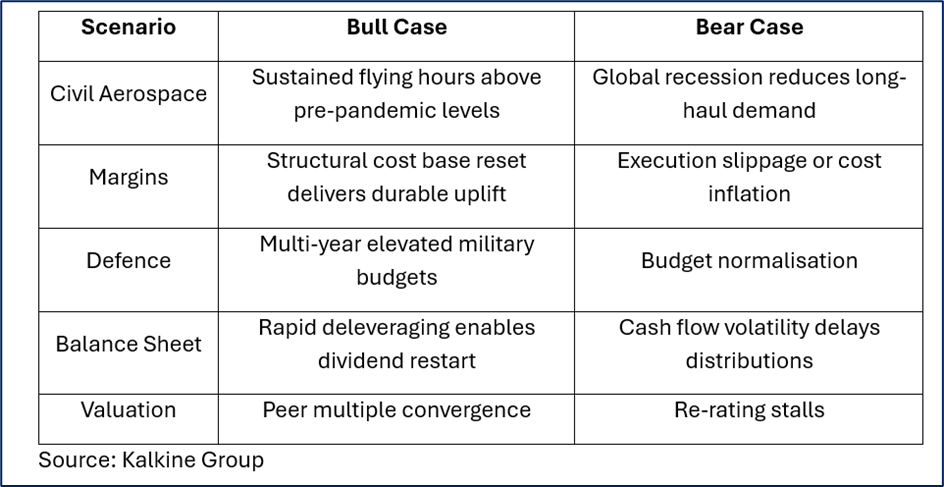
Bull vs Bear Scenario Matrix
What Investment Strategies Could Work in 2026?
Short-Term Strategy
- Tactical momentum participation
- Monitor earnings revisions
- Track GBP/USD trends
Medium-Term Strategy
- Accumulate on volatility
- Focus on free cash flow and debt metrics
- Monitor defence pipeline updates
Long-Term Strategy
- Position as aerospace & defence compounder
- Reinvest potential future dividends
- Evaluate SMR optionality
What Are the Key Risks?
- Global aviation slowdown
- Supply chain constraints
- Currency volatility
- Defence budget shifts
- Execution risk within transformation
Frequently Asked Questions
Why is Rolls-Royce share price rising today?
Improving civil aerospace flying hours, defence visibility, and supportive market sentiment.
Will Rolls-Royce reinstate its dividend in 2026?
Dependent on sustained free cash flow and balance sheet targets.
Is Rolls-Royce overvalued?
Valuation depends on execution confidence. If margin and cash flow targets are achieved, peer convergence could justify current levels.
Is Rolls-Royce a good long-term investment?
For investors seeking exposure to aerospace recovery, defence growth, and operational turnaround themes, it offers structural upside with cyclical risk.
Final Verdict – Can Rolls-Royce Beat the FTSE 100 Again This Year?
Rolls-Royce remains one of the most closely watched FTSE 100 stocks in February 2026. The combination of aerospace recovery momentum, defence tailwinds, margin expansion, cash flow acceleration, and potential dividend reinstatement creates a compelling turnaround narrative.
Short term, momentum remains supportive. Medium term, execution will determine sustainability. Long term, structural aerospace demand and disciplined capital allocation could support durable shareholder returns.
This analysis is for informational purposes only and not financial advice. Investors should conduct independent research before making investment decisions.


 Jun 29, 2026




 Please wait processing your request...