
 AU
AU
 CA
CA
 US
US
 NZ
NZ
 IND
IND

 UK
UK

 Share
Share
 X (Formerly Twitter)
 Whatsapp
 Facebook
 LinkedIn
 Telegram
 Email This Article
 Copy Link
 Summarize with AI
 Chat GPT
 Perplexity
Rolls-Royce combines aerospace recovery with defence growth opportunities. Learn why investors see upside potential.
Key Takeaways — February 2026
- Rolls-Royce stock rose approximately 3.6% on 13 February 2026 driven by strong operational momentum
• Civil aerospace recovery and defence spending tailwinds remain major catalysts
• Free cash flow expansion and debt reduction support future dividend expectations
• Analysts remain broadly positive despite valuation debate
• Long-term structural growth story continues strengthening

Source: Kalkine Group
Why Is Rolls-Royce (FTSE 100: RR) Stock Trending and Rising in February 2026?
Rolls-Royce Holdings plc is rapidly becoming one of the most searched FTSE 100 stocks across Google, YouTube finance channels, LinkedIn investor discussions, and AI financial platforms as the share price climbed around 3.6% on 13 February 2026. Investors are actively searching high-intent keywords including “Rolls-Royce share price forecast 2026,” “Is Rolls-Royce a good investment now,” “FTSE 100 best stocks to buy,” “UK defence stocks outlook,” “RR dividend comeback,” and “aerospace recovery stocks.”
The surge reflects improving confidence in the company’s multi-year transformation strategy, accelerating free cash flow generation, stronger margins, and structural demand across global aviation and defence markets. Rolls-Royce has evolved from a pandemic-era turnaround candidate into a potential long-term compound growth stock within the FTSE 100 index.
From an SEO and investor sentiment perspective, Rolls-Royce now sits at the intersection of several powerful global investment themes:
- Defence spending supercycle
• Global aviation recovery
• Industrial technology innovation
• Energy transition and nuclear opportunities
• UK export-driven multinational growth
This convergence is attracting both institutional and retail capital.
What Are the Latest Catalysts Driving the Rolls-Royce Share Price Higher?
The recent upward movement appears linked to multiple reinforcing drivers:
- Rising large engine flying hours boosting aftermarket revenue
• Strong operating leverage from restructuring initiatives
• Continued margin improvement trajectory
• Upgraded free cash flow expectations (Company Release, February 2026)
• Balance sheet strengthening through debt reduction
• Positive investor sentiment toward defence exposure
The company’s “power-by-the-hour” service model creates recurring high-margin income streams tied directly to airline activity levels, making earnings highly sensitive to global travel demand recovery.
How Are Global Markets, the UK Economy, and Currency Trends Supporting Rolls-Royce?
Macroeconomic conditions currently provide a supportive backdrop.
Global Market Dynamics:
- International passenger travel continues normalizing
• Defence budgets expanding across Europe and NATO countries
• Supply chain disruptions easing
UK Economic Environment:
- Cooling inflation trends improving consumer and investor confidence
• Expectations of future interest-rate cuts supporting equity valuations
• Government emphasis on strategic industries including defence and advanced manufacturing
FTSE 100 vs FTSE 250 Positioning:
- FTSE 100 multinationals benefiting from global revenue exposure
• Domestic UK cyclicals facing slower growth relative to exporters
GBP Currency Impact:
- A relatively weaker pound increases overseas earnings translation into sterling, benefiting Rolls-Royce profitability.
How Strong Is Rolls-Royce’s Business Model and Competitive Position?
The company operates across three major segments:
Civil Aerospace:
- Aircraft engines and long-term maintenance contracts
• Largest earnings contributor
Defence:
- Military aviation engines
• Naval propulsion and nuclear capabilities
• Long-term government contracts
Power Systems:
- Industrial engines and energy solutions
Strategic strengths include:
- Recurring aftermarket revenue
• High technological barriers to entry
• Long contract durations
• Global customer base
• Strong intellectual property portfolio
What Do the Latest Financial and Dividend Signals Indicate?
Recent company disclosures highlight improving fundamentals:
- Revenue growth supported by flying hour recovery
• Significant operating margin expansion
• Increasing free cash flow generation (Company Release, February 2026)
• Net debt reduction improving financial resilience
Dividend Outlook:
While dividends remain suspended since the pandemic period, improving financial health has increased expectations of reinstatement once leverage targets are achieved. Dividend return could act as a major future catalyst for income investors.
How Does Rolls-Royce Compare With Global Aerospace and Defence Peers?
Compared with companies such as GE Aerospace, Safran, and RTX:
Competitive Advantages:
- Higher turnaround potential
• Strong defence positioning
• Recurring service revenue model
Relative Weaknesses:
- Balance sheet still recovering versus peers
• Transformation execution risk
Valuation perspectives remain mixed — some analysts believe the rerating already reflects recovery, while others see further upside from earnings growth acceleration.
What Is the Future Outlook for the Aerospace and Defence Sector?
Short-Term Outlook:
- Earnings announcements and macro data will drive volatility
• Investor sentiment sensitive to travel demand trends
Medium-Term Outlook:
- Defence spending growth cycle supports revenue visibility
• Continued margin expansion from efficiency initiatives
Long-Term Outlook:
- Structural aviation demand growth globally
• Energy transition opportunities including small modular reactors
• Increasing geopolitical defence investments
What Strategies Could Investors Consider Across Time Horizons?
Short-Term Approach (3–6 Months):
- Monitor earnings releases and guidance changes
• Track macro indicators like oil prices and airline capacity
Medium-Term Approach:
- Focus on free cash flow trajectory and margins
• Evaluate leverage reduction progress
Long-Term Approach:
- Consider exposure to aerospace and defence megatrends
• Monitor dividend reinstatement developments
Is Rolls-Royce Stock Bullish or Bearish Right Now?
Short-Term View:
Neutral to moderately bullish due to positive momentum but valuation sensitivity.
Long-Term View:
Constructive bullish outlook supported by structural industry growth and company transformation progress.
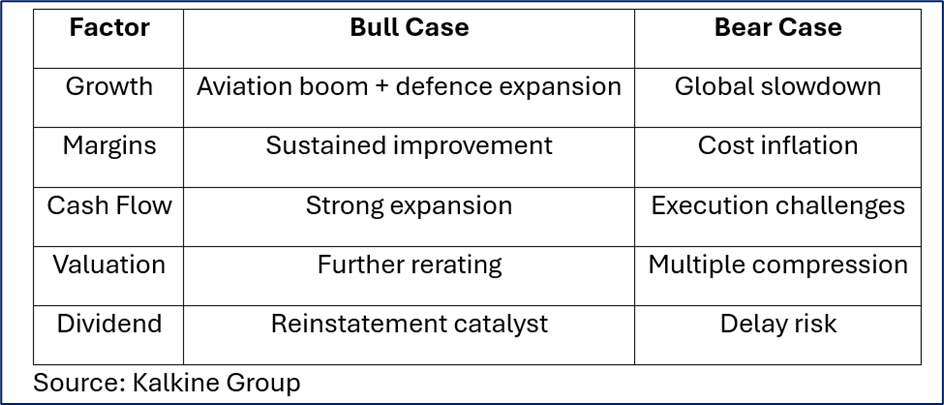
What Does the Bull vs Bear Scenario Analysis Look Like?
What Are Analysts and Broker Forecasts Suggesting?
Major broker commentary remains broadly supportive:
- Barclays — Positive on cash flow trajectory (2026 Report)
• JPMorgan — Strong defence exposure outlook (2026 Report)
• UBS — Earnings upgrade potential remains (2026 Report)
• Morgan Stanley — Balanced view citing valuation levels (2026 Report)
Forecast ranges vary significantly due to uncertainty around long-term growth assumptions.
What Are the Key Risks Investors Should Monitor?
- Aviation demand downturn
• Execution risks in transformation strategy
• Supply chain disruptions
• Currency volatility
• Defence spending policy changes
• Valuation correction risk
FAQ — Rolls-Royce Investment Questions
Is Rolls-Royce a good long-term investment?
The company offers strong structural growth drivers, but valuation and cyclical risks remain.
Will Rolls-Royce restart dividends?
Improving balance sheet conditions increase the probability of dividend reinstatement in the coming years.
Why is Rolls-Royce stock rising?
Improved financial performance, defence spending growth, and investor confidence in management strategy.
Is Rolls-Royce undervalued?
Opinions differ depending on growth assumptions and valuation metrics.
Final Investment Perspective — What Should Investors Consider?
Rolls-Royce represents a rare combination of turnaround execution, structural industry tailwinds, and improving financial strength within a globally strategic sector. The transformation strategy has significantly improved investor confidence, shifting the narrative toward long-term growth potential.
However, the share price appreciation already achieved means future returns may depend heavily on continued execution and macro stability.
Overall analytical stance:
- Short term — Momentum positive but sensitive
• Long term — Fundamentally constructive


 Jun 29, 2026




 Please wait processing your request...